Advertisements
Advertisements
प्रश्न
How good is the system of G.S.T as compared to the old tax system?
Advertisements
उत्तर
The system of G.S.T is good as compared to the old tax system in the following ways:
- Abolition of different tax structures - The implementation of GST resulted in the abolition of state-imposed taxes such as value-added tax, entry tax, octroi, and luxury tax as well as service tax, union excise duty, central sales tax (collected by states), and customs duty. Cess, resale, extra, and turnover taxes, among others, have all been abolished.
- Widening of tax bases - The GST has broadened governments' tax bases. Government administrative expenses have decreased as a result.
- The benefit of Input tax credit - Every stage, whether for the manufacturer, middleman or end user, is subject to the GST levy. The assessee benefits from an input tax credit side by side, which means he simply has to pay the difference between output tax and input tax. As a result, GST has eliminated the tax's cascading effect, following in the footsteps of VAT.
- Neutralization to process, business models, structure, and location - Because of the neutrality of the tax regime, GST is expected to improve economic development, efficiency, and sustainability.
- Because of the lessened effect of tariffs on numerous commodities, GST may contribute to an increase in exports, giving exporters an advantage over their competition in the worldwide market.
- Increased demand and production of goods and services - Because of the GST's lower production costs, manufacturing facilities would grow and there would be more demand for goods and services.
APPEARS IN
संबंधित प्रश्न
‘The fiscal deficit gives the borrowing requirement of the government’. Elucidate.
Suppose that for a particular economy, investment is equal to 200, government purchases are 150, net taxes (that is lump-sum taxes minus transfers) is 100 and consumption is given by C = 100 + 0.75Y (a) What is the level of equilibrium income? (b) Calculate the value of the government expenditure multiplier and the tax multiplier. (c) If government expenditure increases by 200, find the change in equilibrium income.
Consider an economy described by the following functions:- C = 20 + 0.80Y, I = 30, G = 50, TR = 100, calculate the effect on output of a 10 per cent increase in transfers, and a 10 per cent increase in lump-sum taxes. Compare the effects of the two.
We suppose that C = 70 + 0.70Y D, I = 90, G = 100, T = 0.10Y (a) Find the equilibrium income. (b) What are tax revenues at equilibrium Income? Does the government have a balanced budget?
Suppose marginal propensity to consume is 0.75 and there is a 20 per cent proportional income tax. Find the change in equilibrium income for the following (a) Government purchases increase by 20 (b) Transfers decrease by 20.
Are fiscal deficits inflationary?
Answer the following question.
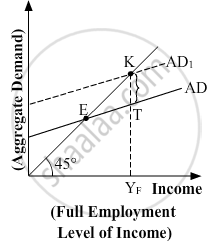
In the given figure, what does the gap 'KT' represent? State any two fiscal measures to correct the situation.
Regressive tax is that which is ______.
| S. No. | Content | Rs (in crores) |
| 1. | Revenue Expenditure | 100 |
| 2. | Capital Receipts | 40 |
| 3. | Net Borrowings | 38 |
| 4. | Net Interest Payments | 27 |
| 5. | Tax Revenue | 50 |
| 6. | Non-tax Revenue | 15 |
Which of the following is MOST LIKELY to be the main contributor to the fiscal deficit in this case?
Which of the following factors necessitated the need for economic reforms?
Read the following statements carefully and choose the correct alternatives given below:
Statement 1: Fiscal Deficit = Total Budget Expenditure - Total Budget Receipts (Net of borrowing)
Statement 2: Primary Deficit = Fiscal Deficit + Interest Payments.
When the revenue receipts are less than the revenue expenditures in a government budget, this shortfall is termed as
Which of the following transactions are correct about ORT?
Identify which of the following statements is true.
A Budget Deficit refers to a situation where:
The Primary Deficit shows the borrowing requirement of the government:
For 2024–25 Budget Estimates, the fiscal deficit was estimated at what percentage of GDP?
