Advertisements
Advertisements
प्रश्न
Can a clumsy person train himself/ herself to overcome shortcomings? How could this be done?
Advertisements
उत्तर
Yes, a clumsy person can train himself to overcome his short comings. People with severe Parkinson’s disease learn to hold a spoon and eat with great difficulties. Children with multiple disabilities and nervous problems learn to button up their shirts, tie the shoelaces and even assist friends with similar ailments. There is no difficulty in the world that is insurmountable. Practice makes one perfect. The author’s wife, without rebuking him publicly for his callous clumsiness, trains her children to be supportive of their father Mr. Bryson who always spills drinks or bumps on something or even sits on chewing gum or spilled oil.
As clumsiness is not a welcome behavior pattern among adults, one must learn how to mend oneself and try to overcome one eccentricity per day with deliberate effort. The author does admit to restraining himself to reduce the laundry bill. But if he extends his efforts even during the presence of his family on long-distance air-travels, it would be nice. Cultivating acceptable behavior in public places is not an impossible task for any sensible man.
‘‘I am not clumsy. It s just the floor that hates me.
The tables and chairs are bullies
And the wall gets in the way.”
APPEARS IN
संबंधित प्रश्न
Nuclear Family or Joint Family
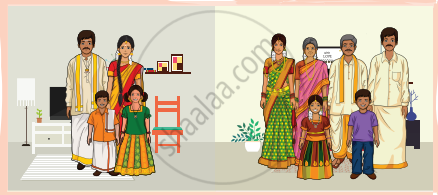
Based on the visuals given above, give five words/phrases each, to describe these two family types.
| Nuclear family | Joint family | ||
Have you won any medals? What are the levels to be accomplished to become an international sportsperson?
How forgetful are you?
What does the author mean when he says the letter in his pocket leads an unadventurous life?
Narrate the plight of the baby on its day out.
Will you sympathize or ridicule someone who is intensely forgetful? Write an essay justifying your point of view.
Many of us have unused, old but valuable items at home. If we wish to get rid of them, we can sell them at an auction. Items like paintings, jewels, household articles, vehicles, even houses can be auctioned.
The flowchart below will help you understand how an auction is conducted.

Describe the activity that was going on in the sale-room at King Street.
How had the author managed the auction without getting involved in the deal?
How does the Narrator show the presence of mind in the sudden turn of events?
The narrator would not forget two things about his friend. What are they?
“And I got it.” Here ‘it’ refers to the ______.
What is the difference between a physical and mental tight corner?
The narrator could not pretend to have made a mistake in bidding. Why?
What was the bidder’s offer to the narrator?
Form a meaningful summary of the lesson by rewriting the numbers in the correct sequence:
| a) The narrator had only 63 pounds with him and did not know how to manage the situation. | |
| b) The narrator thought of all his relations from whom he could borrow. | |
| c) Unfortunately he had made the highest bid. | |
| d) The narrator entered Christie’s as his friend persuaded him to visit the saleroom. | |
| e) Every time someone else made a higher bid and the narrator was not caught. | |
| f) The narrator on a sudden impulse added 50 more guineas, to the amount offered. | |
| g) His friend joined him then but left immediately unable to control his laughter. | |
| h) He even thought of borrowing from moneylenders and considered the possibility of confessing the truth to the staff at Christie’s. | |
| i) The picture was declared sold to the narrator. | |
| j) After some time a picture was put up and a bid for 4000 guineas was raised. | |
| k) A sudden stroke of luck befell the narrator when he heard that the gent who had made the bid of 4000 guineas would offer him the additional 50 guineas and buy the picture. | |
| l) The narrator kept bidding just for fun. | |
| m) The picture was given away to the other bidder and the narrator was saved from humiliation. | |
| n) His friend had left the place roaring with laughter at the narrator’s predicament. | |
| o) The narrator was quite happy at the offer but demanded 100 guineas instead of the 50. Now there was no need for him to make any payment. |
Given below is a list of items or features you find in a good school. Study the list and classify the items as individual and common.
textbooks – uniform – smart classroom – laboratory – competent teachers – library – mid-day meals – blackboard – stationery – playground – sports equipment washrooms
| Individual | Common |
| e.g. textbooks | playground |
Who provides these common facilities? Tick the appropriate source.
- Parents
- Educational institutions
- The Department of Education
- Social Service Organizations
- Other agencies
Discuss this aspect with your partner and share your views on how students can give back to society.
Why are universities necessary for a society?
In what ways have universities improved the society?
Universities develop broad-mindedness. How does Dr. Radhakrishnan drive home this idea?
What should the youngsters aim in life after their graduation?
How does the speaker highlight the importance of giving back to the society?
How did Bryson free himself from the crash position?
How would staying away from liquid mischief benefit Bryson?
How would staying away from liquid mischief benefit Bryson?
As a fellow passenger of Bill Bryson on the flight, make a diary entry describing his clumsy behaviour during the trip and the inconveniences caused to others as a result of his nervousness.
