Advertisements
Advertisements
प्रश्न
- With the help of a diagram, show how when light falls obliquely on the side of a rectangular glass slab, the emergent ray is parallel to the incident ray.
- Show the lateral displacement of the ray on the diagram.
Advertisements
उत्तर
In the following figure, a light ray travelling in air is incident on the rectangular glass slab. It gets refracted and bends towards the normal. Again, a change in direction occurs when the refracted ray travelling in glass emerges into air. Here, the light ray bends away from the normal. We see that the incident and emergent rays are parallel. These rays are parallel because the extent of bending on the opposite and parallel faces of the slab is equal and opposite.

APPEARS IN
संबंधित प्रश्न
The letter F is placed in front of a plane mirror:
- How would its image look like when seen in a plane mirror?
- What is the name of the phenomenon involved?
A boy with a mouth 5 cm wide stands 2 m away from a plane mirror. Where is his image and how wide is the image of his mouth?
With the help of a labelled ray-diagram, describe how a plane mirror forms an image of a point source of light placed in front of it. State the characteristics of the image formed in a plane mirror.
If a ray of light goes form a denser medium to a rarer medium, will it bend towards the normal or away from the normal?
A ray of light passes from air into a block of glass. Does it bend towards the normal or away from it?
In which material do you think light rays travel faster-glass or air?
Which phenomenon of light makes the water to appear shallower than it really is?
State whether the following statement is true or false:
Refraction occurs because light slows down in denser materials.
Light travels more quickly through water than through glass.
If a ray of light passes from glass into water, which way will it bend : towards the normal or away from the normal?
Explain with the help of a labelled ray diagram, why a pencil partly immersed in water appears to be bent at the water surface. State whether the bending of pencil will increase or decrease if water is replaced by another liquid which is optically more dense than water. Give reason for your answer.
Draw a diagram showing the refraction of a light ray from water to glass. Label on it the incident ray, the angle of incidence (/), and the angle of refraction (r)
A ray of light A incident from air suffers partial reflection and refraction at the boundary of water.
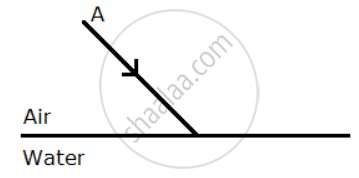
- Complete the diagram showing (i) the reflected ray B and (ii) the refracted ray C.
- How are the angles of incidence i and refraction r related?
List in proper sequence the steps of the experiment for determining the approximate focal length of a given concave mirror by obtaining the image of a distant object.
A real image is formed by the light rays after reflection or refraction when they:
- actually meet or intersect with each other.
- actually converge at a point.
- appear to meet when they are produced in the backward direction.
- appear to diverge from a point.
Which of the above statements are correct?
Identify the wrong figure from the following.
Write scientific reason.
A pencil appears to be broken near the surface of water.
How does the light travel?
The change in the direction of the path of light when it passes from one transparent medium to another transparent medium is called:
The constant \[\frac{\sin i}{\sin r}\] for a given pair of media is called the:
A larger refractive index of a medium means that light travels:
