Advertisements
Advertisements
प्रश्न
Solve the following problem.
A projectile is thrown at an angle of 30° to the horizontal. What should be the range of initial velocity (u) so that its range will be between 40m and 50 m? Assume g = 10 m s-2.
Advertisements
उत्तर
Given: 40 ≤ R ≤ 50, θ = 30°, g = 10 m/s2
To find: Range of initial velocity (u)
Formula: R = `("u"^2 sin (2theta))/"g"`
Calculation: From formula,
The range of initial velocity,
`40 <= ("u"^2 sin (2theta))/"g" <= 50`
∴ `"40g"/(sin (2theta)) <= "u"^2 <= "50g"/(sin(2theta))`
∴ `sqrt(("40g")/(sin (2theta))) <= "u" <= sqrt(("50g")/(sin(2theta))`
∴ `sqrt((40 xx 10)/(sin (60))) <= "u" <= sqrt((50 xx 10)/(sin (60)))`
∴ 21.49 m/s ≤ u ≤ 24.03 m/s
The range of initial velocity should be between 21.49 m/s ≤ u ≤ 24.03 m/s.
APPEARS IN
संबंधित प्रश्न
An aircraft executes a horizontal loop of radius 1.00 km with a steady speed of 900 km/h. Compare its centripetal acceleration with the acceleration due to gravity.
Read the statement below carefully and state, with reason, if it is true or false:
The velocity vector of a particle at a point is always along the tangent to the path of the particle at that point.
A cyclist is riding with a speed of 27 km/h. As he approaches a circular turn on the road of radius 80 m, he applies brakes and reduces his speed at the constant rate of 0.50 m/s every second. What is the magnitude and direction of the net acceleration of the cyclist on the circular turn?
How does uniform circular motion differ from uniform linear motion?
Earth moves around the sun with uniform velocity.
Explain the meaning of uniform circular motion. Give one example of such motion.
Is it possible to have an accelerated motion with a constant speed? Name such type of motion.
Give an example of motion in which speed remains uniform, but the velocity changes.
A uniform linear motion is unaccelerated, while a uniform circular motion is an accelerated motion.
In a uniform circular motion, the speed continuously changes because of the direction of motion changes.
A uniform metre rule of mass 100g is balanced on a fulcrum at mark 40cm by suspending an unknown mass m at the mark 20cm.
To which side the rule will tilt if the mass m is moved to the mark 10cm ?
Which of the following remains constant in a uniform circular motion, Speed or Velocity, or both?
If a particle moves with uniform speed then its tangential acceleration will be ______.
A particle of mass m is executing uniform circular motion on a path of radius r. If p is the magnitude of its linear momentum, the radial force acting on the particle is ______.
Certain neutron stars are believed to be rotating at about 1 rev/s. If such a star has a radius of 1.6 km, the acceleration of an object on the equator of the star will be nearly ____________.
Consider a simple pendulum of length 4 m. Its bob performs a circular motion in horizontal plane with its string making an angle 60° with the vertical. The Period of rotation of the bob is ____________.(Take g = 10 m/s2)
A body of mass ·m' is moving along a circle of radius 'r' with linear speed 'v'. Now, to change the linear speed to `V/2` and to move it along the circle of radius '4r', required change in the centripetal force of the body is ______.
Two particles P and Q are moving in concentric circles of rarui rp and rQ respectively. If their period of revolutions are in ratio 2 : 3, then ratio of their centripetal acceleration is ____________.
A cyclist is riding with a speed of 43.2 km/h. As he approaches a circular turn on the road of radius 60 m, he applies brakes and reduces his speed at constant rate of 1.8 ms-2. The magnitude of the net acceleration of the cyclist is ______.
A body is said to be in nonuniform motion if it travels ______.
If a body is moving in a circle of radius r with a constant speed v, its angular velocity is ______.
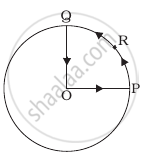
A cyclist starts from centre O of a circular park of radius 1 km and moves along the path OPRQO as shown figure. If he maintains constant speed of 10 ms–1, what is his acceleration at point R in magnitude and direction?
A small bead of mass m can move on a smooth circular wire (radius R) under the action of a force F = `"Km"/"r"^2` directed (r = position of bead r from P and K = constant) towards a point P within the circle at a distance R/2 from the centre. The minimum velocity should be ______ m/s of bead at the point of the wire nearest the centre of force (P) so that bead will complete the circle. (Take `"k"/(3"R")` = 8 unit)

The acceleration of a point on the rim of a flywheel 1 m in diameter, if it makes 1200 rpm is ______.
The kinetic energy K of a particle moving along a circle of radius R depends on the distance covered s as K = as2, where a is a constant. The force acting on the particle is ______.
Explain the meaning of uniform circular motion.
In uniform circular motion, although the speed is constant, why does acceleration occur?
