Topics
Mathematics
Patterns in Mathematics
- Mathematical Patterns
- Patterns in Numbers
- Patterns in Shapes
Lines and Angles
Number Play
- Fundamentals of Numbers
- Supercells
- Number Line
- Working with Number Digits
- Palindromic Patterns
- Kaprekar Number
- Clock and Calendar Numbers
- Mental Math
- Patterns in Numbers
- The Collatz Conjecture
- Basic Concept of Estimation and Approximation of Numbers
Data Handling and Presentation
- Mathematical Data Collection and Organisation
- Pictographs
- Bar Graphs
- Artistic and Aesthetic Considerations
Prime Time
- Multiples and Common Multiples
- Factors and Common Factors
- Prime and Composite Numbers
- Eratosthenes’ Method of Finding Prime Numbers
- Co-prime Numbers
- Prime Factorisation
- Tests for Divisibility of Numbers
- Divisibility by 10
- Divisibility by 5
- Divisibility by 2
- Divisibility by 4
- Divisibility by 8
- Exploring Special Numbers & Logical Reasoning
Perimeter and Area
- Concept of Perimeter
- Perimeter of a Rectangle
- Perimeter of Squares
- Perimeter of Triangle
- Problems based on Perimeter
- Perimeter of a Regular Polygon
- Perimeter of an Equilateral Triangle
- Concept of Area
- Problems based on Area
- Area of a Triangle
- Exploring Shapes Through Perimeter and Area
Fractions
Playing with Constructions
- Basic Concept of Construction
- Squares and Rectangles
- Constructing Squares and Rectangles
- An Exploration in Rectangles
- Constructing Complex Figures
- Exploring Diagonals of Rectangles and Squares
- Points Equidistant from Two Given Points
Symmetry
The Other Side of Zero
- Fundamentals of Numbers
- Negative and Positive Numbers
- Tracking Movement: Using Positive and Negative Numbers
- Comparison of Integers
- Number Line
- Conversion between Addition and Subtraction
- The Token Model
- Integers in Other Places
- Explorations with Integers
- Integers
- Concept of Fractions on a Number Line
- Marking Fractions on the Number Line
Maharashtra State Board: Class 6
Concept of Fractions on a Number Line
Representing fractions on a number line means that we can plot fractions on a number line, which is similar to plotting whole numbers and integers.
Steps to Show a Fraction on a Number Line:
1. Draw a number line of suitable length.
2. Mark the whole numbers where the fraction lies.
- For proper fractions, mark 0 and 1.
- For improper fractions, convert them to mixed form and mark the two nearest whole numbers.
3. Divide the space between whole numbers into parts equal to the denominator.
4. Count forward from the left point using the numerator.
5. Mark the point—this is the fraction on the number line.
Example: `"3"/"7"`
Maharashtra State Board: Class 6
Marking Fractions on the Number Line
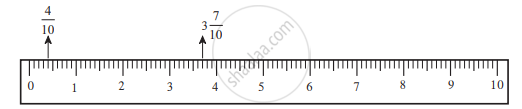
Example : To show `"4"/"10"`, 3`"7"/"10 "`
1. Marking `"4"/"10"`:
- Look at the first unit between 0 and 1.
- Since it is divided into 10 equal parts, go to the 4th mark after 0.
- This point shows the fraction `"4"/"10"`.
2. Marking 3`"7"/"10"`:
- First, go to number 3 on the number line.
- Now, between 3 and 4, again divide the space into 10 equal parts.
- Move to the 7th mark after 3.
- This point shows the fraction 3`"7"/"10"` (which means 3 whole parts and 7 out of 10 parts).
Example
Show the fractions `2/3, 4/3, 7/3` on the number line.
On the number line below, every unit is divided into 3 equal parts.

Shaalaa.com | Representing Factors On Number Line
to track your progress



