Topics
Mathematical Logic
- Statements and Truth Values in Mathematical Logic
- Logical Connectives
- Tautology, Contradiction, and Contingency
- Quantifier, Quantified and Duality Statements in Logic
- Negations of Compound Statements
- Converse, Inverse, and Contrapositive
- Algebra of Statements
- Application of Logic to Switching Circuits
- Overview of Mathematical Logic
Matrices
- Elementry Transformations
- Adjoint & Inverse of Matrix
- Application of Matrices
- Overview of Matrices
Trigonometric Functions
- Trigonometric Equations and Their Solutions
- Solutions of Triangle>Polar Co-Ordinates
- Solving a Triangle>Solving a Triangle
- Basics of Inverse Trigonometric Functions
- Graphs of Inverse Trigonometric Functions
- Domain, Range & Principal Value
- Properties of Inverse Trigonometric Functions
- Overview of Trigonometric Functions
Pair of Straight Lines
Vectors
- Overview of Vectors
- Basic Concepts of Vector Algebra
- Types of Vectors in Algebra
- Algebra of Vectors > Scalar Multiplication
- Algebra of Vectors > Addition of Two Vectors
- Algebra of Vectors > Subtraction of Vectors
- Collinearity and Coplanarity of Vectors
- Vectors in Coordinate Geometry
- Components of Vector in Algebra
- Section Formula in Vector Algebra
- Product of Two Vectors > Scalar (Dot) Product
- Product of Two Vectors > Vector (Cross) Product
- Direction Ratios, Direction Cosine & Direction Angles in Vector
- Scalar Triple Product
Line and Plane
Linear Programming
Differentiation
- Introduction & Derivatives of Some Standard Functions
- Derivatives of Composite Functions
- Geometrical Meaning of Derivative
- Derivative of Inverse Function
- Logarithmic Differentiation
- Derivative of Implicit Functions
- Derivatives of Functions in Parametric Forms
- Higher Order Derivatives
- Overview of Differentiation
Applications of Derivatives
- Applications of Derivatives in Geometry
- Derivatives as a Rate Measure
- Approximations
- Rolle's Theorem
- Lagrange's Mean Value Theorem (LMVT)
- Increasing and Decreasing Functions
- Maxima and Minima
- Overview of Applications of Derivatives
Indefinite Integration
Definite Integration
- Definite Integral as Limit of Sum
- Integral Calculus
- Methods of Evaluation and Properties of Definite Integral
- Overview of Definite Integration
Application of Definite Integration
- Application of Definite Integration
- Area Bounded by Two Curves
- Overview of Application of Definite Integration
Differential Equations
- Basic Concepts of Differential Equations
- Order and Degree of a Differential Equation
- Formation of Differential Equations
- Methods of Solving Differential Equations> Homogeneous Differential Equations
- Methods of Solving Differential Equations>Linear Differential Equations
- Applications of Differential Equation
- Solution of a Differential Equation
- Overview of Differential Equations
Probability Distributions
- Random Variables
- Probability Distribution of Discrete Random Variables
- Probability Distribution of a Continuous Random Variable
- Variance of a Random Variable
- Expected Value and Variance of a Random Variable
- Overview of Probability Distributions
Binomial Distribution
Introduction
Vector addition explains how two or more vectors are combined to produce a single resultant vector. It is a fundamental concept in Vector Algebra and is also useful in physics applications such as displacement and velocity. Vector addition is introduced geometrically through the triangle law and parallelogram law.
Properties
| Property | Statement | Meaning |
|---|---|---|
| Commutative Property | \[(\vec{a}+\vec{b}=\vec{b}+\vec{a})\] | Changing the order of vectors does not change the sum. |
| Associative Property | \[((\vec{a}+\vec{b})+\vec{c}=\vec{a}+(\vec{b}+\vec{c}))\] | Vectors can be grouped in any order while adding. |
| Additive Identity | \[(\vec{a}+\vec{0}=\vec{0}+\vec{a}=\vec{a})\] | The zero vector does not affect a vector when added. |
| Additive Inverse | \[(\vec{a}+(-\vec{a})=\vec{0})\] | Every vector has an opposite vector which gives the zero vector when added. |
Triangle Law of Vector Addition
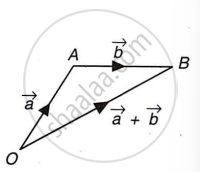
If two vectors are represented by two sides of a triangle taken in order, then their sum is represented by the third side of the triangle taken in the same order.
Parallelogram Law of Vector Addition
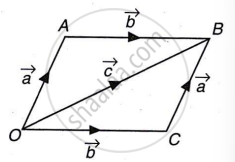
If two vectors are represented by two adjacent sides of a parallelogram, then their resultant is represented by the diagonal passing through their common initial point.
Difference of Two Vectors
The difference of two vectors is obtained by adding the negative of one vector.
Real Life Examples
-
Walking path: A student walks 3 m east and then 4 m north; the direct displacement is the resultant vector.
-
Boat in a river: The motion of a boat crossing a river and the river current together form a resultant velocity, illustrating vector addition.
Key Points: Algebra of Vector Addition
-
A vector has both magnitude and direction.
-
Resultant means the combined effect of two or more vectors.
-
Triangle law uses head-to-tail arrangement.
-
Parallelogram law uses adjacent sides from the same initial point.
-
Vector addition is commutative and associative.
-
Zero vector is the identity element for vector addition.
-
Difference of vectors is obtained by adding the negative of a vector.
