Topics
Introduction to Microprocessors and Organization of 8085
Instruction Set and Programming of 8085
- Introduction to Set and Programming of 8085
- Instruction Cycle
- Addressing Modes
- Programming model of 8085
- Introduction to Classification of 8085
- How to Write and Execute Simple Assembly Language Program ?
- Data Transfer Instruction
- Arithmetic Group Instructions
- Logical Group Instructions
- Branching Group Instructions
- Machine Control Instruction
Introdcution to Intel X-86 Family
Introduction to Microcontroller
Networking Technology
- Introduction to Wired Transmission Media
- Twisted Pair Cable
- Coaxial cable
- Optical Fibre
Coaxial cable (Cable Media)
Construction
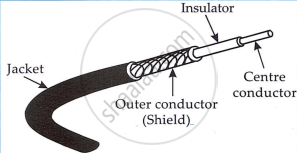
A coaxial cable is constructed with four key components. At the core is a center conductor, typically made of solid or stranded copper wire. Surrounding this is an outer conductor, often braided wires or metallic foil, which serves as a shield to protect the inner conductor from electromagnetic interference (EMI) and acts as a ground. An insulating layer separates the inner and outer conductors, ensuring even spacing between them. Finally, the entire cable is encased in a plastic jacket, providing protection from physical damage.
Types of Coaxial Cable
There are two types of coaxial cable:
i.Thinnet: Thinnet is a light, flexible, and inexpensive cabling medium, easy to install. It belongs to the RG-58 family with a 50-ohm impedance, is 0.25 inches (6 mm) thick, and can reliably transmit signals over 185 meters (610 feet).
ii. Thicknet : Thicknet is thicker than thin net. It is about 0.5 inches (13 mm) in diameter. Since it is thick, it does not bend. It is difficult to work with thicknet. It has thick center core. It can carry more signals and at a larger distance. It can transmit a signal approximately 500 meters (1650 feet).
Advantages and Disadvantages of Coaxial Cable
Advantages:
- Widely used due to availability in various sizes.
- Shielding offers strong resistance to EMI.
- Lower attenuation compared to twisted pair cables.
Disadvantages:
- More expensive than twisted pair, but cheaper than fiber optic.
- Lower bandwidth capacity than fiber optic cables.
Twisted pair cable
This is a popular cable for all new networks. This is a low cost cable. A basic twisted pair cable is shown in figure.
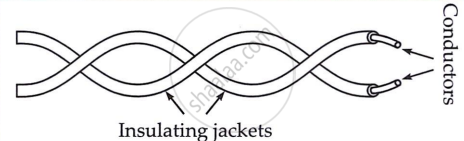
Twisted pair cable consists of two copper wires twisted together, reducing sensitivity to EMI and minimizing radio frequency noise. This design cancels out radiated signals and reduces crosstalk, improving overall signal integrity.
Construction
Shielded twisted pair (STP) cable: Shielded twisted pair (STP) cable includes one or more twisted pairs enclosed in foil and woven copper shielding. The shield, connected to the device's ground, prevents signal interference. STP cables come in various types for different applications.
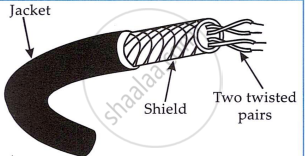
Unshielded Twisted-Pair (UTP) cable: Unshielded twisted pair (UTP) cable lacks a braided shield, differing from STP primarily in attenuation and EMI resistance. Commonly used in telephone systems and increasingly in LANs, UTP cable is available in five categories for various applications.
Advantages and Disadvantages of Coaxial Cable.
Advantages:
- This medium is inexpensive and easy to install.
- Since wires are twisted, it reduces EMI and avoids RF radiation.
- Twisted wires also reduce cross talk.
Disadvantages:
- They can be used only for· short distance communications.
- The twisted pair cable has limited bandwidth for audio telephone it is 4 KHz and it can be maximum 50 KHz.
- The typical speed of computer date is 1200 bits/ second (bps)
Fiber Optic Cable
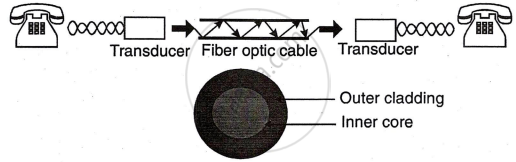
Fiber optic cables are ideal for data transmission due to their extremely high bandwidth, immunity to EMI, and ability to cover long distances. The core, made of refined glass or plastic, transmits light signals with minimal loss, while cladding reflects signals back into the fiber. Though offering superior performance, fiber optic cables are costly and difficult to install. Data signals are converted to light using lasers or LEDs and reconverted to electrical form at the receiving end. Fiber optic communication, which uses light waves instead of electrical signals, overcomes bandwidth limitations and noise interference, making it increasingly popular in modern networks.
Advantages & Disadvantages over conventional cables
Advantages: Fiber optic cables do not use electrical signals to transmit information hence are free from EMI interference. Attenuation is much lower than any other cable and hence it is used for long range communication.
Disadvantages: It is very expensive than other cables. Grater skill is required to install fiber - optic cable. They must be treated gently during installation. Every cable has minimum bend radius. They get damaged if bended sharply. The cable cannot be stretched.
System Of Fiber Optic Communications
Fiber optic communication uses light waves to transmit signals through a special cable called a light pipe or light guide. The light signal travels in a zigzag pattern through the cable due to multiple reflections. While some of the signal is absorbed inside the cable, it can still carry many signals, such as multiple telephone channels, without interference, like how radio waves work.