Topics
Introduction to Microprocessors and Organization of 8085
Instruction Set and Programming of 8085
- Introduction to Set and Programming of 8085
- Instruction Cycle
- Addressing Modes
- Programming model of 8085
- Introduction to Classification of 8085
- How to Write and Execute Simple Assembly Language Program ?
- Data Transfer Instruction
- Arithmetic Group Instructions
- Logical Group Instructions
- Branching Group Instructions
- Machine Control Instruction
Introdcution to Intel X-86 Family
Introduction to Microcontroller
Networking Technology
- Introduction to Transmission Media
- Physical Transmission Media Characteristics
Maharashtra State Board: Class 12
Study of Transmission media
Transmission media enable the transfer of electronic signals, typically binary pulses, between computers. These signals span frequencies from radio waves to microwaves and infrared light, each requiring different media. Radio frequencies, often used in LANs, can be transmitted via twisted pair or coaxial cables. Microwaves are used for focused transmissions between two points, such as between earth stations and satellites.
Transmission Media characteristics
- Cost: Cost is a key factor in networking decisions. Newer technologies tend to be faster but more expensive. Network designers must balance cost and robustness.
- Installation Requirements: Some transmission media require skilled labor, increasing costs and causing delays. A physical layout of the network is needed before installation
- Bandwidth: Bandwidth measures a medium's data transmission capacity, typically in bits per second. Shorter cables have higher bandwidth, while longer cables may cause signal deterioration
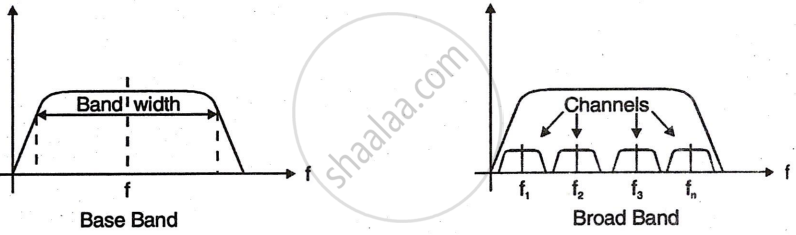
- Band Usage (Baseband or Broadband): Baseband uses the entire medium's capacity for one channel, common in LANs. Broadband allows multiple channels to share bandwidth, using techniques like Frequency Division Multiplexing (FDM) for analog signals.
- Attenuation: Attenuation refers to signal weakening over distance. Repeaters can regenerate signals to counteract this effect.
- Electromagnetic Interference (EMI): EMI distorts signals due to external noise. Crosstalk, a type of EMI, occurs when signals from adjacent wires interfere with each other, posing a problem in networks with many cables.
