Advertisements
Chapters
![Selina solutions for Concise Chemistry [English] Class 6 ICSE chapter 1 - Introduction to Chemistry - Shaalaa.com](/images/concise-chemistry-english-class-6-icse_6:86f10377132e4627bf38e72d54ea19e4.jpg "Selina solutions for Concise Chemistry [English] Class 6 ICSE chapter 1 - Introduction to Chemistry")
Advertisements
Solutions for Chapter 1: Introduction to Chemistry
Below listed, you can find solutions for Chapter 1 of CISCE Selina for Concise Chemistry [English] Class 6 ICSE.
Selina solutions for Concise Chemistry [English] Class 6 ICSE 1 Introduction to Chemistry Exercise
Give two examples of the following substance.
Food preservatives
Give two examples of the following substance.
Fuel
Give two examples of the following substance.
Fungicides
Give two examples of the following substance.
Medicines
Give two examples of the following substance.
Building materials
Give two examples of the following substance.
Chemical war weapons
What is science?
What is chemistry?
How is chemistry helpful in improving the health of human beings?
What is alchemy?
What kind of experiments did Alchemists do?
What is ‘Philosopher’s stone’?
What is the main difference between alchemy and chemistry?
Name the chemicals which help in increasing food production.
Name six such products, which we use daily.
How is the knowledge of chemistry important to mankind?
What is the contribution of chemistry in following field?
Industry
What is the contribution of chemistry in following field?
Clothing
What is the contribution of chemistry in following field?
Cosmetics
What is the contribution of chemistry in the following field?
National Defence
What is the contribution of chemistry in following field?
Medicines
Who is known as the Father of chemistry? Why?
Name the scientists who discovered the following:
Atoms
Name the scientists who discovered the following:
Oxygen
Name the scientists who discovered the following:
Safety lamp
Name the scientists who discovered the following:
Elements
Selina solutions for Concise Chemistry [English] Class 6 ICSE 1 Introduction to Chemistry Objective Type Questions 1
___________ deals with the study of matter and the changes it undergoes.
_____________ help to increase the production of food.
Food items like jams and pickles are protected by using ___________.
Fill in the blank:
L.P.G. is used for ___________
Fill in the blank:
Inert gases were discovered by ___________
Match the following words in column A with those in column B:
| Column A | Column B | ||
| (a) | Clothing | (i) | toothpaste, cosmetics |
| (b) | Green Revolution | (ii) | nylon, wool |
| (c) | Building Material | (iii) | agriculture |
| (d) | Commodities of daily | (iv) | mortar, cement |
Write True or False against the following statement.
Chemistry plays an important role in the national economy:
True
False
Write True or False against the following statement.
Antibiotics are used as preservatives:
True
False
Write True or False against the following statement.
D.D.T. is an important fertiliser:
True
False
Write True or False against the following statement.
Gunpowder is an insecticide:
True
False
Write True or False against the following statement.
Enzymes secreted by our body are chemicals:
True
False
Choose the correct alternative from the choices given below for the following statement:
Trinitrotoluene is used as
a preservative
a fertiliser
a fuel
an explosive
Choose the correct alternative from the choices given below for the following statement:
Which one of the following is a pesticide?
benzoic acid
aldrin
sugar
gunpowder
Choose the correct alternative from the choices given below for the following statement:
Mortar is used as a
plastic material Urea is an
a building material
an insecticide
as medicine
Choose the correct alternative from the choices given below for the following statement:
Used is an important
fuel
preservative
fertiliser
food item
Choose the correct alternative from the choices given below for the following statement:
The chemicals prescribed by a doctor in the treatment of infectious diseases are called
antigens
lotions
antibiotics
creams
Match the following scientists in column A with their discoveries or contributions in column B.
| Column A | Column B | ||
| (a) | Marie Curie | (i) | Safety Lamp |
| (b) | John dalton | (ii) | Helium |
| (c) | William Ramsey | (iii) | Nobel Prize Winner (two times) |
| (d) | Sir Humphry Davy | (iv) | Atomic Theory |
Selina solutions for Concise Chemistry [English] Class 6 ICSE 1 Introduction to Chemistry Additional Questions For Practice
State what is Science and give the basic bifurcation of Science with reasons.
Give the basic difference between Inorganic Chemistry and Organic Chemistry.
State the functions of the following basic glass apparatus:
Glass test tube
State the functions of the following basic glass apparatus:
Hard glass boiling tube
State the functions of the following basic glass apparatus:
Beaker
State the functions of the following basic glass apparatus:
Round bottom flask
State the functions of the following basic glass apparatus:
Retort
State why a round bottom flask is preferred to a flat bottom flask – during the preparation of gases in the laboratory.
State the function of
The wooden handle at the end of the test tube holder.
State the function of
The asbestos fixed at the center of the wire gauze.
State the function of
The clamp mounted on the rod of a retort stand
State the function of
The air regulator in a Bunsen burner.
State the function of The tap at the base of a burette.
State the method used for collecting the following gas:
Oxygen – a gas slightly soluble in water.
State the method used for collecting the following gas-
Ammonia – a gas highly soluble in water and lighter than air
State the method used for collecting the following gas:
Sulphur dioxide – a gas highly soluble in water and heavier than air
Explain in brief the importance of Chemistry in agriculture.
Explain in brief the importance of Chemistry in the production of various products.
‘Alchemists are older words for Chemists’. Discuss the statement in brief.
In the medieval ages – the philosopher’s stone was connected with all transformations. Explain.
State the contributions of Dimitri Mendeleev
State the contributions of Antoine Lavoisier
State the contributions of John Dalton – towards the development of Chemistry.
Differentiate between the terms food preservatives and food processing with appropriate examples.
Explain the term ‘cosmetics’ ‘talc’. Name a few main ingredients in cosmetics the role they play.
Differentiate between natural fibres & synthetic fibres.
State what is Terylene.
State some characteristic properties of Terylene which make it suitable for commercial use.
Explain how medicines are a boon to mankind. State the positive & negative effects of medicines like aspirin and paracetamol.
Give a comparative difference between soaps and detergents. Give a reason. why detergents have an advantage over soap.
State what are – ‘stain removals’. Name three important stain removers & give their prime functions.
Selina solutions for Concise Chemistry [English] Class 6 ICSE 1 Introduction to Chemistry Objective Type Questions 2
Select the correct name from the choices given below for the following case.
The branch of Science which deals with the different forms of energy e.g. light and sound.
Chemistry
Physics
Biology
Select the correct name from the choices given below for the following case.
The branch of Chemistry which includes a study of specific carbon compounds – built up mainly carbon and hydrogen.
Inorganic Chemistry
Physical Chemistry
Organic Chemistry
Select the correct name from the choices given below for the following case.
The scientist who formulated the Periodic Table.
John Dalton
Daniel Rutherford
Demitri Mendeleev
Select the correct name from the choices given below for the following case.
Predecessors to the modern Chemist who created the ‘Philosopher's stone’.
Botanists
Alchemists
Physicists
Select the correct name from the choices given below for the following case.
A synthetic fiber used in clothing.
Cotton
Jute
Terylene
Select the correct name from the choices given below for the following case.
A Medicine to treat pain, fever & inflammation.
Anesthetic
Aspirin
Antacid
Select the correct name from the choices given below for the following case.
A water-soluble cleaning agent – not inactivated by hard water.
Soap
Detergent
Cleanser
Select the correct name from the choices given below for the following case.
A substance which absorbs moisture and keeps the skin dry and free from rashes.
Talc
Preservative
Emulsifier
Select the correct name from the choices given below for the following case.
A chemical used as a preservative for jams, pickles, etc.
Titanium dioxide
Rayon
Benzoic acid
Select the correct name from the choices given below for the following case.
A substance which dissolves grease & oil and is preferred as a – drain cleaner.
Glycerine
Sodium hydroxide
Hydrogen peroxide
Match the apparatus A to J shown below with their correct names 1 to 10 given below:
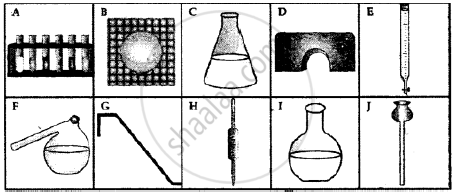
1. Delivery Tube
2. Pipette
3. Wire gauze
4. Bee-hive shelf
5. Thistle funnel
6. Flat bottom flask
7. Test tube stand
8. Burette
9. Retort
10. Conical flask
Select the correct apparatus from A, B, or C for the following functions of the apparatus given.
For gas preparations where heating is required.
Flat bottom flask
Retort
Round bottom flask
Select the correct apparatus from A, B, or C for the following functions of the apparatus given.
For holding washed test tubes
Test tube holder
Test tube stand
Retort stand
Select the correct apparatus from A, B, or C for the following functions of the apparatus given.
A glass apparatus resistant to chemicals, made of pyrex, and used for heating specific liquids.
Beaker
Retort
Boiling Tube
Select the correct apparatus from A, B, or C for the following functions of the apparatus given.
A metallic apparatus which supports the wire gauze.
A Tripod stand
Retort stand
Test tube stand
Select the correct apparatus from A, B, or C for the following functions of the apparatus given.
A long glass apparatus closed at one end used for collecting gases.
Measuring cylinder
Gas jar
Beehive shelf
Select the correct apparatus from A, B, or C for the following functions of the apparatus given.
A glass apparatus that measures liquid by sucking the liquid at one end up to the marked level and later pouring it out.
Burette
Measuring cylinder
Pipette
Select the correct apparatus from A, B, or C for the following functions of the apparatus given.
A long glass tube with a broad inlet at the top, which allows entry of the reactants into the round bottom flask, during laboratory preparations of gases.
Thistle funnel
Delivery tube
Funnel
Select the correct apparatus from A, B, or C for the following functions of the apparatus given.
A modern apparatus with an air regulator, used for heating purposes.
Retort
Beehive shelf
Burette
Select the correct apparatus from A, B, or C for the following functions of the apparatus given.
A modern apparatus with an air regulator, used for heating purposes.
Spirit lamp
Bunsen burner
Electric stove
Select the correct apparatus from A, B, or C for the following functions of the apparatus given.
A rectangular mesh with asbestos at its centre kept for initiating even distribution of heat to the bottom of the apparatus.
Tripod stand
Wire gauze
Retort stand
Selina solutions for Concise Chemistry [English] Class 6 ICSE 1 Introduction to Chemistry Objective Type Questions 3
Give reasons for the following
Alchemy was considered a pseudoscience.
Preservatives are added to food or beverages.
Give reasons for the following
Titanium dioxide is an important ingredient in cosmetics.
Give reasons for the following
Aspirin is one of the most widely used medications – globally.
Give reasons for the following
Ordinary soap is wasted in hard water.
A philosopher’s stone is not exactly a stone.
Food processing is an important procedure for obtaining marketable food products.
Give reasons for the following
Cosmetics may contain preservatives, as one of their ingredients.
Give reasons for the following
Polyester is added to natural fiber cotton, to give terylene.
Give reasons for the following
All medicines must be taken under proper doctors' supervision and in the correct dose.
Solutions for 1: Introduction to Chemistry
Selina solutions for Concise Chemistry [English] Class 6 ICSE chapter 1 - Introduction to Chemistry
Shaalaa.com has the CISCE Mathematics Concise Chemistry [English] Class 6 ICSE CISCE solutions in a manner that help students grasp basic concepts better and faster. The detailed, step-by-step solutions will help you understand the concepts better and clarify any confusion. Selina solutions for Mathematics Concise Chemistry [English] Class 6 ICSE CISCE 1 (Introduction to Chemistry) include all questions with answers and detailed explanations. This will clear students' doubts about questions and improve their application skills while preparing for board exams.
Further, we at Shaalaa.com provide such solutions so students can prepare for written exams. Selina textbook solutions can be a core help for self-study and provide excellent self-help guidance for students.
Concepts covered in Concise Chemistry [English] Class 6 ICSE chapter 1 Introduction to Chemistry are Chemistry and Its Historical Perspective, Importance of Chemistry, Dark Side of Chemistry.
Using Selina Concise Chemistry [English] Class 6 ICSE solutions Introduction to Chemistry exercise by students is an easy way to prepare for the exams, as they involve solutions arranged chapter-wise and also page-wise. The questions involved in Selina Solutions are essential questions that can be asked in the final exam. Maximum CISCE Concise Chemistry [English] Class 6 ICSE students prefer Selina Textbook Solutions to score more in exams.
Get the free view of Chapter 1, Introduction to Chemistry Concise Chemistry [English] Class 6 ICSE additional questions for Mathematics Concise Chemistry [English] Class 6 ICSE CISCE, and you can use Shaalaa.com to keep it handy for your exam preparation.
