O.P. Malhotra, S.K. Gupta, Anubhuti Gangal solutions for Applied Mathematics [English] Class 11 ISC chapter 1 - Sets [Latest edition]
Chapters
▶ 1: Sets
Chapter 2: Relations and Functions
Trigonometry
Chapter 3: Angles and Arc Lengths
Chapter 4: Trigonometrical Functions
Chapter 5: Compound and Multiple Angles
Algebra
Chapter 6: Logarithms
Chapter 7: Complex Numbers
Chapter 8: Quadratic Equations
Chapter 9: Inequalities
Chapter 10: Permutations and Combinations
Chapter 11: Binomial Theorem
Chapter 12: Sequence and Series
Coordinate Geometry
Chapter 13: Basic Concepts of Points and Their Coordinates
Chapter 14: Straight Line
Chapter 15: Circle
Chapter 16: Parabola
Calculus
Chapter 17: Limits
Chapter 18: Differentiation
Statistical Methods and Probability
Chapter 19: Measures of Central Tendency
Chapter 20: Statistics
Chapter 21: Measures of Dispersion
Chapter 22: Moments, Skewness and Kurtosis
Chapter 23: Correlation Analysis
Chapter 24: Linear Regression
Chapter 25: Probability
Mathematical Reasoning
Chapter 26: Mathematical Reasoning
Financial Mathematics
Chapter 27: Simple Interest and Compound Interest
Chapter 28: Annuities
Chapter 29: Таxation
Chapter 30: Bills
Advertisements
Advertisements
Solutions for Chapter 1: Sets
Below listed, you can find solutions for Chapter 1 of CISCE O.P. Malhotra, S.K. Gupta, Anubhuti Gangal for Applied Mathematics [English] Class 11 ISC.
Advertisements
O.P. Malhotra, S.K. Gupta, Anubhuti Gangal solutions for Applied Mathematics [English] Class 11 ISC 1 Sets EXERCISE 1(A) [Pages 6 - 8]
Type I. (Questions related to definitions and description of sets)
Which of the collections are sets?
- The collection of all the months of a year, beginning with the letter J.
- The collection of ten most talented writers of India.
- The collection of all natural numbers less than 100.
- A collection of most dangerous animals of the world.
Let A = {1, 2, 3, 4, 5, 6}. Insert the appropriate symbol ∈ or ∉ in the blank space:
5 _____ A
∈
∉
Let A = {1, 2, 3, 4, 5, 6}. Insert the appropriate symbol ∈ or ∉ in the blank space:
8 ____ A
∈
∉
Let A = {1, 2, 3, 4, 5, 6}. Insert the appropriate symbol ∈ or ∉ in the blank space:
0 ____ A
∈
∉
Let A = {1, 2, 3, 4, 5, 6}. Insert the appropriate symbol ∈ or ∉ in the blank space:
4 _____ A
∈
∉
Write down a description of the following set. (There could be different suitable descriptions.)
{2, 4, 6, 8}
Write down a description of the following set. (There could be different suitable descriptions.)
{7, 14, 21, 28, 35}
Write down a description of the following set. (There could be different suitable descriptions.)
{1, 2, 3, 4, 6, 12}
List the following set in roster form.
The set of square numbers less than 40.
List the following set in roster form.
The set of colours of the rainbow.
List the following set in roster form.
The set of factors of 144.
List the following set in roster form.
The set of prime factors of 144.
List the following set in roster form.
The set of natural numbers less than 50.
List the following set in roster form.
The set of consonants before i in the English alphabet.
List the following set in roster form.
The set of letters in the word ‘Satellite’.
Rewrite the following set in the indicated notation.
{−2, −4, −6, −8}; Words
Rewrite the following set in the indicated notation.
{−2, −4, −6, −8}; Set-builder notation
Rewrite the following set in the indicated notation.
Positive multiples of 11; Roster form
Rewrite the following set in the indicated notation.
{−9, −7, −5, −3, −1}; Set-builder notation
Rewrite the following set in the indicated notation.
Even numbers between 27 and 39; Roster form
Rewrite the following set in the indicated notation.
Even numbers between 27 and 39; Set-builder notation
Rewrite the following set in the indicated notation.
{x | 0 < x < 1}; Words
Rewrite the following set in the indicated notation.
{x | 0 < x < 1}; Roster form
Rewrite the following set in the indicated notation.
 ; Roster form
Rewrite the following set in the indicated notation.
Negative multiples of 3; Set-builder form
Rewrite the following set in the indicated notation.
 ; Set-builder form
Rewrite the following set in the indicated notation.
Numbers more than 2 units from 8; Set-builder form
Rewrite the following set in the indicated notation.
x ≠ 5 and x ≤ 10; Set-builder form
Rewrite the following set in the indicated notation.
{y | y = 5x − 2, y ∈ N}; Roster form
Rewrite the following set in the indicated notation.
\[ \left\{ x \,\middle|\, x = \frac{3p + 1}{2p - 1}, \ p \in W \ \mathrm{and} \ p \leq 5 \right\} \]; Roster form
Type II. (Questions related to types of sets)
State whether the following set is finite or infinite:
The set of lines which are parallel to the x-axis.
State whether the following set is finite or infinite:
The set of letters in the English alphabet.
State whether the following set is finite or infinite:
The set of numbers which are multiple of 5.
State whether the following set is finite or infinite:
The set of animals living on the earth.
State whether the following set is finite or infinite:
The set of circles passing through the origin (0, 0).
State whether the following set is finite or infinite:
The set of whole numbers greater than 5.
State whether the following set is finite or infinite:
The set of natural numbers less than one billion.
State whether the following set is finite or infinite:
The set of integers between −4 and 4.
State whether the following set is finite or infinite:
The set of rational numbers between 0 and 1.
Which of the following sets are empty sets?
(i) A = {x : x is a human being living on Mars}
(ii) B = {x : x is an odd number divisible by 2}
(iii) C = {x : x is a point common to any two parallel lines}
(iv) D = {0}
(v) E = {x : x is a natural number, x < 5 and simultaneously x > 7}
Are the following pair of sets equal? Give reasons.
A = {2, 3}, B = {x : x is solution of x2 + 5x + 6 = 0}
Are the following pair of sets equal? Give reasons.
A = {x : x is a letter in the word FOLLOW};
B = {y : y is a letter in the word WOLF}
Which of the following are singleton sets?
(i) A = {x : |x| = 5, x ∈ N}
(ii) B = {x : x2 − 11x + 24 = 0, x ∈ N}
(iii) C = {x : x3 = −125, x ∈ Z}
State the value of n(A) for the following set.
A = {Months of the year}
State the value of n(A) for the following set.
A = {Planets of our solar system}
State the value of n(A) for the following set.
A = {x : x is an integer and −8 ≤ x ≤ 3}
State the value of n(A) for the following set.
A = {x : x is an even number}
Tуpe III. (Questions related to interval notation)
Use interval notation to represent the set of numbers.
−17 < x < 0
Use interval notation to represent the set of numbers.
6 ≤ x ≤ 12
Use interval notation to represent the set of numbers.
−1 < x ≤ 4
Use interval notation to represent the set of numbers.
−4 ≤ x < 7
Use interval notation to represent the set of numbers.
x ≤ 3 or 5 < x ≤ 9
Use interval notation to represent the set of numbers.
{x | x ≥ 99}
Use interval notation to represent the set of numbers.
{x | x ≠ 1}
Use interval notation to represent the set of numbers.
{1, 3, 5, 7, ...}
Use interval notation to represent the set of numbers.
x ≠ 3
Use interval notation to represent the set of numbers.

Use interval notation to represent the set of numbers.

Use interval notation to represent the set of numbers.

Use interval notation to represent the set of numbers.

Use interval notation to represent the set of numbers.

O.P. Malhotra, S.K. Gupta, Anubhuti Gangal solutions for Applied Mathematics [English] Class 11 ISC 1 Sets EXERCISE 1(B) [Pages 11 - 12]
Find the subsets of {a}.
Find the subsets of {Reena, Sonu}.
Find the subsets of $$\phi$$.
Find the subsets of {5, {7}}.
Let A = {p, q, r}
List all the subsets of A.
Let A = {p, q, r}
List all the proper subsets of A.
Let P = {whole numbers less than 30}
(i) List the subset Q {even numbers}
(ii) List the subset R {odd numbers}
(iii) List the subset S {prime numbers}
(iv) List the subset T {square numbers}
(v) List the subset U {triangular numbers}
Tell the following, whether first set is a subset of the second set or not.
A = Set of letters in the word 'LATE'
B = Set of letters in the word 'PLATE'
Tell the following, whether first set is a subset of the second set or not.
P = Set of even prime numbers.
Q = {x | x = 2p, p ∈ N and 1 ≤ p ≤ 3}
Tell the following, whether first set is a subset of the second set or not.
L = Set of digits in the number 1590
M = Set of digits in the number 178902
Tell the following, whether first set is a subset of the second set or not.
E = Set of all triangles having 4 sides.
F = Set of digits in the number '100'.
Write the proper subsets of the following set:
{7}
Write the proper subsets of the following set:
{1, 3}
Write the proper subsets of the following set:
{c, a, b}
Write the proper subsets of the following set:
$$\phi$$
How many subsets does the following set have?
A set having 5 elements.
How many subsets does the following set have?
The set of letters of the word ‘CENTENARY’
How many proper subsets does the following set have?
The set of factors of 12.
How many proper subsets does the following set have?
The set A {x | x is a prime number, x < 20}
Answer True or False.
3 ⊆ {3, 0}
Answer True or False.
{3} ⊆ {3, 0}
Answer True or False.
\(\phi\) ∈ {3, 0}
Answer True or False.
0 ∈ {3, 0}
Answer True or False.
\(\phi\) ⊂ {3, 0}
Answer True or False.
\(\phi \subseteq\{\phi\}\)
Answer True or False.
For any two sets A and B either A ⊆ B or B ⊆ A.
Answer True or False.
Every set has a proper subset.
Answer True or False.
Every subset of a finite set is finite.
Answer True or False.
Every subset of an infinite set is infinite.
Find the power set of the following set:
A = {digits in the number 98}
Find the power set of the following set:
B = {letters in the word 'KID'}
Find the power set of the following set:
S = {2, 3}
Find the power set of the following set:
T = {4, 7, 9}
O.P. Malhotra, S.K. Gupta, Anubhuti Gangal solutions for Applied Mathematics [English] Class 11 ISC 1 Sets EXERCISE 1(C) [Pages 13 - 14]
Suggest a universal set for the following:
{Jaipur, Chennai, Bangalore, Itanagar}
Suggest a universal set for the following:
{Narmada, Cauvery, Mahanadi, Jhelum}
Suggest a universal set for the following:
{Asia, Europe, Antarctica}
Suggest a universal set for the following:
{Earth, Mars, Venus}
Suggest a universal set for the following:
{0, 5, 10, 15, 20, 25}
What universal set may be proposed for the following set?
The set of parallelograms
What universal set may be proposed for the following set?
The set of irrational numbers
What universal set may be proposed for the following set?
The set of positive even numbers
Solve the following equation:
{x | 2x + 6 = 0, x ∈ Z}
Solve the following equation:
{x | 5x + 16 = 1, x ∈ N}
Solve the following equation:
{x | 2x − 3 < 7, x ∈ W}
Solve the following equation:
{x | 4x − 25 > 13, x ∈ Z}
Solve the following equation:
\[ \left\{ y \,\middle|\, \frac{5y}{3} - 7 \leq 13, \ y \ \mathrm{is\ a\ prime\ number} \right\} \]
\[\xi=\left\{-2 \frac{1}{2},-1, \sqrt{2}, 3.5, \sqrt{30}, \sqrt{36}\right\}\]
X = {integers}, Y = {irrational numbers}
List the members of (i) X and (ii) Y
\({\xi}\) = {40, 41, 42, 43, 44, 45, 46, 47, 48, 49}
A = {prime numbers}, B = {odd numbers}
Place the ten numbers in the correct places on the diagram.
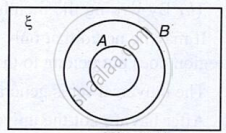
X = {all triangles}, P = {isosceles triangles}, Z = {equilateral triangles}, draw a Venn diagram to illustrate the relationship between these sets.
Draw a Venn diagram to show the relationship between the following sets:
\(\xi\) = {quadrilaterals}, A = {parallelograms}, B = {rectangles}, C = {rhombuses}
Show in your diagram the region that represents the set of squares.
Using \(\xi\) = {books}, N = {novels} and D = {detective novels}, represent the following statement as a Venn diagram:
‘Some novels are not detective novels.’
Answer true or false:
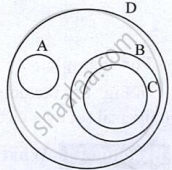
A ⊂ D
Answer true or false:
B ⊂ C
Answer true or false:
A ⊄ B
Answer true or false:
C ⊂ D
Answer true or false:
B ⊂ D
O.P. Malhotra, S.K. Gupta, Anubhuti Gangal solutions for Applied Mathematics [English] Class 11 ISC 1 Sets EXERCISE 1(D) [Pages 16 - 17]
Find A ∪ B if
A = {a, b, c}, B = {x, y}
Find A ∪ B if
A = {c, a, t}, B = {s, a, t}
Find A ∪ B if
A = Set of letters in the word ‘INDIA’
B = Set of letters is the word ‘DRAIN’
Find A ∪ B if
A = {factors of 12}, B = {factors of 16}
Find A ∪ B if
A = {prime numbers < 10}, B = {odd numbers < 10}
Find A ∪ B if
A = {x | x = 3p, p ∈ N}, B = {y | y = 4n, n ∈ N}
Find A ∪ B if
A = {x | x is a positive integer}, B = {x | x is a negative integer}
If A = {1, 2, 3, 4}, B = {3, 4, 5, 6}, C = {5, 6, 7, 8} and D = {7, 8, 9, 10}; find
A ∪ B
If A = {1, 2, 3, 4}, B = {3, 4, 5, 6}, C = {5, 6, 7, 8} and D = {7, 8, 9, 10}; find
A ∪ C
If A = {1, 2, 3, 4}, B = {3, 4, 5, 6}, C = {5, 6, 7, 8} and D = {7, 8, 9, 10}; find
B ∪ C
If A = {1, 2, 3, 4}, B = {3, 4, 5, 6}, C = {5, 6, 7, 8} and D = {7, 8, 9, 10}; find
B ∪ D
If A = {1, 2, 3, 4}, B = {3, 4, 5, 6}, C = {5, 6, 7, 8} and D = {7, 8, 9, 10}; find
A ∪ B ∪ C
If A = {1, 2, 3, 4}, B = {3, 4, 5, 6}, C = {5, 6, 7, 8} and D = {7, 8, 9, 10}; find
A ∪ B ∪ D
If A = {1, 2, 3, 4}, B = {3, 4, 5, 6}, C = {5, 6, 7, 8} and D = {7, 8, 9, 10}; find
B ∪ C ∪ D
If A = {2, 3, 5, 7, 11}, B = {1, 3, 5, 7, 9}, C = {0, 1, 2, 3}, then find (A ∪ B) ∪ C and A ∪ (B ∪ C), and verify that (A ∪ B) ∪ C = A ∪ (B ∪ C).
Given L = {letters of CRICKET}, M = {letters of CATERPILLAR} and N = {letters of CARETAKER}, find:
L ∪ M
Given L = {letters of CRICKET}, M = {letters of CATERPILLAR} and N = {letters of CARETAKER}, find:
M ∪ N
Given L = {letters of CRICKET}, M = {letters of CATERPILLAR} and N = {letters of CARETAKER}, find:
L ∪ N
O.P. Malhotra, S.K. Gupta, Anubhuti Gangal solutions for Applied Mathematics [English] Class 11 ISC 1 Sets EXERCISE 1(E) [Page 19]
Find A ∩ B if
A = {1, 2, 3}, B = {1, 3, 5}
Find A ∩ B if
A = {a, e, i, o, u}, B = {a, r, e}
Find A ∩ B if
A = {letters in the word ‘nation’}, B = {t, r, a, i, n}
Find A ∩ B if
A = {x : x ∈ N and x is a multiple of 3}
B = {x : x ∈ N and x < 10}
Find A ∩ B if
A = {x : x ∈ N and 1 < x ≤ 6}
B = {x : x ∈ N and 6 < x < 10}
Find A ∩ B if
A = {1, 2, 3}, B = \(\phi\)
If A = {5, 6, 7, 8, 9}, B = {10, 11, 12}, C = {6, 7, 11, 12, 13}, D = {5, 12, 13, 15}, find:
A ∩ C
If A = {5, 6, 7, 8, 9}, B = {10, 11, 12}, C = {6, 7, 11, 12, 13}, D = {5, 12, 13, 15}, find:
A ∩ D
If A = {5, 6, 7, 8, 9}, B = {10, 11, 12}, C = {6, 7, 11, 12, 13}, D = {5, 12, 13, 15}, find:
B ∩ C
If A = {5, 6, 7, 8, 9}, B = {10, 11, 12}, C = {6, 7, 11, 12, 13}, D = {5, 12, 13, 15}, find:
B ∩ D
If A = {5, 6, 7, 8, 9}, B = {10, 11, 12}, C = {6, 7, 11, 12, 13}, D = {5, 12, 13, 15}, find:
A ∩ B
If A = {5, 6, 7, 8, 9}, B = {10, 11, 12}, C = {6, 7, 11, 12, 13}, D = {5, 12, 13, 15}, find:
(A ∩ B) ∩ C
If A = {5, 6, 7, 8, 9}, B = {10, 11, 12}, C = {6, 7, 11, 12, 13}, D = {5, 12, 13, 15}, find:
(B ∩ C) ∪ (A ∩ B)
If A = {5, 6, 7, 8, 9}, B = {10, 11, 12}, C = {6, 7, 11, 12, 13}, D = {5, 12, 13, 15}, find:
(A ∩ D) ∩ (B ∩ C)
If A = {2, 4, 6, 8, 9, 10, 12}, B = {1, 6, 7, 10, 11, 12}, C = {2, 5, 8, 12, 15}, prove that A ∩ B = B ∩ A.
If A = {2, 4, 6, 8, 9, 10, 12}, B = {1, 6, 7, 10, 11, 12}, C = {2, 5, 8, 12, 15}, prove that (A ∩ B) ∩ C = A ∩ (B ∩ C).
If A = {x : x is a natural number}, B = {x : x is an even natural number} C = {x : x is an odd natural number} and D = {x : x is a prime number}, find:
A ∩ B
If A = {x : x is a natural number}, B = {x : x is an even natural number} C = {x : x is an odd natural number} and D = {x : x is a prime number}, find:
A ∩ C
If A = {x : x is a natural number}, B = {x : x is an even natural number} C = {x : x is an odd natural number} and D = {x : x is a prime number}, find:
A ∩ D
If A = {x : x is a natural number}, B = {x : x is an even natural number} C = {x : x is an odd natural number} and D = {x : x is a prime number}, find:
B ∩ C
If A = {x : x is a natural number}, B = {x : x is an even natural number} C = {x : x is an odd natural number} and D = {x : x is a prime number}, find:
B ∩ D
If A = {x : x is a natural number}, B = {x : x is an even natural number} C = {x : x is an odd natural number} and D = {x : x is a prime number}, find:
C ∩ D
State whether the following pairs of sets are disjoint.
{1, 2, 3, 4} and {x : x is a natural number and 4 ≤ x ≤ 6}
State whether the following pairs of sets are disjoint.
{a, e, i, o, u} and {c, d, e, f}
State whether the following pairs of sets are disjoint.
{x : x is an even integer} and {x : x is an odd integer}
Which of the following pairs of sets are disjoint?
{x : x is a prime number} and {x : x is an even natural number}
Let A {x : 2x + 9 = 0, x ∈ N}, B = {1, 2, 3, 4}, find out whether A and B are disjoint sets or not.
In the given Venn diagram, shade the region A ∪ (B ∩ C).
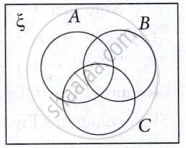
If A and B are two sets, then A ∩ (A ∪ B) equals ______.
A
B
Φ
A ∩ B
If sets A and B are defined as A = `{(x, y) | y = 1/x, 0 ≠ x ∈ "R"}` B = {(x, y) | y = – x, x ∈ R}, then ______.
A ∩ B = A
A ∩ B = B
A ∩ B = Φ
A ∪ B = A
A ∪ B = B
O.P. Malhotra, S.K. Gupta, Anubhuti Gangal solutions for Applied Mathematics [English] Class 11 ISC 1 Sets EXERCISE 1(F) [Page 22]
If X = {a, b, c, d} and Y = {f, b, d, g}, find
X – Y
If X = {a, b, c, d} and Y = {f, b, d, g}, find
Y – X
If A = {3, 6}, B = {3, 6, 9, 12}, then find
A − B
If A = {3, 6}, B = {3, 6, 9, 12}, then find
B − A
If A = {1, 2, 3, 4}, B = {3, 4, 5, 6}, C = {5, 6, 7, 8}, find
A − B
If A = {1, 2, 3, 4}, B = {3, 4, 5, 6}, C = {5, 6, 7, 8}, find
B − C
If A = {1, 2, 3, 4}, B = {3, 4, 5, 6}, C = {5, 6, 7, 8}, find
A − C
If A = {1, 2, 3, 4}, B = {3, 4, 5, 6}, C = {5, 6, 7, 8}, find
C − A
If A = {1, 2, 3, 4, 5, 6} and B = {2, 4, 6, 8}, show that A – B ≠ B – А.
If R is the set of real numbers and Q is the set of rational numbers, then what is R – Q?
Given L = {1, 2, 3, 4}, M = {3, 4, 5, 6} and N = {1, 3, 5}. Verify that L – (M ∪ N) = (L – M) ∩ (L – N)
With the help of Venn diagram, show that for all sets A, B and C.
(A − B) ∪ (A ∩ B) = A
With the help of Venn diagram, show that for all sets A, B and C.
(A ∪ B) − B = А − В
With the help of Venn diagram, show that for all sets A, B and C.
A − (B − C) ≠ (А − B) − С
O.P. Malhotra, S.K. Gupta, Anubhuti Gangal solutions for Applied Mathematics [English] Class 11 ISC 1 Sets EXERCISE 1(G) [Page 24]
Find A Δ B if
A = {a, b, c, d}, B = {a, c, e, f}
Find A Δ B if
A = {5, 10, 15, 25}, В = {10, 25, 30, 40}
Find A Δ B if
A = {letters of the word ‘RIVER’}, B = {letters of the word ‘WRITE’}
Find A Δ B if
A = {c, a, r}, B = {m, u, t, e}
Find A Δ B if
A = {x | x ∈ N, x ≤ 10}, B = {x | x is a prime number, x < 6}
Find A Δ B if
A = \(\phi\), B = {5, 7, 9, 11}
If A = {3, 6, 8, 15, 19} and B = {1, 2, 6, 8, 14, 15}, then verify that A Δ B = (A ∪ B) − (A ∩ B).
O.P. Malhotra, S.K. Gupta, Anubhuti Gangal solutions for Applied Mathematics [English] Class 11 ISC 1 Sets EXERCISE 1(H) [Pages 26 - 27]
If U = {a, b, c, d, e, f, g, h}, find the complements of the following set:
A = {a, b, c}
If U = {a, b, c, d, e, f, g, h}, find the complements of the following set:
B = {d, e, f, g}
If U = {a, b, c, d, e, f, g, h}, find the complements of the following set:
C = {a, c, e, g}
If U = {a, b, c, d, e, f, g, h}, find the complements of the following set:
D = {f, g, h, a}
If \[\xi\] = {1, 2, 3, 4}, A = {1, 4}, B = {1, 3}, then list the elements of
(i) A'
(ii) B'
(iii) (A ∩ В)'
(iv) (A ∪ B)'
(v) A' ∩ В'
(vi) A' ∪ В'
also shows that (A ∩ В)' = A' ∪ В' and (A ∪ B)' = A' ∩ В'.
Given \[\xi\] = {1, 2, 3, 4, 5, 6, 7, 8, 9, 10}, A = {1, 3, 6, 10}, B = {1, 3, 5, 7, 9} and C = {1, 4, 9}, then list the elements of the following set.
(A − B)'
Given \[\xi\] = {1, 2, 3, 4, 5, 6, 7, 8, 9, 10}, A = {1, 3, 6, 10}, B = {1, 3, 5, 7, 9} and C = {1, 4, 9}, then list the elements of the following set.
(C − B)'
Given \[\xi\] = {1, 2, 3, 4, 5, 6, 7, 8, 9, 10}, A = {1, 3, 6, 10}, B = {1, 3, 5, 7, 9} and C = {1, 4, 9}, then list the elements of the following set.
(C − A)'
Given \[\xi\] = {1, 2, 3, 4, 5, 6, 7, 8, 9, 10}, A = {1, 3, 6, 10}, B = {1, 3, 5, 7, 9} and C = {1, 4, 9}, then list the elements of the following set.
(A ∪ B)'
Given \[\xi\] = {1, 2, 3, 4, 5, 6, 7, 8, 9, 10}, A = {1, 3, 6, 10}, B = {1, 3, 5, 7, 9} and C = {1, 4, 9}, then list the elements of the following set.
(A ∩ B)'
Given \[\xi\] = {1, 2, 3, 4, 5, 6, 7, 8, 9, 10}, A = {1, 3, 6, 10}, B = {1, 3, 5, 7, 9} and C = {1, 4, 9}, then list the elements of the following set.
(A' ∩ B) ∩ C'
Given \[\xi\] = {1, 2, 3, 4, 5, 6, 7, 8, 9, 10}, A = {1, 3, 6, 10}, B = {1, 3, 5, 7, 9} and C = {1, 4, 9}, then list the elements of the following set.
(B' ∪ C) ∩ A'
Given \[\xi\] = {1, 2, 3, 4, 5, 6, 7, 8, 9, 10}, A = {1, 3, 6, 10}, B = {1, 3, 5, 7, 9} and C = {1, 4, 9}, then list the elements of the following set.
(A ∪ B ∪ C)'
Given \[\xi\] = {1, 2, 3, 4, 5, 6, 7, 8, 9, 10}, A = {1, 3, 6, 10}, B = {1, 3, 5, 7, 9} and C = {1, 4, 9}, then list the elements of the following set.
(A ∩ B ∩ C)'
Taking the set of natural numbers as the universal set, write down the complements of the following set:
{x : x is an even natural number}
Taking the set of natural numbers as the universal set, write down the complements of the following set:
{x : x is a positive multiple of 3}
Taking the set of natural numbers as the universal set, write down the complements of the following set:
{x : x is a prime number}
Taking the set of natural numbers as the universal set, write down the complements of the following set:
{x : x is a natural number divisible by 3 and 5}
Taking the set of natural numbers as the universal set, write down the complements of the following set:
{x : x + 5 = 8}
Taking the set of natural numbers as the universal set, write down the complements of the following set:
{x : 2x + 5 = 9}
Taking the set of natural numbers as the universal set, write down the complements of the following set:
{x : x ≥ 7}
Taking the set of natural numbers as the universal set, write down the complements of the following set:
{x : x ∈ N and 2x + 1 > 10}
Let U be the set of all triangles in a plane. If A is the set of all triangles with at least one angle different from 60°, what is A'?
Shade the region as directed:
Complement of set B
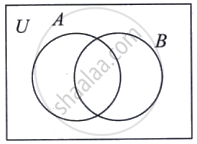
Shade the region as directed:
(A ∪ B)'
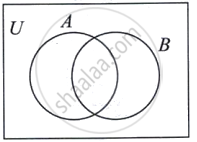
Shade the region as directed:
A' ∩ C'
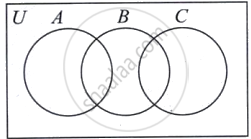
Describe the shaded regions in the following diagram.
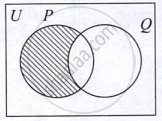
Describe the shaded regions in the following diagram.
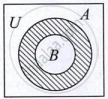
Describe the shaded regions in the following diagram.
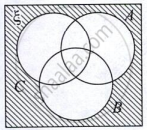
Describe the shaded regions in the following diagram.
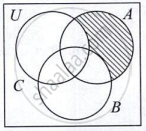
Describe the shaded regions in the following diagram.
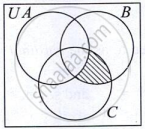
Describe the shaded regions in the following diagram.
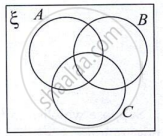
Use the given diagram to shade the region (A ∩ B ∩ C)'.
O.P. Malhotra, S.K. Gupta, Anubhuti Gangal solutions for Applied Mathematics [English] Class 11 ISC 1 Sets EXERCISE 1(I) [Page 30]
If \[\text{n}(\xi)\] = 80, n(A) = 48, n(B) = 40 and n(A ∩ B) = 25, draw a Venn diagram to find:
(i) n(A ∪ B)
(ii) n(A ∪ B)'
(iii) n(A − В)
(iv) n(B − А)
(v) n(A ∩ B)'
(vi) n(A' ∩ B)
If \[\xi\] = {x | x ∈ N, x < 10}, A = {x | x is a prime number, x < 10}, B = {x | x is an even number, x < 10} draw a Venn diagram to find:
(i) n(A ∪ B)
(ii) n(A ∩ B)
(iii) n(A ∪ B)'
(iv) n(A ∩ B')
(v) n(A' ∩ B)
Given \[\text{n}(\xi)\] = 40, n(A') = 12, n(B) = 15 and B ⊂ A. Draw a Venn diagram to illustrate this information. Hence, find n(A − B).
The Venn diagram shows:
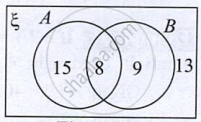
\[\xi\] = {pupils in class 8}
A = {pupils who play cricket}
B = {pupils who play basketball}
How many pupils:
(i) are in class 8?
(ii) play cricket?
(iii) play basketball?
(iv) play both cricket and basketball?
(v) play neither cricket nor basketball?
In the Venn diagram
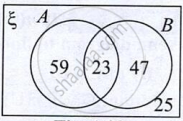
\[\xi\] = {people at a function}
A = {those who asked for tea}
B = {those who watched the ballet}
Write down the number who:
(i) asked for tea
(ii) asked for tea and watched the ballet
(iii) neither asked for tea nor watched the ballet
(iv) attended the function
If X and Y are two sets such that X ∪Y has 18 elements, X has 8 elements and Y has 15 elements; how many elements does X ∩Y have?
If S and T Are Two Sets Such that S Has 21 Elements, T Has 32 Elements, and S ∩ T Has 11 Elements, How Many Elements Does S ∪ T Have?
If X and Y are two sets such that X has 40 elements, X ∪Y has 60 elements and X ∩Y has 10 elements, how many elements does Y have?
O.P. Malhotra, S.K. Gupta, Anubhuti Gangal solutions for Applied Mathematics [English] Class 11 ISC 1 Sets EXERCISE 1(J) [Pages 33 - 34]
In a class of 35 students, 24 like to play cricket and 16 like to play football. Also each student likes to play at least one of the two games. How many students like to play both cricket and football?
In a group of 70 people, 37 like coffee, 52 like tea, and each person likes at least one of the two drinks. How many people like both coffee and tea?
In a group of students 100 students know Hindi, 50 know English and 25 know both. Each of the students knows either Hindi or English. How many students are there in the group?
In a survey of 400 students in a school, 100 were listed as taking apple juice, 150 as taking orange juice and 75 were listed as taking both apple as well as orange juice. Find how many students were taking neither apple juice nor orange juice.
In a college 500 students study Mathematics and 400 study Economics. If 200 students study both the subjects, find the total number of students enrolled in these two subjects.
In a group of 70 people, 48 speak Tamil, 36 speak English and all the people speak at least one language. Find:
- How many speak both languages?
- How many speak only Tamil?
- How many speak only English?
Out of 100 candidates who appeared in an entrance test in English and Mathematics, 80 passed in at least one subject. If 60 passed in English and 65 in Mathematics. Find:
- How many passed in both subjects?
- How many passed in English only?
- How many failed in Mathematics?
In a group of 30 people, 18 play squash and 19 play tennis. How many play both games, provided everyone plays at least one game?
In a class of 50 students, 22 like History, 25 like Geography and 10 like both subjects. Draw a Venn diagram and find the number of students who
(i) do not like History
(ii) do not like Geography
(iii) like neither History nor Geography
2000 candidates appear in a written test in Mathematics and General Awareness for a Government job. 1800 passed in at least one subject. If 1200 passed in Mathematics and 1500 passed in General Awareness. Find:
- How many passed in both subjects?
- How many passed in Mathematics only?
- How many failed in General Awareness?
In a group of 80 people, 40 like Indian food, 36 like Chinese food and 27 do not like any kind of these foods. Draw Venn diagram to find:
- How many like both kinds of food?
- How many like only the Indian food?
- How many like only the Chinese food?
[Hint: Let A and B be the sets of those people who like Indian and Chinese food, respectively. Then, we have n(A) = 40, n(B) = 36, n(A ∪ B) = 80 − 27 = 53]
In a group of people, two-seventh speak Bengali only and three-seventh speak Hindi only. If 20 people speak none of these languages and 80 speak both, find using Venn diagram the total number of people in the group.
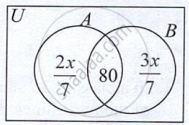
[Hint: Let A and B be the sets of people speaking Bengali and Hindi, respectively. Let the number of people in the group be x. Then n(U) = x]
\[\left[\therefore \frac{2 x}{7}+\frac{3 x}{7}+80+20=x\right]\]
A firm has 40 workers working in the factory premises, 30 working in its office and 20 working in both the places. How many workers are there in the firm? How many are working in the
- factory,
- office alone?
There are 200 individuals with a skin disorder; 120 had been exposed to the chemical C1, 50 to chemical C2, and 30 to both the chemicals C1 and C2. Find the number of individuals exposed to
- Chemical C1 but not chemical C2
- Chemical C2 but not chemical C1
- Chemical C1 or chemical C2.
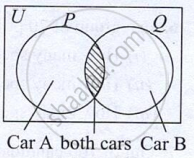
Out of 500 car owners investigated, 400 owned car A and 200 owned car B, 50 owned both A and B cars. Is this data correct?
A survey shows that 63% of the people watch a news channel whereas 76% watch another channel. If x% of the people watch both channels, then
x = 35
x = 63
39 ≤ x ≤ 63
x = 39
O.P. Malhotra, S.K. Gupta, Anubhuti Gangal solutions for Applied Mathematics [English] Class 11 ISC 1 Sets EXERCISE 1(K) [Pages 37 - 38]
In a survey it was found that 21 people liked product A, 26 liked product B and 29 liked product C. If 14 people liked products A and B, 12 people liked products C and A, 14 people liked products B and C and 8 liked all the three products. Find how many liked product C only.
In a survey of 200 students of a school, it was found that 120 study Mathematics, 90 study Physics and 70 study Chemistry, 40 study Mathematics and Physics, 30 study Physics and Chemistry, 50 study Chemistry and Mathematics and 20 none of these subjects.
- Find the number of students who study all the three subjects.
- Also, find the number of students who study Mathematics only.
In a group of 500 person, 300 take tea, 150 take coffee, 250 take cold drink, 90 take tea and coffee, 110 take tea and cold drink, 80 take coffee and cold drink and 50 take all the three drinks.
- Find the number of persons who take none of the three drinks.
- Find the number of persons who take only tea.
- Find the number of persons who take coffee and cold drink but not tea.
In a group of 50 students, the number of students studying French, English, Sanskrit were found to be as follows:
French = 17, English = 13, Sanskrit = 15 French and English = 09, English and Sanskrit = 4 French and Sanskrit = 5, English, French and Sanskrit = 3. Find the number of students who study
- French only
- English only
- Sanskrit only
- English and Sanskrit but not French
- French and Sanskrit but not English
- French and English but not Sanskrit
- At least one of the three languages
- None of the three languages
In a survey it was found that 21 persons liked product P1, 26 liked product P2 and 29 liked product P3. If 14 persons liked products P1 and P2, 12 persons liked products P1 and P3, 14 persons liked products P2 and P3 and 8 liked all the three products, then how many liked only one product?
In a survey of 100 persons it was found that 28 read magazine A, 30 read magazine B, 42 read magazine C, 8 read magazines A and B, 10 read magazines A and C, 5 read magazines B and C and 3 read all the three magazines. Find:
- How many read none of three magazines?
- How many read magazine C only?
O.P. Malhotra, S.K. Gupta, Anubhuti Gangal solutions for Applied Mathematics [English] Class 11 ISC 1 Sets EXERCISE 1(L) [Page 42]
VERY SHORT ANSWER TYPE QUESTIONS (VSAs)
Identify whether the following is set or not? Justify your answer.
The collection of ten most talented writers of India.
Write the set A = {1, 4, 9, 16, 25, ....} in set builder form.
Write the set {3, 9, 27, 81} in set builder form.
Write the set {x ∈ R : 1 ≤ x ≤ 2} in Roster form.
Write the solution set of the equation x2 + x − 2 = 0 in Roster form.
Write down all possible subsets of each of the following set:
{a, b, c}
Write all subsets of set A = {\(\phi\), 1}
If a set contains n elements, then write the number of elements in its power set.
Write the power set of {1, 2}.
The number of elements in the power set of A = {a, b, c} is ______.
When A = Φ, then number of elements in P(A) is ______.
If A = the set of letters in the word 'PEAR' and B = the set of letters in the word 'REAP', is A = B?
Are the two sets A and B equal, if A = {a, b, c, d} and B = {a, b, c, p}?
A = {1, 2, 3, 4, 5}, B = {2, 4, 6, 8}, then find:
A − B
A = {1, 2, 3, 4, 5}, B = {2, 4, 6, 8}, then find:
A ∪ В
A = {1, 2, 3, 4, 5}, B = {2, 4, 6, 8}, then find:
n(A ∩ B)
If U = {x : x ∈ N and x ≤ 10} and A = {x : x is a composite number}; then find A'.
Let A = {All prime numbers less than 10} and B = {All odd number less than 10}, find {A − (А ∩ B)}.
If U = {1, 2, 3, 4, 5, 6, 7, 8, 9}, A = {1, 2, 3, 4}, B = {2, 4, 6, 8}, find (A − B)'.
From the adjoining diagram, determine the following sets:
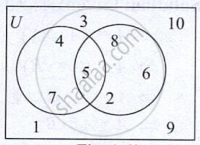
(i) (A ∪ В)'
(ii) (A ∩ B)'
In the adjoining Venn diagram, shade the following set.
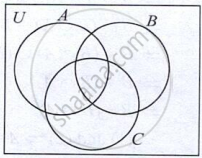
A' ∩ (B ∪ C)
In the adjoining Venn diagram, shade the following set.
A' ∩ (C − B)
O.P. Malhotra, S.K. Gupta, Anubhuti Gangal solutions for Applied Mathematics [English] Class 11 ISC 1 Sets EXERCISE 1(M) [Pages 43 - 44]
MULTIPLE CHOICE QUESTIONS (MCQs)
If A = {1, 2, 3, 4, 5}, and B = {2, 4, 6} then A − B is equal to:
{1, 3, 5, 6}
{0, 1, 3, 5, 6}
{1, 3, 5}
{2, 4}
If A = {x | x ∈ N, x is a prime number less than 12} and B = {x | x ∈ N, x is a factor of 10}, then A ∩ B = ______.
{2}
{2, 5}
{2, 5, 10}
{1, 2, 5, 10}
Two sets A and B have 27 and 33 elements, respectively. If (A ∪ B) contains 48 elements, then how many elements are there in (A ∩ B)?
6
9
12
15
A set T is given as T = {x ∈ R | (x − 3) = (x + 4)2, x < 2}. Which of these would be true about the set T?
T is the empty set
T is a singleton set
x = 3 is a member of T
x = −4 is a member of T
Write the set builder form of A = {−1, 1}
A = {x : x is an integer}
A = {x : x is a root of the equation x2 + 1 = 0}
A = {x : x is a real number}
A = {x : x is a root of the equation x2 = 1}
If a set A has 4 elements, then the total number of proper subsets of set A, is:
16
14
15
17
If A = {1, 2, 3}, B = {3, 4} and C = {4, 5, 6} then A ∪ (B ∩ C) is equal to:
{1, 2}
{\(\phi\)}
{4, 5}
{1, 2, 3, 4}
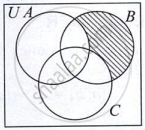
The shaded region in the figure represents
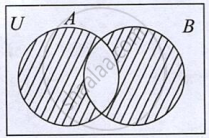
A ∩ B
A ∪ В
B − A
A − B
(A − B) ∪ (B − А)
If A = {x : x is a square of a natural number and x < 100} and B is a set of even natural numbers, then what is the cardinality of A ∩ B:
4
5
9
None of these
Let S = set of points inside the square, T = the set of points inside the triangle and C = the set of points inside the circle. If the triangle and circle intersect each other and are contained in a square. Then ______.
S ∩ T ∩ C = Φ
S ∪ T ∪ C = C
S ∪ T ∪ C = S
S ∪ T = S ∩ C
What does the shaded region in the figure represent?
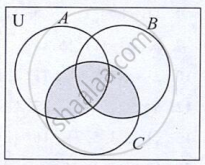
(A ∩ B) ∩ C
(A ∪ B) ∩ C
(A ∪ B) − C
None of these
A, B and C are three sets and U is the universal set such that n(U) = 700, n(A) = 200, n(B) = 300 and n(A ∩ B) = 100, then what is the value of n(A' ∩ B')?
100
200
300
400
The set (A ∩ B′)′ ∪ (B ∩ C) is equal to ______.
A′ ∪ B ∪ C
A′ ∪ B
A′ ∪ C′
A′ ∩ B
If X = {8n – 7n – 1 | n ∈ N} and Y = {49n – 49 | n ∈ N}. Then ______.
X ⊂ Y
Y ⊂ X
X = Y
X ∩ Y = Φ
Let U = {x ∈ N : 1 ≤ x ≤ 10} be the universal set, N being the set of natural numbers. If A = {1, 2, 3, 4} and B = {2, 3, 6, 10}, then what is the complement of (A – В)?
{6, 10}
{1, 4}
{2, 3, 5, 6, 7, 8, 9, 10}
{5, 6, 7, 8, 9, 10}
Two finite sets have m and n elements. The number of subsets of the first set is 112 more than that of the second set. The values of m and n are, respectively ______.
4, 7
7, 4
4, 4
7, 7
If A = {x, y} then the power set of A is
{xy, yx}
{\(\phi\), x, y}
{\(\phi\), {x}, {y}}
{\(\phi\), {x}, {y}, {x, y}}
In a class of 60 students, 25 students play cricket and 20 students play tennis, and 10 students play both the games. Then, the number of students who play neither is ______.
0
25
35
45
If A and B are two sets, then (A ∪ B)′ ∪ (A′ ∩ B) is
A′
A
B′
None of these
A and B are subsets of the universal set U such that n(U) = 800, n(A) = 300, n(B) = 400, and n(A ∩ B) = 100. The number of elements in the set A' ∩ B' is:
100
200
300
400
Solutions for 1: Sets
O.P. Malhotra, S.K. Gupta, Anubhuti Gangal solutions for Applied Mathematics [English] Class 11 ISC chapter 1 - Sets
Shaalaa.com has the CISCE Mathematics Applied Mathematics [English] Class 11 ISC CISCE solutions in a manner that help students grasp basic concepts better and faster. The detailed, step-by-step solutions will help you understand the concepts better and clarify any confusion. O.P. Malhotra, S.K. Gupta, Anubhuti Gangal solutions for Mathematics Applied Mathematics [English] Class 11 ISC CISCE 1 (Sets) include all questions with answers and detailed explanations. This will clear students' doubts about questions and improve their application skills while preparing for board exams.
Further, we at Shaalaa.com provide such solutions so students can prepare for written exams. O.P. Malhotra, S.K. Gupta, Anubhuti Gangal textbook solutions can be a core help for self-study and provide excellent self-help guidance for students.
Concepts covered in Applied Mathematics [English] Class 11 ISC chapter 1 Sets are .
Using O.P. Malhotra, S.K. Gupta, Anubhuti Gangal Applied Mathematics [English] Class 11 ISC solutions Sets exercise by students is an easy way to prepare for the exams, as they involve solutions arranged chapter-wise and also page-wise. The questions involved in O.P. Malhotra, S.K. Gupta, Anubhuti Gangal Solutions are essential questions that can be asked in the final exam. Maximum CISCE Applied Mathematics [English] Class 11 ISC students prefer O.P. Malhotra, S.K. Gupta, Anubhuti Gangal Textbook Solutions to score more in exams.
Get the free view of Chapter 1, Sets Applied Mathematics [English] Class 11 ISC additional questions for Mathematics Applied Mathematics [English] Class 11 ISC CISCE, and you can use Shaalaa.com to keep it handy for your exam preparation.
