If n(𝜉) = 80, n(A) = 48, n(B) = 40 and n(A ∩ B) = 25, draw a Venn diagram to find: (i) n(A ∪ B) (ii) n(A ∪ B)' (iii) n(A − В) (iv) n(B − А) (v) n(A ∩ B)' (vi) n(A' ∩ B)
Advertisements
Question
If \[\text{n}(\xi)\] = 80, n(A) = 48, n(B) = 40 and n(A ∩ B) = 25, draw a Venn diagram to find:
(i) n(A ∪ B)
(ii) n(A ∪ B)'
(iii) n(A − В)
(iv) n(B − А)
(v) n(A ∩ B)'
(vi) n(A' ∩ B)
Advertisements
Solution
Given: \[\text{n}(\xi)\] = 80, n(A) = 48, n(B) = 40 and n(A ∩ B) = 25
From the given values:
Number of elements only in A: n(A − B) = n(A) − n(A ∩ B)
= 48 − 25
= 23
Number of elements only in B: n(B − A) = n(B) − n(A ∩ B)
= 40 − 25
= 15
Number of elements outside both A and B: n(A ∪ B)' = 80 − (23 + 25 + 15)
= 80 − 63
= 17
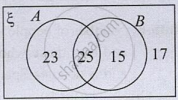
The Venn diagram above displays the number of elements in each disjoint region of sets A and B inside the universal set \[\xi\].
From the Venn diagram:
(i) n(A ∪ B) = 23 + 25 + 15 = 63
(ii) n(A ∪ B)' = \[\text{n}(\xi)\] − n(A ∪ B)
= 80 − 63
= 17
(iii) n(A − B) = n(A) − n(A ∩ B)
= 48 − 25
= 23
(iv) n(B − A) = n(B) − n(A ∩ B)
= 40 − 25
= 15
(v) n(A ∩ B)' = \[\text{n}(\xi)\] − n(A ∩ B)
= 80 − 25
= 55
(vi) n(A' ∩ B) = n(B − A)
= 40 − 25
= 15
