Advertisements
Online Mock Tests
Chapters
1: Bricks, Beads And Bones: The Harappan Civilisation
2: Kings, Farmers And Towns: Early States and Economies
3: Kinship, Caste And Class: Early Societies
4: Thinkers, Beliefs And Buildings: Cultural Developments
Part 2
5: Through The Eyes Of Travellers: Perceptions of Society
6: Bhakti –Sufi Traditions: Changes in Religious Beliefs and Devotional Texts
7: An Imperial Capital: Vijayanagara
8: Peasants, Zamindars And The State: Agrarian Society and the Mughal Empire
Part 3
▶ 9: Colonialism And The Countryside: Exploring Official Archives
10: Rebels And The Raj: 1857 Revolt and its Representations
11: Mahatma Gandhi And The Nationalist Movement: Civil Disobedience and Beyond
12: Framing The Constitution: The Beginning of a New Era
![NCERT solutions for Themes In Indian History Part I, II, and III [English] Class 12 chapter 9 - Colonialism And The Countryside: Exploring Official Archives - Shaalaa.com](/images/themes-in-indian-history-part-i-ii-and-iii-english-class-12_6:81c2d22dfccf437dbdcef1d2cd896e40.jpg "NCERT solutions for Themes In Indian History Part I, II, and III [English] Class 12 chapter 9 - Colonialism And The Countryside: Exploring Official Archives")
Advertisements
Solutions for Chapter 9: Colonialism And The Countryside: Exploring Official Archives
Below listed, you can find solutions for Chapter 9 of CBSE NCERT for Themes In Indian History Part I, II, and III [English] Class 12.
NCERT solutions for Themes In Indian History Part I, II, and III [English] Class 12 9 Colonialism And The Countryside: Exploring Official Archives Intext Questions [Pages 232 - 255]
Read the text accompanying the figure below carefully and insert the following terms in appropriate places along the arrows: rent, revenue, interest, loan, produce.
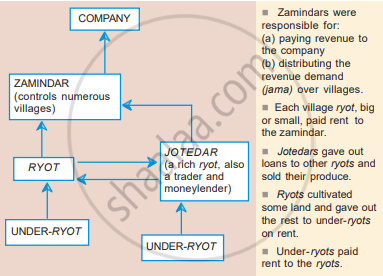
|
Buchanan described the ways in which the jotedars of Dinajpur in North Bengal resisted being disciplined by the zamindar and undermined his power: Landlords do not like this class of men, but it is evident that they are absolutely necessary, unless the landlords themselves would advance money to their necessitous tenantry … The jotedars who cultivate large portions of lands are very refractory, and know that the zamindars have no power over them. They pay only a few rupees on account of their revenue and then fall in balance almost every kist (instalment); they hold more lands than they are entitled to by their pottahs (deeds of contract). Should the zamindar’s officers, in consequence, summon them to the cutcherry, and detain them for one or two hours with a view to reprimand them, they immediately go and complain at the Fouzdarry Thanna (police station) for imprisonment and at the munsiff ’s (a judicial officer at the lower court) cutcherry for being dishonoured and whilst the causes continue unsettled, they instigate the petty ryots not to pay their revenue consequently … |
Describe the ways in which the jotedars resisted the authority of the zamindars.
|
Referring to the condition of zamindars and the auction of lands, the Fifth Report stated: The revenue was not realised with punctuality, and lands to a considerable extent were periodically exposed to sale by auction. In the native year 1203, corresponding with 1796-97, the land advertised for sale comprehended a jumma or assessment of sicca rupees 28,70,061, the extent of land actually sold bore a jumma or assessment of 14,18,756, and the amount of purchase money sicca rupees 17,90,416. In 1204, corresponding with 1797-98, the land advertised was for sicca rupees 26,66,191, the quantity sold was for sicca rupees 22,74,076, and the purchase money sicca rupees 21,47,580. Among the defaulters were some of the oldest families of the country. Such were the rajahs of Nuddea, Rajeshaye, Bishenpore (all districts of Bengal), … and others, the dismemberment of whose estates at the end of each succeeding year threatened them with poverty and ruin, and in some instances presented difficulties to the revenue officers in their efforts to preserve undiminished the amount of public assessment. |
From the tone in which evidence is recorded, what do you think is the attitude of the report to the facts narrated? What is the Report trying to say through the figures? Can you think of any problem in making long-term generalisations from these figures of two years?
Discuss
Compare the account of the zamindars in “the Fifth Report” with that in “Peasants, Zamindars and the State.”
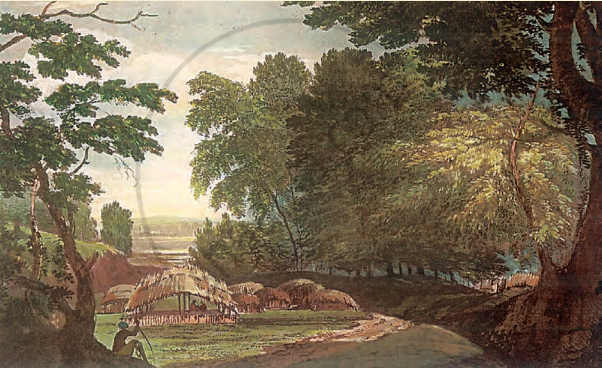
Look at the painting and identify the ways in which it represents the traditions of the picturesque.
Look at the figures below. Describe how the pictures represent the relationship between tribal people and nature.
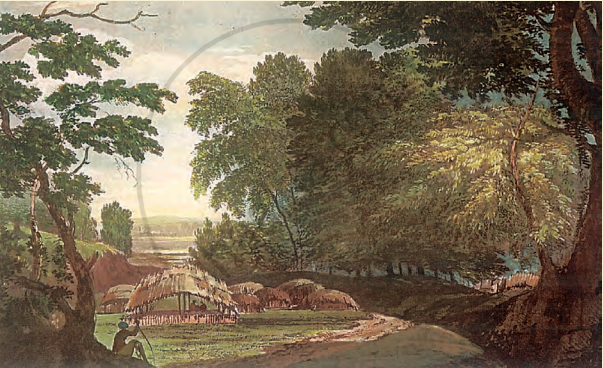
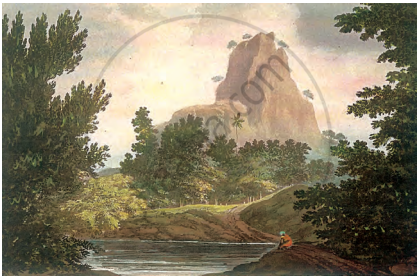
Contrast the image of the Santhal village with the painting “Santhals Fight the Sepoys of the British Raj.”
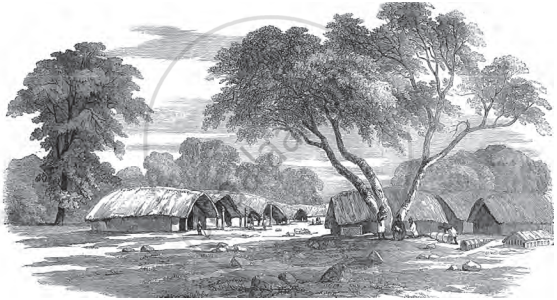
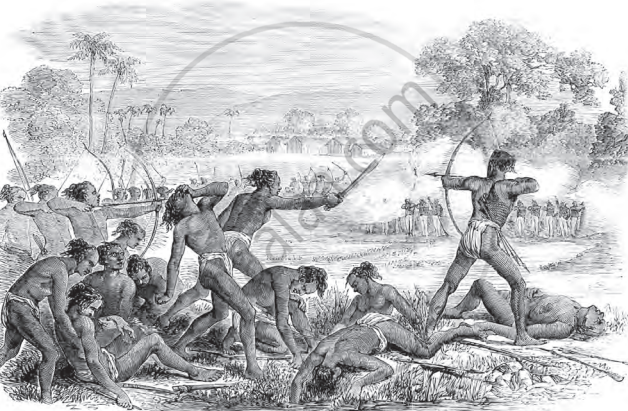
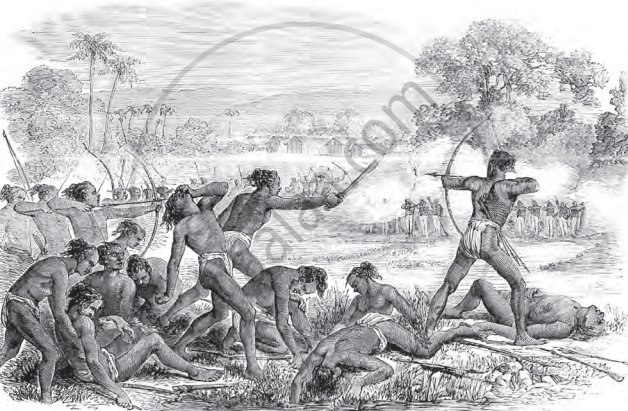
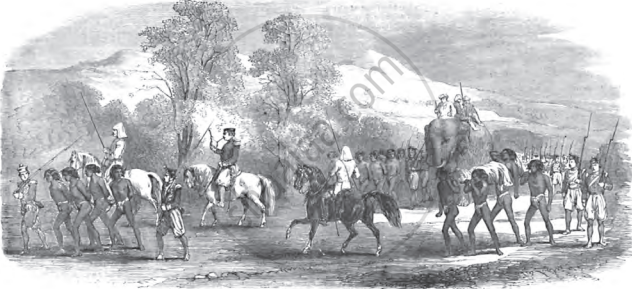
Imagine you are a reader of the Illustrated London News in England. How will you react to the images depicted in the following figures? What image of the Santhals would these pictures create in your mind?
Discuss
What does Buchanan’s description tell us about his ideas of development? Illustrate your argument by quoting from the excerpts. If you were a Paharia forest dweller, how would you have reacted to these ideas?
|
The following report, titled ‘The ryot and the moneylender’, appeared in the Native Opinion (6 June 1876) and was quoted in Report of the Native Newspapers of Bombay: They (the ryots) first place spies on the boundaries of their villages to see if any Government officers come, and to give timely intimation of their arrival to the offenders. They then assemble in a body and go to the houses of their creditors, and demand from them a surrender of their bonds and other documents, and threaten them in case of refusal with assault and plunder. If any Government officer happens to approach the villages where the above is taking place, the spies give intimation to the offenders and the latter disperse in time. |
The words and terms used by a writer often tell us something about his or her prejudices. Read the above source carefully and pick out the terms that indicate any prejudices of the writer. Discuss how a ryot of the area would have described the same situation.
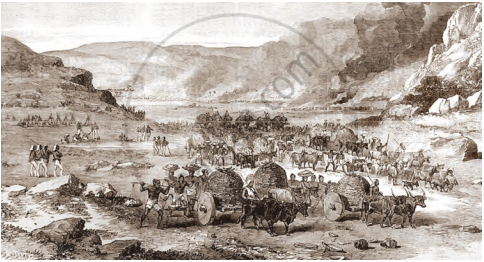
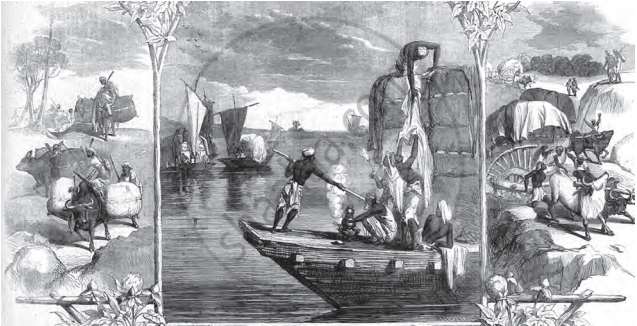
The three panels in the following figure depict different modes of transporting cotton. Notice the bullocks collapsing under the weight of the cotton, the boulders on the road, and the huge pile of bales on the boat. What is the artist suggesting through these images?
|
This is an example of a petition from a ryot of the village of Mirajgaon, Taluka Karjat, to the Collector, Ahmednagar, Deccan Riots Commission: The sowkars (sahukars)… have of late begun to oppress us. As we cannot earn enough to defray our household expenses, we are actually forced to beg of them to provide us with money, clothes and grain, which we obtain from them not without great difficulty, nor without their compelling us to enter into hard conditions in the bond. Moreover, the necessary clothes and grain are not sold to us at cash rates. The prices asked from us are generally twenty-five or fifty per cent more than demanded from customers making ready money payments … The produce of our fields is also taken by the sowkars, who at the time of removing it assure us that it will be credited to our account, but they do not actually make any mention of it in the accounts. They also refuse to pass us any receipts for the produce so removed by them. |
Explain the complaints that the ryot is making in the petition. Why was the harvest taken by the moneylenders not credited to the peasants’ account? Why were peasants not given any receipts? If you were a moneylender, what reasons would you give for these practices?
|
When debts mounted, the peasant was unable to pay back the loan to the moneylender. He had no option but to give over all his possessions – land, carts, and animals – to the moneylender. But without animals he could not continue to cultivate. So he took land on rent and animals on hire. He now had to pay for the animals which had originally belonged to him. He had to sign a deed of hire stating very clearly that these animals and carts did not belong to him. In cases of conflict, these deeds could be enforced through the court. The following is the text of a deed that a peasant signed in November 1873, from the records of the Deccan Riots Commission: I have sold to you, on account of the debt due to you, my two carriages having iron axles, with their appurtenances and four bullocks … I have taken from you on hire under (this) deed the very same two carriages and four bullocks. I shall pay every month the hire thereof at Rupees four a month, and obtain a receipt in your own handwriting. In the absence of a receipt, I shall not contend that the hire had been paid. |
List all the commitments that the peasant is making in this deed. What does such a deed of hire tell us about the relationship between the peasant and the moneylender? How would it change the relationship between the peasant and the bullocks he previously owned?
|
In a petition to the Deccan Riots Commission, a ryot explained how the system of loans worked: A sowkar lends his debtor Rs 100 on bond at Rs 3-2 annas per cent per mensem. The latter agrees to pay the amount within eight days from the passing of the bond. Three years after the stipulated time for repaying the amount, the sowkar takes from his debtor another bond for the principal and interest together at the same rate of interest, and allows him 125 days’ time to liquidate the debt. After the lapse of 3 years and 15 days, a third bond is passed by the debtor … (this process is repeated) at the end of 12 years … his interest on Rs 1000 amounts to Rs 2028-10 annas -3 paise. |
Calculate the rate of interest that the ryot was paying over the years.
Discuss
Check what rates of interest are charged in the region where you live at present. Find out whether these rates have changed over the last 50 years. Is there a variation in the rates paid by different groups of people? What are the reasons for the differences?
NCERT solutions for Themes In Indian History Part I, II, and III [English] Class 12 9 Colonialism And The Countryside: Exploring Official Archives Exercises [Pages 256 - 257]
Answer in 100-150 Words
Why Was the Jotedar a Powerful Figure in Many Areas of Rural Bengal?
Answer in 100-150 Words
How Did Zamindars Manage to Retain Control Over Their Zamindaris?
Answer in 100-150 words.
How Did the Paharias Respond to the Coming of Outsiders?
Answer in 100-150 Words
Why Did the Santhals Rebel Against British Rule?
Answer in 100-150 Words
What Explains the Anger of the Deccan Ryots Against the Moneylenders?
Write a short essay (250-300 words) on the following:
Why were many zamindaris auctioned after the Permanent Settlement?
Write a short essay (250-300 words) on the following:
In what way was the livelihood of the Paharias different from that of the Santhals?
Write a Short Essay (250-300 Words) on the Following:
How Did the American Civil War Affect the Lives of Ryots in India?
Write a short essay (250-300 words) on the following:
What are the problems of using official sources in writing about the history of peasants?
Map work
On an outline map of the subcontinent, mark out the areas described in this chapter. Find out whether there were other areas where the Permanent Settlement and the ryotwari system were prevalent and plot these on the map as well.
Projects (choose one)
Francis Buchanan published reports on several districts of eastern India. Read one report and collate the information available about rural society, focusing on the themes discussed in “Colonialism and the Countryside: Exploring Official Archives.” Highlight the ways in which historians can use such texts.
In the region where you live, talk to the older people within a rural community and visit the fields they now cultivate. Find out what they produce, how they earn their livelihoods, what their parents did, what their sons and daughters do now, and how their lives have changed over the last 75 years. Write a report based on your findings.
Solutions for 9: Colonialism And The Countryside: Exploring Official Archives
NCERT solutions for Themes In Indian History Part I, II, and III [English] Class 12 chapter 9 - Colonialism And The Countryside: Exploring Official Archives
Shaalaa.com has the CBSE Mathematics Themes In Indian History Part I, II, and III [English] Class 12 CBSE solutions in a manner that help students grasp basic concepts better and faster. The detailed, step-by-step solutions will help you understand the concepts better and clarify any confusion. NCERT solutions for Mathematics Themes In Indian History Part I, II, and III [English] Class 12 CBSE 9 (Colonialism And The Countryside: Exploring Official Archives) include all questions with answers and detailed explanations. This will clear students' doubts about questions and improve their application skills while preparing for board exams.
Further, we at Shaalaa.com provide such solutions so students can prepare for written exams. NCERT textbook solutions can be a core help for self-study and provide excellent self-help guidance for students.
Concepts covered in Themes In Indian History Part I, II, and III [English] Class 12 chapter 9 Colonialism And The Countryside: Exploring Official Archives are Bengal and the Zamindars, The Hoe and the Plough, A Revolt in the Countryside the Bombay Deccan, The Deccan Riots Commission, Overview of Colonalism and The Countryside Exploring Official Archives, Overview of Colonalism and The Countryside Exploring Official Archives.
Using NCERT Themes In Indian History Part I, II, and III [English] Class 12 solutions Colonialism And The Countryside: Exploring Official Archives exercise by students is an easy way to prepare for the exams, as they involve solutions arranged chapter-wise and also page-wise. The questions involved in NCERT Solutions are essential questions that can be asked in the final exam. Maximum CBSE Themes In Indian History Part I, II, and III [English] Class 12 students prefer NCERT Textbook Solutions to score more in exams.
Get the free view of Chapter 9, Colonialism And The Countryside: Exploring Official Archives Themes In Indian History Part I, II, and III [English] Class 12 additional questions for Mathematics Themes In Indian History Part I, II, and III [English] Class 12 CBSE, and you can use Shaalaa.com to keep it handy for your exam preparation.
