Advertisements
Online Mock Tests
Chapters
1: Bricks, Beads And Bones: The Harappan Civilisation
2: Kings, Farmers And Towns: Early States and Economies
3: Kinship, Caste And Class: Early Societies
4: Thinkers, Beliefs And Buildings: Cultural Developments
Part 2
5: Through The Eyes Of Travellers: Perceptions of Society
▶ 6: Bhakti –Sufi Traditions: Changes in Religious Beliefs and Devotional Texts
7: An Imperial Capital: Vijayanagara
8: Peasants, Zamindars And The State: Agrarian Society and the Mughal Empire
Part 3
9: Colonialism And The Countryside: Exploring Official Archives
10: Rebels And The Raj: 1857 Revolt and its Representations
11: Mahatma Gandhi And The Nationalist Movement: Civil Disobedience and Beyond
12: Framing The Constitution: The Beginning of a New Era
![NCERT solutions for Themes In Indian History Part I, II, and III [English] Class 12 chapter 6 - Bhakti –Sufi Traditions: Changes in Religious Beliefs and Devotional Texts - Shaalaa.com](/images/themes-in-indian-history-part-i-ii-and-iii-english-class-12_6:81c2d22dfccf437dbdcef1d2cd896e40.jpg "NCERT solutions for Themes In Indian History Part I, II, and III [English] Class 12 chapter 6 - Bhakti –Sufi Traditions: Changes in Religious Beliefs and Devotional Texts")
Advertisements
Solutions for Chapter 6: Bhakti –Sufi Traditions: Changes in Religious Beliefs and Devotional Texts
Below listed, you can find solutions for Chapter 6 of CBSE NCERT for Themes In Indian History Part I, II, and III [English] Class 12.
NCERT solutions for Themes In Indian History Part I, II, and III [English] Class 12 6 Bhakti –Sufi Traditions: Changes in Religious Beliefs and Devotional Texts Intext Questions [Pages 143 - 165]
Discuss
Find out about gods and goddesses worshipped in your town or village, noting their names and the ways in which they are depicted. Describe the rituals that are performed.
|
This is an excerpt from a composition of an Alvar named Tondaradippodi, who was a Brahmana: You (Vishnu) manifestly like those “servants” who express their love for your feet, though they may be born outcastes, more than the Chaturvedins who are strangers and without allegiance to your service. |
Do you think Tondaradippodi was opposed to the caste system?
|
This is a verse composed by Appar, a Nayanar saint: O rogues who quote the law books, Of what use are your gotra and kula? Just bow to Marperu’s lord (Shiva who resides in Marperu, in Thanjavur, Tamil Nadu) as your sole refuge. |
Are there any similarities or differences in the attitudes of Tondaradippodi and Appar towards Brahmanas?
|
This is an excerpt from a poem by Karaikkal Ammaiyar in which she describes herself: The female Pey (demoness) with . . . bulging veins, protruding eyes, white teeth and shrunken stomach, red haired and jutting teeth lengthy shins extending till the ankles, shouts and wails while wandering in the forest. This is the forest of Alankatu, which is the home of our father (Shiva) who dances … with his matted hair thrown in all eight directions, and with cool limbs. |
List the ways in which Karaikkal Ammaiyar depicts herself as presenting a contrast to traditional notions of feminine beauty.
Discuss
Why do you think kings were interested in proclaiming their connections with bhaktas?
|
Here is a vachana composed by Basavanna: When they see a serpent carved in stone, they pour milk on it. If a real serpent comes, they say: “Kill. Kill.” To the servant of the god who could eat if served they say: “Go away! Go away!” But to the image of the god which cannot eat, they offer dishes of food. |
Describe Basavanna’s attitude towards rituals. How does he attempt to convince the listener?
|
This is an excerpt from a farman (imperial order) issued by Akbar in 1598: Whereas it reached our eminent and holy notice that the padris (fathers) of the Holy Society of Jesus wish to build a house of prayer (church) in the city of Kambayat (Khambat, in Gujarat); therefore an exalted mandate … is being issued, … that the dignitaries of the city of Kambayat should in no case stand in their way but should allow them to build a church so that they may engage themselves in their own worship. It is necessary that the order of the Emperor should be obeyed in every way. |
Who were the people from whom Akbar anticipated opposition to his order?
|
Here is an excerpt from a letter written by Aurangzeb to a Jogi in 1661-62: The possessor of the sublime station, Shiv Murat, Guru Anand Nath Jio! May your Reverence remain in peace and happiness ever under the protection of Sri Shiv Jio! … A piece of cloth for the cloak and a sum of twenty-five rupees, which have been sent as an offering, will reach (Your Reverence) … Your Reverence may write to us whenever there is any service which can be rendered by us. |
Identify the deity worshipped by the Jogi. Describe the attitude of the emperor towards the Jogi.
Discuss
Find out more about the architecture of mosques in your village or town. What are the materials used to build mosques? Are these locally available? Are there any distinctive architectural features?
Are there any khanqahs or dargahs in your town or village? Find out when these were built, and what are the activities associated with them. Are there other places where religious men and women meet or live?
Describe how the artist differentiates between the Shaikh and his disciple.
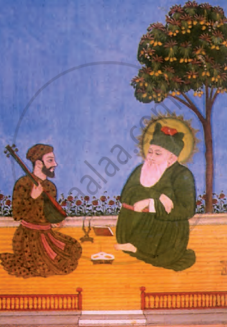
Find his signature on the painting.
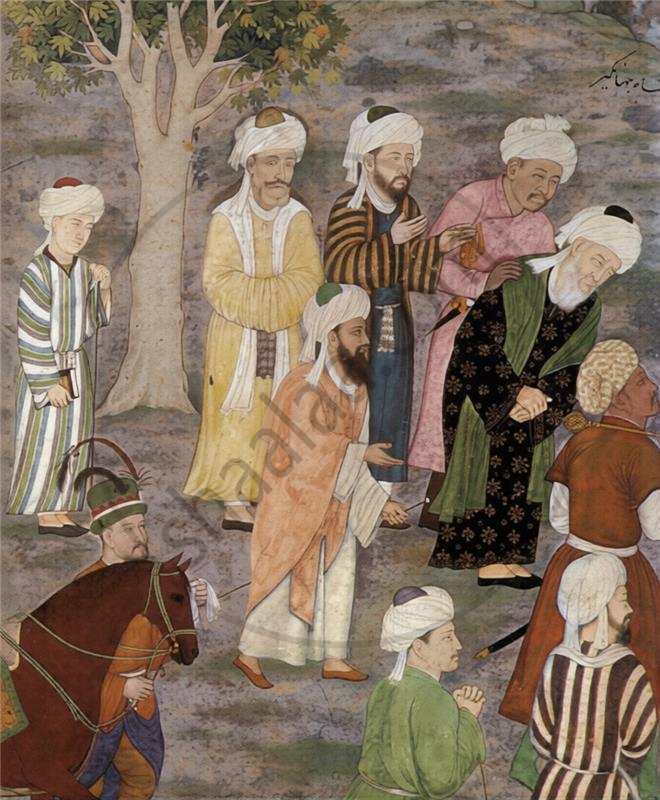
|
The following is an excerpt from Jahanara’s biography of Shaikh Muinuddin Chishti, titled Munis al Arwah (The Confidant of Spirits): After praising the one God … this lowly faqira (humble soul) Jahanara ... went from the capital Agra in the company of my great father (Emperor Shah Jahan) towards the pure region of incomparable Ajmer … I was committed to this idea, that every day in every station I would perform two cycles of optional prayer … For several days ... I did not sleep on a leopard skin at night, I did not extend my feet in the direction of the blessed sanctuary of the revered saving master, and I did not turn my back towards him. I passed the days beneath the trees. On Thursday, the fourth of the blessed month of Ramzan, I attained the happiness of pilgrimage to the illuminated and the perfumed tomb … With an hour of daylight remaining, I went to the holy sanctuary and rubbed my pale face with the dust of that threshold. From the doorway to the blessed tomb I went barefoot, kissing the ground. Having entered the dome, I went around the light-filled tomb of my master seven times … Finally, with my own hand I put the finest quality of itar on the perfumed tomb of the revered one, and having taken off the rose scarf that I had on my head, I placed it on the top of the blessed tomb ... |
What are the gestures that Jahanara records to indicate her devotion to the Shaikh? How does she suggest that the dargah was a special place?
|
A song set to the rhythm of the spinning wheel: As you take the cotton, you do zikr-i jali |
In what ways are the ideas and modes of expression used in this song similar to or different from those used by Jahanara to describe her ziyarat (The pilgrimage of the Mughal princess Jahanara, 1643)?
Discuss
What are the potential sources of conflict in the relationship between religious and political leaders?
|
This excerpt from a Sufi text describes the proceedings at Shaikh Nizamuddin Auliya’s hospice in 1313: I (the author, Amir Hasan Sijzi) had the good fortune of kissing his (Shaikh Nizamuddin Auliya’s) feet … At this time a local ruler had sent him the deed of ownership to two gardens and much land, along with the provisions and tools for their maintenance. The ruler had also made it clear that he was relinquishing all his rights to both the gardens and land. The master … had not accepted that gift. Instead, he had lamented: “What have I to do with gardens and fields and lands? … None of … our spiritual masters had engaged in such activity.” Then he told an appropriate story: “… Sultan Ghiyasuddin, who at that time was still known as Ulugh Khan, came to visit Shaikh Fariduddin (and) offered some money and ownership deeds for four villages to the Shaikh, the money being for the benefit of the dervishes (sufis), and the land for his use. Smiling, Shaikh al Islam (Fariduddin) said: ‘Give me the money. I will dispense it to the dervishes. But as for those land deeds, keep them. There are many who long for them. Give them away to such persons.’” |
What aspects of the relationship between the Sufis and the state do you think are best illustrated in this account? What does the account tell us about the modes of communication between the Shaikh and his disciples?
|
Here is a composition attributed to Kabir: Tell me, brother, how can there be |
What is Kabir’s argument against the distinction made between gods of different communities?
|
This is part of a song attributed to Mirabai: I will build a funeral pyre of sandalwood and aloe; In another verse, she sings: |
What does this indicate about Mirabai’s attitude towards the king?
Discuss
Why do you think the traditions of Kabir, Baba Guru Nanak and Mirabai remain significant in the twenty-first century?
NCERT solutions for Themes In Indian History Part I, II, and III [English] Class 12 6 Bhakti –Sufi Traditions: Changes in Religious Beliefs and Devotional Texts Exercises [Pages 168 - 169]
Answer in100-150 words
Explain with examples what historians mean by the integration of cults.
Answer in 100-150 words
To what extent do you think the architecture of mosques in the subcontinent reflects a combination of universal ideals and local traditions?
Answer in100-150 words
What were the similarities and differences between the be-shari‘a and ba-shari‘a sufi traditions?
Answer in100-150 words
Discuss the ways in which the Alvars, Nayanars and Virashaivas expressed critiques of the caste system.
Answer in 100-150 words.
Describe the major teachings of either Kabir or Baba Guru Nanak, and the ways in which these have been transmitted.
Write a short essay (about 250-300 words) on the following:
Discuss the major beliefs and practices that characterised Sufism.
Write a short essay (about 250-300 words) on the following:
Examine how and why rulers tried to establish connections with the traditions of the Nayanars and the sufis.
Write a short essay (about 250-300 words) on the following:
Analyse, with illustrations, why bhakti and sufi thinkers adopted a variety of languages in which to express their opinions.
Write a short essay (about 250-300 words) on the following:
Read any five of the sources included in this chapter and discuss the social and religious ideas that are expressed in them.
Map work
On an outline map of India, plot three major sufi shrines, and three places associated with temples (one each of a form of Vishnu, Shiva and the goddess).
Projects (choose one)
Choose any two of the religious teachers/thinkers/saints mentioned in “Bhakti-Sufi Traditions: Changes in Religious Beliefs and Devotional Texts,” and find out more about their lives and teachings. Prepare a report about the area and the times in which they lived, their major ideas, how we know about them, and why you think they are important.
Find out more about the practices of pilgrimage associated with the shrines mentioned in “Bhakti-Sufi Traditions: Changes in Religious Beliefs and Devotional Texts.” Are these pilgrimages still undertaken? When are these shrines visited? Who visits these shrines? Why do they do so? What are the activities associated with these pilgrimages?
Solutions for 6: Bhakti –Sufi Traditions: Changes in Religious Beliefs and Devotional Texts
NCERT solutions for Themes In Indian History Part I, II, and III [English] Class 12 chapter 6 - Bhakti –Sufi Traditions: Changes in Religious Beliefs and Devotional Texts
Shaalaa.com has the CBSE Mathematics Themes In Indian History Part I, II, and III [English] Class 12 CBSE solutions in a manner that help students grasp basic concepts better and faster. The detailed, step-by-step solutions will help you understand the concepts better and clarify any confusion. NCERT solutions for Mathematics Themes In Indian History Part I, II, and III [English] Class 12 CBSE 6 (Bhakti –Sufi Traditions: Changes in Religious Beliefs and Devotional Texts) include all questions with answers and detailed explanations. This will clear students' doubts about questions and improve their application skills while preparing for board exams.
Further, we at Shaalaa.com provide such solutions so students can prepare for written exams. NCERT textbook solutions can be a core help for self-study and provide excellent self-help guidance for students.
Concepts covered in Themes In Indian History Part I, II, and III [English] Class 12 chapter 6 Bhakti –Sufi Traditions: Changes in Religious Beliefs and Devotional Texts are New Devotional Paths Dialogue and Dissent in Northern India, Reconstructing Histories of Religious Traditions, A Mosaic of Religious Beliefs and Practices, Poems of Prayer Early Traditions of Bhakti, The Virashaiva Tradition in Karnataka, Religious Ferment in North India, New Strands in the Fabric Islamic Traditions, The Growth of Sufism, The Chishtis in the Subcontinent, Bhakti-Sufi Traditions Changes in Religious Beliefs and Devotional Texts (c. eighth to eighteenth centuries), Bhakti-Sufi Traditions Changes in Religious Beliefs and Devotional Texts (c. eighth to eighteenth centuries).
Using NCERT Themes In Indian History Part I, II, and III [English] Class 12 solutions Bhakti –Sufi Traditions: Changes in Religious Beliefs and Devotional Texts exercise by students is an easy way to prepare for the exams, as they involve solutions arranged chapter-wise and also page-wise. The questions involved in NCERT Solutions are essential questions that can be asked in the final exam. Maximum CBSE Themes In Indian History Part I, II, and III [English] Class 12 students prefer NCERT Textbook Solutions to score more in exams.
Get the free view of Chapter 6, Bhakti –Sufi Traditions: Changes in Religious Beliefs and Devotional Texts Themes In Indian History Part I, II, and III [English] Class 12 additional questions for Mathematics Themes In Indian History Part I, II, and III [English] Class 12 CBSE, and you can use Shaalaa.com to keep it handy for your exam preparation.
