Advertisements
Chapters
1: World Geography: Some Glimpses
Theme B - Tapestry of the Past
2: India’s Long Road to Independence
Theme C - Our Cultural Heritage and Knowledge Traditions
3: A Journey Through Indian Architecture
Theme D - Governance and Democracy
4: The Role of the Judiciary in Our Society
▶ 5: Citizenship: Rights and Duties
Theme E - Economic Life Around Us
6: Dynamics of Population
7: India’s Urban Landscape
8: Cultural Currents: 13th to 17th Centuries
![NCERT solutions for Social Science Exploring Society India and Beyond Part 2 [English] Class 8 chapter 5 - Citizenship: Rights and Duties - Shaalaa.com](/images/social-science-exploring-society-india-and-beyond-part-2-english-class-8_6:d01fdcd1fdf244fc869f361ef89f5af3.png "NCERT solutions for Social Science Exploring Society India and Beyond Part 2 [English] Class 8 chapter 5 - Citizenship: Rights and Duties")
Advertisements
Solutions for Chapter 5: Citizenship: Rights and Duties
Below listed, you can find solutions for Chapter 5 of CBSE NCERT for Social Science Exploring Society India and Beyond Part 2 [English] Class 8.
NCERT solutions for Social Science Exploring Society India and Beyond Part 2 [English] Class 8 5 Citizenship: Rights and Duties Intext Questions [Pages 143 - 163]
The Big Questions
What does it mean to be a citizen, not just legally, but in everyday life?
Why are both rights and duties essential?
How can we help build a society where everyone is treated fairly, respected, and included?
LET’S EXPLORE
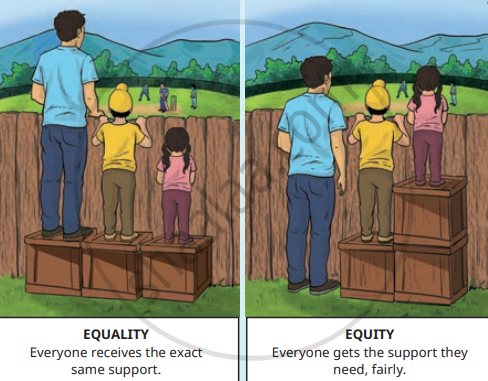
What do you observe in the illustrations above? As you can see, sometimes providing the same thing to every individual does not provide the same benefits on account of differences among them. These differences can be due to inequality and discrimination which may have been carried historically too. To be able to ensure that everyone gets the support they need, we look at the principle of equity (as you can see in the figure on the right). There are many initiatives taken by the government as well as civil society organisations to ensure that equity is established in such cases. The Beti Bachao Beti Padhao campaign was to build awareness in society as well as to provide support to girls’ education. Can you think of other such examples?
THINK ABOUT IT
It’s Sports Day at school. The weather is very hot. Some students are told to wear full school uniforms with shoes, even though they will be running, playing games, and spending time outdoors. A few students feel uncomfortable and wonder why they can’t wear lighter clothes like T-shirts and sports shoes for such activities. One student starts a discussion at break time. “Shouldn’t we be allowed to wear comfortable sports clothes on Sports Day?” Some classmates agree, saying that comfort and safety are important while playing sports. Others feel that wearing the school uniform shows discipline and equality among all students. A couple of teachers overhear the conversation and remind everyone that school rules about uniforms must be followed. Was the student exercising freedom of speech? Could they have raised their concern differently? How should schools handle student opinions?
DON’T MISS OUT
- Some countries have given rivers the same rights as people. Imagine if a tree could say, “Don’t cut me down!” In New Zealand, the Whanganui River is legally treated as a living being. Costa Rica, too, protects Nature’s rights in its Constitution.
- In 2017, the Uttarakhand High Court declared the rivers Ganga and Yamuna as legal entities, giving them the rights of a living person. The Court also appointed legal guardians responsible for protecting and conserving the rivers. However, this decision was suspended and ultimately overturned by the Supreme Court of India, who called it ‘legally unsustainable’. Why do you think some people want to give nature (like rivers and forests) legal rights, just like humans? How could this help protect the environment?
What would you do if you saw a child working instead of being in school? Discuss in class, then write one step you could take:
- Could you talk to your teacher or principal?
- Could you write to a child helpline?
“If I was asked to name any particular article in this Constitution as the most important an article without which this Constitution would be a nullity I could not refer to any other article except this one [right to constitutional remedies]. It is the very soul of the Constitution and the very heart of it…”, said Dr. B.R. Ambedkar during the Constituent Assembly Debates. Why is it important to have a way to protect rights?
DON’T MISS OUT
When the Indian Constitution came into effect in 1950, it had no Fundamental Duties. They were added in 1976 by an amendment to the Constitution. At first, there were 10 duties listed in Article 51A (Part IV-A). In 2002, the 11th duty was added, which stated that parents or guardians must make sure children between ages 6 and 14 years get an education.
Can you name a duty that matches your right to education?
Here are some everyday situations for reflection. Which right or duty is involved?
- Ravi decides not to join a protest march at school because he disagrees with it. Some classmates say they will exclude him from their group unless he joins.
- On School Culture Day, Rukmini wants to wear her family’s traditional dress from her village. Some students laugh at her and say she should wear ‘modern’ clothes instead.
- During the recess, some children were throwing chocolate wrappers on the playground, instead of the dustbin. The teacher then reminds them to keep their surroundings clean.
- In a mock youth parliament activity, students use a voting app to share their ideas for improving school facilities. Even those who live in remote areas are able to join in the discussion online.
Can we demand rights without doing our duties?
The following are two caselets. Read them individually and discuss the questions at the end in small groups.
- A group of students makes fun of Rohan’s weight; they nickname him ‘Drummy’. They make it difficult for him to join their football game, joking that he would be competing with the football. Everyone around notices this behaviour of the group.
- Mina’s school announced an overnight educational trip to a historical site. Many of her classmates were excited and enrolled immediately. Mina, however, did not; she knew that her family would not able to afford paying for it. When her friends found out, some started ignoring her, whispering to each other that she “wasn’t fun”, “never joined anything”, or “was not of their status”. Mina felt hurt and left out.
What are the types of discrimination you can identify in the examples given above? What would you do if you were part of the groups? Have you faced discrimination yourself? What did you do about it?
Imagine there is a student in your class who takes a little longer to read or write because they have a different way of learning. Sometimes during group work, others do not wait for them or forget to include them. What would you do in this situation? Could you support them by being patient, explaining something clearly, or making sure they get a chance to speak? What steps can you take to make your classroom more inclusive?
NCERT solutions for Social Science Exploring Society India and Beyond Part 2 [English] Class 8 5 Citizenship: Rights and Duties Questions and activities [Pages 165 - 166]
Why is it important to respect others’ religions?
How would you feel if you were left out of something?
If rights are guaranteed, why do we still see discrimination in society?
Can there ever be a conflict between rights and duties? Give an example.
How does respecting diversity strengthen democracy?
Do you think technology (social media, online platforms) makes it easier or harder to practise citizenship? Why?
Imagine everyone in society enjoyed rights but ignored their duties. What would life look like?
How can students your age practise inclusion in everyday school life?
What can be done in the following situation?
A school does not allow girls to join a mathematics or science club.
What can be done in the following situation?
A fellow student has dropped out of school because they are forced to work in a welding shop.
Make a classroom charter that outlines rights and duties, and ensures inclusion and prevents discrimination.
Solutions for 5: Citizenship: Rights and Duties
NCERT solutions for Social Science Exploring Society India and Beyond Part 2 [English] Class 8 chapter 5 - Citizenship: Rights and Duties
Shaalaa.com has the CBSE Mathematics Social Science Exploring Society India and Beyond Part 2 [English] Class 8 CBSE solutions in a manner that help students grasp basic concepts better and faster. The detailed, step-by-step solutions will help you understand the concepts better and clarify any confusion. NCERT solutions for Mathematics Social Science Exploring Society India and Beyond Part 2 [English] Class 8 CBSE 5 (Citizenship: Rights and Duties) include all questions with answers and detailed explanations. This will clear students' doubts about questions and improve their application skills while preparing for board exams.
Further, we at Shaalaa.com provide such solutions so students can prepare for written exams. NCERT textbook solutions can be a core help for self-study and provide excellent self-help guidance for students.
Concepts covered in Social Science Exploring Society India and Beyond Part 2 [English] Class 8 chapter 5 Citizenship: Rights and Duties are .
Using NCERT Social Science Exploring Society India and Beyond Part 2 [English] Class 8 solutions Citizenship: Rights and Duties exercise by students is an easy way to prepare for the exams, as they involve solutions arranged chapter-wise and also page-wise. The questions involved in NCERT Solutions are essential questions that can be asked in the final exam. Maximum CBSE Social Science Exploring Society India and Beyond Part 2 [English] Class 8 students prefer NCERT Textbook Solutions to score more in exams.
Get the free view of Chapter 5, Citizenship: Rights and Duties Social Science Exploring Society India and Beyond Part 2 [English] Class 8 additional questions for Mathematics Social Science Exploring Society India and Beyond Part 2 [English] Class 8 CBSE, and you can use Shaalaa.com to keep it handy for your exam preparation.
