Advertisements
Chapters
2: Cell: The Building Block of Life
3: Tissues in Action
4: Describing Motion Around Us
5: Exploring Mixtures and their Separation
6: How Forces Affect Motion
7: Work, Energy, and Simple Machines
8: Journey Inside the Atom
▶ 9: Atomic Foundations of Matter
10: Sound Waves: Characteristics and Applications
11: Reproduction: How Life Continues
12: Patterns in Life: Diversity and Classification
13: Earth as a System: Energy, Matter, and Life

Advertisements
Solutions for Chapter 9: Atomic Foundations of Matter
Below listed, you can find solutions for Chapter 9 of CBSE NCERT for Science Exploration [English] Class 9.
NCERT solutions for Science Exploration [English] Class 9 9 Atomic Foundations of Matter Intext Questions [Pages 162 - 180]
Think It Over

Water can be obtained from various sources. Are all these samples of water chemically identical?
Oxygen is sometimes represented as O and sometimes as O2 What is the difference between these symbols?
Why does dissolved salt in water conduct electricity, but sugar does not?
Think as a Scientist
You are given a chemical reaction in which zinc reacts with dilute hydrochloric acid to form zinc chloride and hydrogen gas.
Zinc + Hydrochloric acid (dilute) $$\rightarrow$$ Zinc chloride + Hydrogen
Design and perform an experiment to test the hypothesis that mass is conserved during the chemical reaction. You may use a set-up different from the one shown in Activity 9.2.
Pause and Ponder
A student burns 10 g of ethanol in an open beaker. After the reaction, no residue is left in the beaker. Does this mean the Law of Conservation of Mass is violated? Explain.
When 20 g of hydrogen reacts completely with 160 g of oxygen, how much water is formed according to the Law of Conservation of Mass?
A compound consists of 40% sulfur and 60% oxygen by mass. In a sample of the same compound containing 20 g of sulfur, what mass of oxygen must be present to satisfy the Law of Constant Proportions?
Carbon monoxide (CO) contains carbon and oxygen in the mass ratio of 3:4. How much oxygen will combine with 9 g of carbon to form carbon monoxide?
The Law of Definite Proportions holds true for compounds but not for mixtures. Give reason.
Students X and Y, both prepared an oxide of copper by combining copper and oxygen in the ratios of 4:1 and 8:2, respectively. Do their results justify the Law of Constant Proportions? Explain.
What if ...
atoms could combine in any ratio and not in a fixed ratio? How would this affect the substances around us?
Pause and Ponder
Assertion (A): 2 g of hydrogen combines with 16 g of oxygen to form 18 g of water.
Reason (R): According to Dalton’s Atomic Theory, atoms combine in a simple whole number ratio by mass to form compounds.
Choose the correct option:
Both A and R are true, and R is the correct explanation of A.
Both A and R are true, but R is not the correct explanation of A.
A is true, but R is false.
A is false, but R is true.
Nitrogen has five valence electrons. Draw the structure of the nitrogen molecule $$\left(\mathrm{N}_{2}\right).$$
The atomic number of fluorine is 9. Explain the formation of the fluorine molecule $$\left(\mathrm{F}_{2}\right).$$
Show the formation of the following molecule:
Carbon dioxide CO2
Show the formation of the following molecule:
Hydrogen sulfide H2S
Show the formation of the following molecule:
Ammonia NH3
Neon (atomic number 10) neither transfers nor shares its valence electrons. Explain.
What if ...
We could see atoms directly? How would it help scientists and what challenges would it cause?
Pause and Ponder
What kind of ion will oxygen (O) form?
Among magnesium and chlorine, magnesium atom can give two electrons to become \(\mathrm{Mg}^{2+}\). However, chlorine can take only one electron to become ______ Now, ______ ion of magnesium and ______ ions of chlorine combine to give magnesium chloride.
Show the formation of cations of potassium (K) and calcium (Ca) atoms, and the formation of their corresponding chlorides using diagrams.
Illustrate how sodium sulfide (Na2S) is formed.
Name the following:
$$(\mathrm{CO}_{2})$$ ______
Name the following:
$$(\mathrm{NO}_{2})$$ ______
Name the following:
$$(\mathrm{SF}_{6})$$ ______
Name the following:
$$(\mathrm{PCl}_{3})$$ ______
Write the formula for the following:
Sodium hydrogencarbonate ______
Write the formula for the following:
Sulfur dioxide
Write the formula for the following:
Ferric chloride ______
Write the formula for the following:
Cuprous oxide
Write the formulae for the compound formed from the following pairs of ions:
$$\mathrm{Fe}^{3+}$$ and $$\mathrm{OH}^{-}$$
Write the formulae for the compound formed from the following pairs of ions:
$$\mathrm{K}^{+}$$ and $$\mathrm{CO}_{3}^{2-}$$
Pause and Ponder
What type of chemical bond is present in a solid compound that does not conduct electricity in the solid state but conducts electricity when dissolved in water?
Metal M, with two electrons in its valence shell (M shell), reacts with oxygen to form a compound that is slightly soluble in water. Predict its:
- formula
- type of bond
- electrical conductivity of its aqueous solution
Pause and Ponder
Find the molecular mass of nitric acid $$(\mathrm{HNO}_{3})$$.
Atomic mass - $$(\mathrm{H}=1 \mathrm{u} ; \mathrm{N}=14 \mathrm{u} ; \mathrm{O}=16 \mathrm{u})$$.
Find the molecular mass of methane $$(\mathrm{CH}_{4})$$.
Atomic mass - $$(\mathrm{C}=12 \mathrm{u} ; \mathrm{H}=1 \mathrm{u})$$.
Pause and Ponder
Find the formula unit mass of potassium chloride (KCl).
Atomic mass- $$(\mathrm{K}=39 \mathrm{u} ; \mathrm{Cl}=35.5 \mathrm{u})$$.
Find the formula unit mass of magnesium hydroxide, $$\mathrm{Mg}(\mathrm{OH})_{2}.$$
Atomic mass - $$\mathrm{Mg}=24 \mathrm{u} ; \mathrm{O}=16 \mathrm{u} ; \mathrm{H}=1 \mathrm{u}$$.
NCERT solutions for Science Exploration [English] Class 9 9 Atomic Foundations of Matter Revise, Reflect, Refine [Pages 181 - 183]
A particular element (A) has one electron in its third shell. There is another element (B) with six electrons in its second shell.
- How many electrons does A tend to give or take to become stable?
- What kind of ion would it form?
- How many electrons does B tend to give or take to become stable?
- What kind of ion would it form?
- If A and B were to combine, what kind of bond would be formed?
- What would be the formula for the compound thus formed?
An element X has six electrons in its outer shell and forms a diatomic molecule.
- Why would that be so?
- What kind of bond would it form?
- Draw the structure of the molecule it would form.
- A certain other element Y has two electrons in its second shell. Draw the structure of the molecule that X would form with Y.
You want to design a new ionic compound, where the total positive charge is 6+ and the total negative charge is 6−. Which of the following combinations gives the correct number of ions?
2 Al3⁺ and 3 Cl⁻
\begin{array}{l} 3\ \mathrm{Mg^{2+}}\ \text{and}\ 1\ \mathrm{PO_4^{3-}} \end{array}
2 Fe3⁺ and 3 O2⁻
\begin{array}{l} 3\ \mathrm{Ca^{2+}}\ \text{and}\ 2\ \mathrm{SO_4^{2-}} \end{array}
Choose the correct statement(s) and correct the false statement(s).
Elements are made up of molecules and compounds are made up of atoms.
The molecule of a compound is always made up of two or more atoms of the same kind.
One molecule of nitrogen gas contains three nitrogen atoms.
Water is made of two hydrogen atoms, covalently bonded with one oxygen atom.
Write the chemical formulae for the following compound.
Aluminium nitrate
Write the chemical formulae for the following compound.
Calcium oxide
Write the chemical formulae for the following compound.
Ferric oxide
Write the formulae of the compound formed from the following pair of ion.
$$\mathrm{Ca}^{2+}$$ and $$\mathrm{Br}^{-}$$
Write the formulae of the compound formed from the following pair of ion.
$$\mathrm{Al}^{3+}$$ and $$\mathrm{CO}_{3}^{2-}$$
Write the formulae of the compound formed from the following pair of ion.
$$\mathrm{K}^{+}$$ and $$\mathrm{SO}_{4}^{2-}$$
Write the formulae of the compound formed from the following pair of ion.
$$\mathrm{NH}_{4}^{+}$$ and $$\mathrm{Cl}^{-}$$
Which of the following, in Fig. correctly represents $$\mathrm{Cl}^{-}$$ ion (Atomic number of chlorine = 17).
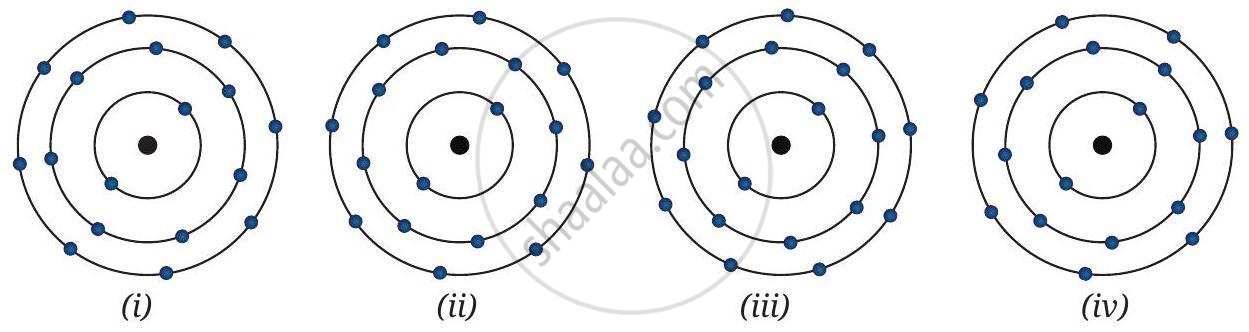
Determine the formula unit mass of the following substance.
Ammonium nitrate $$\left(\mathrm{NH}_4\mathrm{NO}_3\right)$$, used as a nitrogen fertiliser, which is essential for plant growth.
Determine the formula unit mass of the following substance.
Phosphoric acid $$\left(\mathrm{H}_3\mathrm{PO}_4\right)$$, used to make phosphate fertiliser and detergents.
Determine the formula unit mass of the following substance.
Sodium hydrogencarbonate $$\left(\mathrm{NaHCO}_3\right)$$, used to relieve acidity and helps in digestion.
Write the formulae for the compounds formed by the reaction of:
Magnesium and nitrogen
Write the formulae for the compounds formed by the reaction of:
Lithium and nitrogen
Write the formulae for the compounds formed by the reaction of:
Sodium and sulfur
Write the formulae for the compounds formed by the reaction of:
Aluminium and oxygen
Complete the Table by writing the formulae of the compounds formed by the cations on the left and the anions at the top. $$\mathrm{LiNO}_3$$ is given as an example.
| $$\mathrm{NO}_3^-$$ | $$\mathrm{SO}_4^{2-}$$ | $$\mathrm{PO}_4^{3-}$$ | |
|---|---|---|---|
| $$\mathrm{NH}_4^+$$ | |||
| $$\mathrm{Li}^+$$ | $$\mathrm{LiNO}_3$$ | ||
| $$\mathrm{Al}^{3+}$$ | |||
| $$\mathrm{Cu}^{2+}$$ |
5.3 g of sodium carbonate and 6.0 g of acetic acid react to produce 2.2 g of carbon dioxide, 0.9 g of water, and 8.2 g of sodium acetate. Verify whether the law of conservation of mass is valid.
If a species has 11 protons, 12 neutrons and 10 electrons then
- what is its atomic number and mass number?
- is it neutral, a cation or an anion? Explain.
- write its electronic configuration.
- name the species.
Two elements, A and B, have the following configurations-
A: 2, 8, 5
B: 2, 8, 7
- Which element is more reactive?
- Will A and B form ionic or covalent bonds when they combine? Explain using electron transfer or sharing.
- Predict the formula of the compound they would form.
Assertion (A): Copper sulfate conducts electricity in the molten state but not in the solid state.
Reason (R): Copper and sulfate ions are fixed in the lattice in molten state, while in solid state they can move freely.
Choose the correct option:
Both A and R are true, and R is the correct explanation of A.
Both A and R are true, but R is not the correct explanation of A.
A is true, but R is false.
A is false, but R is true.
The species $$^{27}\mathrm{Al}$$, $$^{80}\mathrm{Br}^{-}$$ and $$^{201}\mathrm{Hg}^{2+}$$ have 13, 35 and 80 protons, respectively. How many electrons and neutrons do they have?
NCERT solutions for Science Exploration [English] Class 9 9 Atomic Foundations of Matter The Journey Beyond [Page 183]
Design and perform an experiment to show and compare that water always contains hydrogen and oxygen in the same ratio, regardless of its source.
Compare atoms and ions of any three elements. Show the number of electrons before and after ion formation using bar graphs.
Make a card game with cations and anions. Possible ideas may include —
- Pick cards from the pile or from open cards and match them with cards in your hand to form compounds. You may discard any unwanted cards.
- Ask other players for cards and form compounds using the cards they already have.
The Quest Continues …
Are there any chemical changes that do not obey the Law of Conservation of Mass?
Solutions for 9: Atomic Foundations of Matter
NCERT solutions for Science Exploration [English] Class 9 chapter 9 - Atomic Foundations of Matter
Shaalaa.com has the CBSE Mathematics Science Exploration [English] Class 9 CBSE solutions in a manner that help students grasp basic concepts better and faster. The detailed, step-by-step solutions will help you understand the concepts better and clarify any confusion. NCERT solutions for Mathematics Science Exploration [English] Class 9 CBSE 9 (Atomic Foundations of Matter) include all questions with answers and detailed explanations. This will clear students' doubts about questions and improve their application skills while preparing for board exams.
Further, we at Shaalaa.com provide such solutions so students can prepare for written exams. NCERT textbook solutions can be a core help for self-study and provide excellent self-help guidance for students.
Concepts covered in Science Exploration [English] Class 9 chapter 9 Atomic Foundations of Matter are .
Using NCERT Science Exploration [English] Class 9 solutions Atomic Foundations of Matter exercise by students is an easy way to prepare for the exams, as they involve solutions arranged chapter-wise and also page-wise. The questions involved in NCERT Solutions are essential questions that can be asked in the final exam. Maximum CBSE Science Exploration [English] Class 9 students prefer NCERT Textbook Solutions to score more in exams.
Get the free view of Chapter 9, Atomic Foundations of Matter Science Exploration [English] Class 9 additional questions for Mathematics Science Exploration [English] Class 9 CBSE, and you can use Shaalaa.com to keep it handy for your exam preparation.
