Advertisements
Chapters
1: Geography as a Discipline
Unit 2 : The Earth
2: The Origin and Evolution of the Earth
3: Interior of the Earth
4: Distribution of Oceans and Continents
Unit 3: Landforms
5: Geomorphic Processes
6: Landforms and their Evolution
Unit 4 : Climate
7: Composition and Structure of Atmosphere
8: Solar Radiation, Heat Balance and Temperature
9: Atmospheric Circulation and Weather Systems
10: Water in the Atmosphere
11: World Climate and Climate Change
Unit 5 : Water (Oceans)
12: Water (Oceans)
▶ 13: Movements of Ocean Water
Unit 6: Life on the Earth
14: Biodiversity and Conservation

Advertisements
Solutions for Chapter 13: Movements of Ocean Water
Below listed, you can find solutions for Chapter 13 of CBSE NCERT for Fundamentals of Physical Geography [English] Class 11.
NCERT solutions for Fundamentals of Physical Geography [English] Class 11 13 Movements of Ocean Water Intext Question [Page 112]
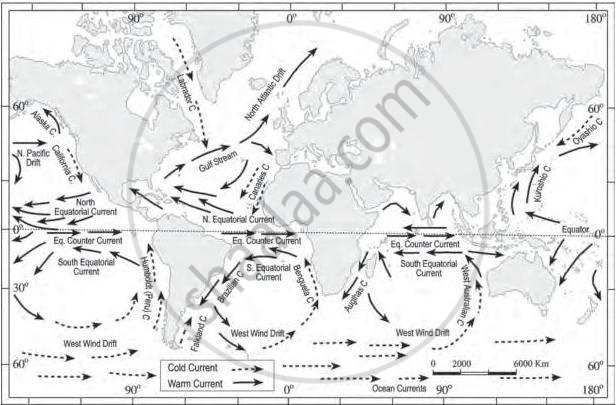
Prepare a list of currents which are found in Pacific, Atlantic and Indian Oceans.
How is the movement of currents influenced by prevailing winds? Give some examples from the following figure.
NCERT solutions for Fundamentals of Physical Geography [English] Class 11 13 Movements of Ocean Water Exercises [Page 113]
Multiple choice questions.
Upward and downward movement of ocean water is known as the ______.
tide
current
wave
none of the above
Spring tides are caused ______.
As result of the moon and the sun pulling the earth gravitationally in the same direction.
As result of the moon and the sun pulling the earth gravitationally in the opposite direction.
Indention in the coast line.
None of the above.
The distance between the earth and the moon is minimum when the moon is in ______.
Aphelion
Perigee
Perihelion
Apogee
The earth reaches its perihelion in ______.
October
September
July
January
Answer the following questions in about 30 words
What are waves?
Where do waves in the ocean get their energy from?
What are tides?
How are tides caused?
How are tides related to navigation?
Answer the following questions in about 150 words.
How do currents affect the temperature?
How does currents affect the temperature of coastal areas in the N. W. Europe?
What are the causes of currents?
Project Work
Visit a lake or a pond and observe the movement of waves. Throw a stone and notice how waves are generated.
Take a globe and a map showing the currents of the oceans. Discuss why certain currents are warm or cold and why they deflect in certain places and examine the reasons.
Solutions for 13: Movements of Ocean Water
NCERT solutions for Fundamentals of Physical Geography [English] Class 11 chapter 13 - Movements of Ocean Water
Shaalaa.com has the CBSE Mathematics Fundamentals of Physical Geography [English] Class 11 CBSE solutions in a manner that help students grasp basic concepts better and faster. The detailed, step-by-step solutions will help you understand the concepts better and clarify any confusion. NCERT solutions for Mathematics Fundamentals of Physical Geography [English] Class 11 CBSE 13 (Movements of Ocean Water) include all questions with answers and detailed explanations. This will clear students' doubts about questions and improve their application skills while preparing for board exams.
Further, we at Shaalaa.com provide such solutions so students can prepare for written exams. NCERT textbook solutions can be a core help for self-study and provide excellent self-help guidance for students.
Concepts covered in Fundamentals of Physical Geography [English] Class 11 chapter 13 Movements of Ocean Water are Introduction to Movements of Ocean Water, Waves in Ocean Water, Tides, Types of Tides, Ocean Currents.
Using NCERT Fundamentals of Physical Geography [English] Class 11 solutions Movements of Ocean Water exercise by students is an easy way to prepare for the exams, as they involve solutions arranged chapter-wise and also page-wise. The questions involved in NCERT Solutions are essential questions that can be asked in the final exam. Maximum CBSE Fundamentals of Physical Geography [English] Class 11 students prefer NCERT Textbook Solutions to score more in exams.
Get the free view of Chapter 13, Movements of Ocean Water Fundamentals of Physical Geography [English] Class 11 additional questions for Mathematics Fundamentals of Physical Geography [English] Class 11 CBSE, and you can use Shaalaa.com to keep it handy for your exam preparation.
