Advertisements
Chapters
*: Bharat Our Land
2: The Pot Maker
*: Gifts of Grace: Honouring Our Vocations
3: Winds of Change
*: Canvas of Soil
4: Vitamin-M
*: I Cannot Remember My Mother
5: The World of Limitless Possibilities
*: Nine Gold Medals
▶ 6: Twin Melodies
*: A Friend Found in Music
7: Carrier of Words
*: Words
8: Follow That Dream
*: Believe in Yourself
Advertisements
Solutions for Chapter 6: Twin Melodies
Below listed, you can find solutions for Chapter 6 of CBSE NCERT for English Kaveri Class 9.
NCERT solutions for English Kaveri Class 9 6 Twin Melodies Reflect and Respond [Page 169]
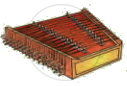
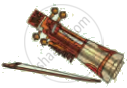
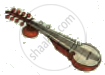
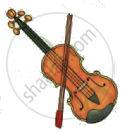
Given below are some stringed musical instruments. Work in pairs and identify them by first letter of the spellings of their names.
 |
 |
 |
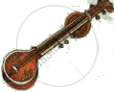 |
| S.......... | S.......... | S.......... | S.......... |
 |
 |
 |
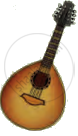 |
| M.......... | V.......... | G.......... | B.......... |
Do you play a musical instrument? If given a choice, which one would you choose and why?
Is there any difference in the choice of music between children and elders? If yes, why? If no, why not?
Work in pairs to complete the paragraph given on the next page by choosing the correct phrases given in the box. Discuss with your teacher whether the following phrases have a literal meaning or a figurative one.
| wearing a look of distress | bite the bullet |
| found words | lost in his thoughts |
| bring it up | throw a party |
| winding up | sweating on |
| come around |
The theatre club was 1. ______ their practice. Anil saw Sunny was 2. ______ and not speaking to anyone. They had a disagreement in the morning and since then, Sunny was 3. ______. Anil did not want to 4. ______ and disturb Sunny further but he finally decided to 5. ______ and speak to Sunny. He was sure if he apologised first, his friend would 6. ______. With a lot of anxiety, he 7. ______ to apologise. And finally, Sunny smiled! Everyone clapped and asked them to 8. ______ to celebrate.
NCERT solutions for English Kaveri Class 9 6 Twin Melodies Intex Questions [Pages 174 - 181]
Check Your Understanding:
Complete the table given below based on Act I of the play. Check your answers with the teacher.
| Setting |
|
|
| Children and the instruments they play |
|
|
| Speaker | Words of the Speaker | Reason |
| ................. | Oh ho! Wow Shruti! You are a sensation now! The least you can do is throw a party! | ................. |
| ................. | There is need to worry Iqbal! You don’t know papa. | ................. |
| ................. | That’s the spirit! | ................. |
Do you think Shruti will gather the courage to speak to her father? Give a reason.
What might be Shruti’s father’s reaction? Why?
Check Your Understanding:
Complete the summary of Act II by choosing the correct words from the box given below. There are two extra words that you do not need. Check your answers with the teacher.
| disapproval | plea | absent-minded |
| setback | surprised | scolded |
| courage | firm | clash |
| relief |
Shruti seemed 1. ______ during dinner. She finally gathered the 2. ______ to inform her father, Nabin, about her wish to participate in an upcoming Indo-Western fusion concert. Nabin reacted negatively, expressing 3. ______ of fusion music and dismissed the idea. Despite Shruti’s 4. ______ to him to attend a practice before deciding, Nabin was 5. ______ in his decision. Shruti’s mother, Leela, 6. ______ her for not seeking permission earlier. The tension highlights the 7. ______ between traditional and contemporary musical preferences within the family. Despite the 8. ______, Shruti promises not to hide again and is urged to go to bed by her mother.
Will Shruti’s father go for the rehearsal? Support your answer with a reason.
Do you think Shruti and her parents would understand one another? If yes, why? If no, why not?
Check Your Understanding:
Work in pairs. Identify the true statements. Check the answers with your teacher.
| 1. | During the rehearsal, Shruti’s parents enter the room and are overjoyed at her performance. | ______ |
| 2. | Shruti initially considers telling her friends that she can’t join them for the performance, after practising one last time. | ______ |
| 3. | Shruti’s father expressed that she had sung a few notes incorrectly during her performance. | ______ |
| 4. | Shruti’s father had followed the family’s tradition of being a violinist and worked very hard to achieve all that he did. | ______ |
| 5. | Shruti’s mother helped her husband realise why he should support their daughter. | ______ |
| 6. | Shruti’s father accepts that he underrated the potential of classical music. | ______ |
NCERT solutions for English Kaveri Class 9 6 Twin Melodies Exercise [Pages 182 - 193]
Critical Reflection:
Read the extract given below and answer the questions that follow.
| Shruti: | There is need to worry Iqbal! You don’t know papa. He is very strict about these things. He will think it a desecration of the violin to be played to Western tunes. Papa firmly believes that Classical Hindustani music, with its ragas and aalaaps, is the only kind of music that an artist of any worth should play. I don’t want papa to feel that I don’t care about his opinions, because I do. It’s just that I want to give this a try too. I just don’t know how to tell him in the right way! |
| Iqbal: | All ways are right ways, Shruti. He is your father, he will understand. |
(i) Select the option that correctly identifies Shruti’s situation.
- confident
- indifferent
- content
- in a dilemma
(ii) What does Shruti mean by ‘the right way’, in the sentence, “I just don’t know how to tell him in the right way!”?
(iii) Complete the following with a suitable reason.
We can say that the extract reflects the generational gap in understanding art and tradition because ______.
(iv) Explain how Iqbal’s words were meant as an assurance to Shruti.
(v) Fill in the blank with a phrase from the extract.
The critics argued that only films which provoke thoughtful discussion are ______.
Read the extract given below and answer the questions that follow.
| Nabin: | I underestimated the power of our own music. I was afraid you would be lost to us. I realise that my fears were baseless. After all each bay, its own wind. I trust you Shruti and I will root for your group at the concert! |
(Shruti hugs both of her parents)
(i) Select the suitable option to complete the sentence.
Nabin’s breakthrough in his understanding of artistic freedom, highlights a bridge between ______.
- personal ambition and professional success
- traditional values and modern expressions
- strict discipline and casual learning
- historical techniques and futuristic innovations
(ii) Fill in the blank with a suitable phrase.
The extract uses the word ‘lost’ both in the sense of losing ______ and physical separation.
(iii) In the line, ‘Shruti hugs her parents’, which word from those given below, does not show what it conveys?
| reconciliation | harmony | duty |
| acceptance | understanding |
(iv) What can be inferred about Shruti’s future in music following her father’s expression of trust and support?
(v) Identify the phrase that refers to the uniqueness of each artist’s journey and style.
Answer the following questions.
Justify the title ‘Twin Melodies’. How does the play explore the theme of tradition and modernity?
What are the different perspectives of Peter, Iqbal, and Avinash regarding confronting figures of authority? How do their attitudes towards Shruti’s dilemma with her father provide insight into their own characters and values?
Analyse the character of Nabin Sharma. How does his attitude towards music evolve throughout the play?
How does the play use Shruti’s internal conflict to explore the theme of duty towards family versus personal passion?
Evaluate the effectiveness of the play’s conclusion. Does it realistically address the conflicts presented?
Assess how well the role of cultural diversity contributes to the storyline of the play.
Vocabulary and Structures in Context:
Read the highlighted word given in the brackets.
SHRUTI (Aside): Oh, how much I enjoy performing this piece. Perhaps I can practise one last time and soon after that I will tell them that I can’t join them for the performance.
What is ‘aside’ used for?
enables characters to talk about the story
shows what a character thinks or feels
makes a direct link between the audience and the character
(i), (ii), and (iii)
Read the following words from the text.
Ahem ahem, I…er…
Now, select the correct answer for the question given below.
Why are they used?
to fill gaps while speaking
to increase clarity
to provide confidence
Choose suitable non-lexical fillers given in the box to describe the emoticons 1 to 4. There is an extra word you do not need.
| whew | err | arrgh |
| hmmm | ahem-ahem |
 |
 |
 |
 |
| 1 | 2 | 3 | 4 |
Match the meanings of other music-related words in Column 1 with their meanings in Column 2.
| Column 1 | Column 2 |
| 1. rhythm | (i) the lowest tone or part in music |
| 2. tempo | (ii) a mixture of loud unpleasant sounds |
| 3. bass [p.base] | (iii) the pattern of beats or time intervals in music |
| 4. baritone | (iv) the speed or pace at which a piece of music is played |
| 5. cacophony | (v) a male voice that falls between the higher and lower ranges |
| 6. pitch | (vi) a series of musical notes moving upwards or downwards |
| 7. scale | (vii) the perceived frequency of a sound, how high or low a sound is |
Write the meaning of the underlined phrase based on your understanding of the usage in sentence.
My mother told me, “When you follow trends without thinking, you drown your individual style.”
Write the meaning of the underlined phrase based on your understanding of the usage in sentence.
The pianist was appreciated for his sense of musicality.
Write the meaning of the underlined phrase based on your understanding of the usage in sentence.
When one of the performers in the group was injured, they felt their practise would go down the drain.
Read the dialogues given below.
- Oh, how much I enjoy performing this piece!
- Wah, how soulful! You all have done a wonderful job!
Sentences 1. and 2. are ______ sentences.
(declarative/interrogative/exclamatory/imperative)
Now, convert the exclamatory sentences given above to declarative sentences.
Write the sentences given below in reported speech. One example has been done for you.
- “Wow Shruti! You’re a sensation!” suggested Avinash.
Avinash exclaimed with wonder that Shruti was a great sensation. - “What an incredible achievement! I can’t believe we pulled it off!” said Iqbal.
Iqbal exclaimed that it ______. - “Bravo! Each note was executed perfectly, and the performance was flawless!” said Shruti’s mother.
Shruti’s mother applauded that ______. - Iqbal: I basically have a little bit of scolding for breakfast every day!
- Shruti: Sorry mummy, won’t hide from you again. I promise!
- Avinash: You are a sensation now! The least you can do is throw a party!
Report the following dialogue in the indirect form of speech.
| Asma: | Wow! What a unique experience I had at the art studio today! |
| Deepa: | Tell me! I’m eager to hear! |
| Asma: | I accidentally spilled paint all over my canvas. |
| Deepa: | Oh, my goodness! What a pity! |
| Asma: | No worries! The painting now looks better than my original plan! |
| Deepa: | That’s incredible! |
Asma exclaimed excitedly that she 1. ______. Deepa urged her to tell her as she was eager to hear. Asma said that 2. ______. Deepa pitied Asma. However, Asma replied to her not to worry as 3. ______. Deepa exclaimed that 4. ______.
Listen and Respond:
Look at the given stringed musical instruments and decide which one could be the yazh [yāḻ].
 |
 |
 |
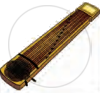 |
| 1 | 2 | 3 | 4 |
Listen to a musician describing the yazh and check if your previous choice was correct.
Listen to the musician’s description of the yazh once again. As you listen, complete the notes below with not more than three words.
The Yazh
1. Type of instrument – The Indian ______
- Was used in: ______
- Earlier version of: ______
2. Design
- stem tip – shaped like ______ of mythological animal
- resonator
- shape of a ______
- material – ______
3. Design variety
- peacock, ______, ______, and bow string
Speaking Activity:
Stress and intonation exercises can be a great way to understand the emotional and rhythmic feelings associated with dialogues in a play.
Let us pick a few lines from the play and speak them aloud. Focus on how stress and intonation can change their meaning or emotional impact.
| Sentences | Stress | Intonation |
| I don’t want papa to feel that I don’t care about his opinions, because I do. |
|
|
| Tonight, at dinner, I promise to bring this up. |
|
|
| Why are you lost in thought my dear child? |
|
|
| Each bay, its own wind |
|
|
Practice speaking aloud a few other sentences from the play on your own. Understanding what is being said and why, will help you stress the suitable portions and use the appropriate tone.
Writing Task:
Read the beginning of a story given below.
Learning Beyond the Text:
Study the words given in brackets in the following dialogues taken from the text. What do you notice?
- Iqbal: (a little loudly) Shruti!
- Avinash: (very loudly) SHRUTI!
- Nabin: (calmly but firmly) No is the answer.
- Iqbal: (picking up a newspaper from his desk)...
- Nabin: (getting up)...
- Why do we not use inverted commas to convey the dialogues?
- Where do we use colons?
- What is written within the brackets? What do these convey?
- How does it help the actors?
Did you know that there is an orchestra that made musical instruments from recycling junk or discarded waste items?
There is one such orchestra, called the Recycled Orchestra of Cateura, Paraguay, that was formed in 2012, and children are a part of it. They play musical instruments made from scrap materials collected from landfills.
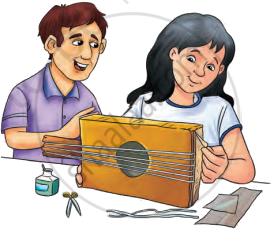
Indigenous musical instruments are crafted from natural materials like bamboo, gourds, animal hides, and shells, reflecting a deep connection to the environment and cultural heritage. These instruments are diverse, ranging from percussion instruments like drums and rattles to wind instruments like flutes, etc. Find out more about such indigenous instruments that are used in your region.
In groups of five, select objects around yourself to create a rhythm.
Present it in the class. Enjoy!
Read the book Rigmarole and Other Plays by Sai Paranjpye and enjoy the humour and wit.
Rigmarole and Other Plays, a collection by Sai Paranjpye, includes the play ‘Rigmarole,’ which follows a silly King, his Council of nine Ministers, and a bed bug, leading to humorous events. Other plays in the collection, like ‘The Boy Who Wrote a Constitution,’ seek to educate children while entertaining them.
Solutions for 6: Twin Melodies
NCERT solutions for English Kaveri Class 9 chapter 6 - Twin Melodies
Shaalaa.com has the CBSE Mathematics English Kaveri Class 9 CBSE solutions in a manner that help students grasp basic concepts better and faster. The detailed, step-by-step solutions will help you understand the concepts better and clarify any confusion. NCERT solutions for Mathematics English Kaveri Class 9 CBSE 6 (Twin Melodies) include all questions with answers and detailed explanations. This will clear students' doubts about questions and improve their application skills while preparing for board exams.
Further, we at Shaalaa.com provide such solutions so students can prepare for written exams. NCERT textbook solutions can be a core help for self-study and provide excellent self-help guidance for students.
Concepts covered in English Kaveri Class 9 chapter 6 Twin Melodies are .
Using NCERT English Kaveri Class 9 solutions Twin Melodies exercise by students is an easy way to prepare for the exams, as they involve solutions arranged chapter-wise and also page-wise. The questions involved in NCERT Solutions are essential questions that can be asked in the final exam. Maximum CBSE English Kaveri Class 9 students prefer NCERT Textbook Solutions to score more in exams.
Get the free view of Chapter 6, Twin Melodies English Kaveri Class 9 additional questions for Mathematics English Kaveri Class 9 CBSE, and you can use Shaalaa.com to keep it handy for your exam preparation.
