Advertisements
Chapters
▶ 1: Indian Economy on the Eve of Independence
2: Indian Economy 1950-1990
Unit 2: Economic Reforms since 1991
3: Liberalisation, Privatisation and Globalisation: An Appraisal
Unit 3: Current Challenges Facing the Indian Economy
4: Human Capital Formation in India
5: Rural Development
6: Employment: Growth, Informalisation and Other Issues
7: Environment and Sustainable Development
Unit 4: Development Experiences of India : a Comparison with Neighbours
8: Comparative Development Experiences of India and Its Neighbours
![NCERT solutions for Economics Indian Economic Development [English] Class 12 chapter 1 - Indian Economy on the Eve of Independence - Shaalaa.com](/images/economics-indian-economic-development-english-class-12_6:a654e356f641434097869c2416a05abb.jpg "NCERT solutions for Economics Indian Economic Development [English] Class 12 chapter 1 - Indian Economy on the Eve of Independence")
Advertisements
Solutions for Chapter 1: Indian Economy on the Eve of Independence
Below listed, you can find solutions for Chapter 1 of CBSE NCERT for Economics Indian Economic Development [English] Class 12.
NCERT solutions for Economics Indian Economic Development [English] Class 12 1 Indian Economy on the Eve of Independence Intext Question [Pages 5 - 12]
| Agriculture During Pre-British India |
|
The French traveller, Bernier, described seventeenth-century Bengal in the following way: “The knowledge I have acquired of Bengal in two visits inclines me to believe that it is richer than Egypt. It exports, in abundance, cottons and silks, rice, sugar and butter. It produces amply, for its own consumption, wheat, vegetables, grains, fowls, ducks and geese. It has immense herds of pigs and flocks of sheep and goats. Fish of every kind it has in profusion. From Rajmahal to the sea is an endless number of canals, cut in bygone ages from the Ganges by immense labour for navigation and irrigation.”
|
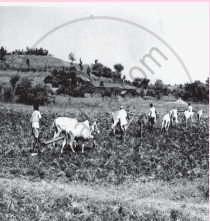
Take note of the agricultural prosperity in our country in the seventeenth century. Contrast it with agricultural stagnation around the time when the British left India, around 200 years later.
Work These Out
Compare the map of British India with that of independent India and find out the areas that became parts of Pakistan. Why were those parts so important to India from the economic point of view? (Refer, to your advantage, Dr Rajendra Prasad’s book, India Divided).
What were the various forms of revenue settlement adopted by the British in India? Where did they implement them and to what effect? How far do you think those settlements have a bearing on the current agricultural scenario in India? (In your attempt to find answers to these questions, you may refer to Ramesh Chandra Dutt’s Economic History of India, which comes in three volumes, and B.H. Baden-Powell’s The Land Systems of British India, also in two volumes. For better comprehension of the subject, you can also try and develop an illustrated agrarian map of British India either by hand or with the help of your school computer. Remember, nothing helps better than an illustrated map to understand the subject at hand.)
Prepare a list showing where and when other modern industries of India were first set up. Can you also find out what the basic requirements are for setting up any modern industry? What, for example, might have been the reasons for the setting up of the Tata Iron and Steel Company at Jamshedpur, which is now in the state of Jharkhand?
How many iron and steel factories are there in India at present? Are these iron and steel factories among the best in the world, or do you think that these factories need restructuring and upgradation? If yes, how can this be done? There is an argument that industries which are not strategic in nature should not continue to be in the public sector. What is your view?
On a map of India, mark the cotton textiles, jute mills and textile mills that existed at the time of independence.
Prepare a list of items that were exported from and imported into India during the British rule.
Collect information from the Economic Survey for various years published by the Ministry of Finance, Government of India, on various items of export from India and its imports. Compare these with imports and exports from the pre-independence era. Also find out the names of prominent ports which now handle the bulk of India’s foreign trade.
Can you find out the reasons behind frequent occurrence of famines in India before independence? You may read from Nobel Laureate Amartya Sen’s book, Poverty and Famines.
Prepare a pie chart for the occupational structure in India at the time of independence.
Work This Out
There is a perception still going around that, in many ways, the British administration in India was quite beneficial. This perception needs an informed debate. How would you look at this perception? Argue this out in your class,‘Was the British Raj good for India’?
NCERT solutions for Economics Indian Economic Development [English] Class 12 1 Indian Economy on the Eve of Independence Exercise [Pages 14 - 15]
What was the focus of the economic policies pursued by the colonial government in India? What were the impacts of these policies?
Name some notable economists who estimated India’s per capita income during the colonial period.
What were the main causes of India’s agricultural stagnation during the colonial period?
Name some modern industries which were in operation in our country at the time of independence.
What was the two-fold motive behind the systematic deindustrialisation effected by the British in pre-independent India?
The traditional handicrafts industries were ruined under the British rule. Do you agree with this view? Give reasons in support of your answer.
What objectives did the British intend to achieve through their policies of infrastructure development in India?
Critically appraise some of the shortfalls of the industrial policy pursued by the British colonial administration.
What do you understand by the drain of Indian wealth during the colonial period?
Which is regarded as the defining year to mark the demographic transition from its first to the second decisive stage?
Give a quantitative appraisal of India’s demographic profile during the colonial period.
Highlight the salient features of India’s pre independence occupational structure.
Underscore some of the India’s most crucial economic challenges at the time of independence.
When was India’s first official census operation undertaken?
Indicate the volume and direction of trade at the time of independence.
Were there any positive contributions made by the British in India? Discuss.
SUGGESTED ADDITIONAL ACTIVITIES
Prepare a list of goods and services that were available to people in pre-independence India in rural and urban areas. Compare it with the consumption pattern of such goods and services by the people today. Highlight the perceptible difference in the people’s standard of living.
Find pictures of towns/villages in your vicinity of the pre-independence period and compare these with their present scenario. What changes can you mark? Are such changes for better or for worse? Discuss.
Rally around your teacher and organise a group discussion on ‘Has the zamindari system really been abolished in India’? If the consensus is negative, then what measures would you think should be taken to banish it and why?
Identify the major occupations followed by the people of our country at the time of independence. What major occupations do the people follow today? In the light of reform policies, how would you visualise the occupational scenario in India 15 years from now,say, 2035?
Solutions for 1: Indian Economy on the Eve of Independence
NCERT solutions for Economics Indian Economic Development [English] Class 12 chapter 1 - Indian Economy on the Eve of Independence
Shaalaa.com has the CBSE Mathematics Economics Indian Economic Development [English] Class 12 CBSE solutions in a manner that help students grasp basic concepts better and faster. The detailed, step-by-step solutions will help you understand the concepts better and clarify any confusion. NCERT solutions for Mathematics Economics Indian Economic Development [English] Class 12 CBSE 1 (Indian Economy on the Eve of Independence) include all questions with answers and detailed explanations. This will clear students' doubts about questions and improve their application skills while preparing for board exams.
Further, we at Shaalaa.com provide such solutions so students can prepare for written exams. NCERT textbook solutions can be a core help for self-study and provide excellent self-help guidance for students.
Concepts covered in Economics Indian Economic Development [English] Class 12 chapter 1 Indian Economy on the Eve of Independence are India's Economy Before Independence, Low Level of Economic Development Under the Colonial Rule, Agricultural Sector in India, Industrial Sector, Demographic Condition, Occupational Structure, Infrastructure, Foreign Trade of India, Post-Independence Economic Systems and Planning, Five Year Plans (FYP), Agriculture, Industry and Trade, Trade Policy: Import Substitution, The 1991 Economic Crisis and Reforms, Background of the New Economic Policy, Liberalisation, Privatisation, Globalisation, World Trade Organisation (WTO), Impact of the Economic Reforms, India's Economy Before Independence, Agricultural Sector in India, Industrial Sector, Demographic Condition, Occupational Structure, Infrastructure, Low Level of Economic Development Under the Colonial Rule, Concept of Trade, India's Economy Before Independence, Low Level of Economic Development Under the Colonial Rule, Agricultural Sector in India, Industrial Sector, Demographic Condition, Occupational Structure, Infrastructure, Foreign Trade of India, Post-Independence Economic Systems and Planning, Five Year Plans (FYP), Agriculture, Industry and Trade, Trade Policy: Import Substitution, The 1991 Economic Crisis and Reforms, Background of the New Economic Policy, Liberalisation, Privatisation, Globalisation, World Trade Organisation (WTO), Impact of the Economic Reforms.
Using NCERT Economics Indian Economic Development [English] Class 12 solutions Indian Economy on the Eve of Independence exercise by students is an easy way to prepare for the exams, as they involve solutions arranged chapter-wise and also page-wise. The questions involved in NCERT Solutions are essential questions that can be asked in the final exam. Maximum CBSE Economics Indian Economic Development [English] Class 12 students prefer NCERT Textbook Solutions to score more in exams.
Get the free view of Chapter 1, Indian Economy on the Eve of Independence Economics Indian Economic Development [English] Class 12 additional questions for Mathematics Economics Indian Economic Development [English] Class 12 CBSE, and you can use Shaalaa.com to keep it handy for your exam preparation.
