Advertisements
Chapters
1: Factors of Production
Unit II - Theory of Demand and Supply
2: Elementary Theory of Demand
3: Elasticity of Demand
4: Theory of Supply
Unit III - Market
5: Meaning and Types of Markets
Unit IV - Banking in India
▶ 6: Meaning and Functions of Money
7: Commercial Banks
8: Central Bank
9: Introduction to Public Finance
10: Public Revenue
11: Public Expenditure
12: Public Debt
Unit V - Inflation
13: Inflation
Unit VI - Consumer Awareness
14: Consumer Awareness
![Goyal Brothers Prakashan solutions for Economics [English] Class 10 ICSE chapter 6 - Meaning and Functions of Money - Shaalaa.com](/images/economics-english-class-10-icse_6:79542639410243508fde8e322c338fd1.jpg "Goyal Brothers Prakashan solutions for Economics [English] Class 10 ICSE chapter 6 - Meaning and Functions of Money")
Advertisements
Solutions for Chapter 6: Meaning and Functions of Money
Below listed, you can find solutions for Chapter 6 of CISCE Goyal Brothers Prakashan for Economics [English] Class 10 ICSE.
Goyal Brothers Prakashan solutions for Economics [English] Class 10 ICSE 6 Meaning and Functions of Money Exercise [Pages 153 - 159]
MULTIPLE CHOICE QUESTIONS
Read the following dialogue between two people:
| Sita: | I want 1 kg of potatoes. |
| Rani: | What will you give in exchange? |
| Sita: | I can give you 2 litres of milk in return for the potatoes. |
| Rani: | I don't need milk, I want a pair of shoe. |
Which of the following problem is being faced by Sita and Rani in their exchange process?
Lack of double coincidence of wants
Absence of common unit of value
Lack of store of value
Lack of standard of deferred payment
Which of the following is not a problem of barter system of exchange?
Store of value
Double Coincidence of Wants
Unit of Account
Unemployment
Currency and ______ are two modern forms of money.
demand deposits
time deposits
coins
government securities
Who regulates money supply in India?
Government of India
Reserve Bank of India
Commercial Banks
NITI Aayog
______ implies demand deposits with banks.
Paper money
Bank money
Near money
None of these
Money whose value as a commodity is equal to its face value is called:
Credit money
Full bodied money
High powered money
Legal tender money
Which of the following agency is responsible for issuing ₹ 1 currency note in India?
Reserve Bank of India
Ministry of Commerce
Ministry of Finance
NITI Aayog
Name the system in which the double coincidence of wants is an essential feature.
Barter system
Money economy
Global economy
None of these
Which of the following institutions is authorised to issue currency in India?
Reserve Bank of India
Bank of India
Parliament of India
State Bank of India
Which one of the following is not a modern form of money?
Demand deposits
Paper currency
Coins
Precious metals
Bank money is ______.
Non legal tender
Legal tender
Neither (a) nor (b)
Both (a) and (b)
By currency we mean ______.
Currency notes only
Currency notes + Coins + Demand deposits
Currency notes + Coins
Both (a) and (b)
______ is the main source of money supply in an economy.
Central Bank
Commercial Banks
Both Central Bank and Commercial Banks
Government
One rupee note in India bears the signature of ______.
Secretary, Ministry of Finance
CEO, NITI Aayog
Governor, RBI
President, Govt. of India
Which of the following is a contingent function of money?
Measure of value
Store of value
Medium of exchange
Distribution of National Income
In ancient India ______ was accepted as form of money.
Gold
Go-Ohan (cow-wealth)
Coins
Commodity money
Identify which of the following statement is true?
Money is accepted by all as a medium of exchange
Money is a means and not an end
Standard of deferred payment is a secondary function of money
All the above
Bank money implies ______.
currency
coins
demand deposits with bank
Vault cash in banks
Which of the following is not included in money?
ATC card
Paper money
Coins
Demand deposits
Which of the following is included in money?
Paper notes
Coins
Demand deposits
All the above
______ possess general acceptability.
Cheque
Money
Bank draft
Bond
There are five stages of the evolution of money. Which of the following order is correct?
Bank, paper, metallic, commodity, animal
Paper, metallic, bank, commodity, animal
Animal, commodity, metallic, paper, bank
Animal, commodity, metallic, bank, paper
Simultaneous fulfilment of mutual wants by buyers and sellers are ______.
Common measure of value
Double coincidence of wants
Divisibility of goods
Standard of deferred payments
______ payments are referred to those payment; which are to be done in future.
Deferred payments
Stable payments
Derived payments
Indirect payment
Under ______ system, it is difficult to store value.
Money exchange
Price exchange
Store exchange
Barter exchange
Lack of divisibility is a problem of ______ system of exchange.
Trade
Barter
Money
Capital
A shirt costing ₹ 300 is ______ function of money.
Measure of value
Store of value
Transfer of value
Cognisable value
Barter system is also called as a ______.
D-D. economy
D-C. economy
C-C. economy
C-D. economy
The evolution of money started with ______ stage.
Commodity money
Metallic money
Bank money
Animal money
Which of the following is considered as legal tender money?
Currency notes and coins
Draft and cheques
Credit cards
Debit cards
Credit transaction requiring future payments cannot place take smoothly under:
Lack of standard of deferred payment
Deferred payments
Bank trading
Money market
The system of direct exchange between different commodity and service is known as ______.
Barter system
Monetary system
Banking system
Market system
Which function of money facilitates future payments?
Standard of deferred payment
Transfer of value
Measure of value
Unit of value
The evolution of money started with ______ stage.
Commodity money
Metallic money
Bank money
Animal money
There was difficulty in future payments under barter system due to ______.
Lack of divisibility
Lack of common measure of value
Lack of storage system
Lack of standard of deferred payments
During barter exchange the rate of exchange was arbitrarily fixed. This resulted from ______.
Lack of common measure of Value
Lack of divisibility
Problem of storing wealth
Problem of deferred payment
This refers to the legal definition of money -
Anything which generally acts as money.
Money are those things which are used as a medium of exchange.
Anything declared by the government as money is called money.
Money consists of those things which have a high degree of portability.
A shirt costing ₹ 300 is ______ function of money.
Measure of value
Store of value
Transfer of value
Cognisable value
Which is an essential feature of barter system?
It is based on transfer of value.
It is based on double coincidence of wants.
It is based on unit of account.
It is based on store of value.
“Money helps to express the monetary value of goods and services in the market”.
On the basis of the given statement, Identify the function performed by money.
Medium of exchange
Store of value
Measure of value
Transfer of value
During barter exchange the rate of exchange was arbitrarily fixed. This resulted from ______.
Lack of common measure of Value
Lack of divisibility
Problem of storing wealth
Problem of deferred payment
"Does a shirt priced at Rs. 300 exemplify the store of value function of money? Select the appropriate option:
True
False
From the above visual depiction, identify the problem faced by two people shown in this image.
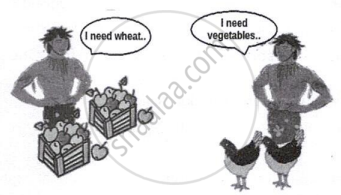
Lack of double coincidence of wants
Lack of store of value
Lack of standard of deferred payment
Disagreement between rate of exchange
When the value of commodity is expressed in terms of money it is called ______.
Deposit
Price
Barter system
Transfer of value
ASSERTION-REASONING & STATEMENT BASED QUESTIONS Read the following statements-Assertion (A) and Reason (R). Choose one of the correct alternatives given below:
Assertion (A): Under barter system, it is difficult to store value.
Reason (R): There is lack of double coincidence in the wants of buyers and sellers in barter exchange.
Both Assertion (A) and Reason (R) are true and Reason (R) is the correct explanation of Assertion (A).
Both Assertion (A) and Reason (R) are true and Reason (R) is not the correct explanation of Assertion (A).
Assertion (A) is true but Reason (R) is false.
Assertion (A) is false but Reason (R) is true.
Assertion (A): Money is a medium of exchange.
Reason (R): Money possesses general acceptability.
Both Assertion (A) and Reason (R) are true and Reason (R) is the correct explanation of Assertion (A).
Both Assertion (A) and Reason (R) are true and Reason (R) is not the correct explanation of Assertion (A).
Assertion (A) is true but Reason (R) is false.
Assertion (A) is false but Reason (R) is true.
Read the following statements carefully and choose one of the correct alternatives given below:
Statement (1): Medium of exchange is the tertiary function of money.
Statement (2): Store of value is the secondary function of money.
Both the statements are true.
Both the statements are false
Statement 1 is true, Statement 2 is false.
Statement 2 is true, Statement 1 is false.
Read the following statements - Assertion (A) and Reason (R). Choose one of the correct alternatives given below:
Assertion (A): High powered money is known as monetary base.
Reason (R): High powered money is called monetary base because it provides basis for credit creation.
Both Assertion (A) and Reason (R) are true and Reason (R) is the correct explanation of Assertion (A).
Both Assertion (A) and Reason (R) are true and Reason (R) is not the correct explanation of Assertion (A).
Assertion (A) is true but Reason (R) is false.
Assertion (A) is false but Reason (R) is true.
Read the following statements carefully and choose one of the correct alternatives given below:
Statement (1): In India, rupee is the unit of account.
Statement (2): Money works as a common parameter in which the value of every good or service is expressed in monetary term.
Both the statements are true.
Both the statements are false.
Statement 1 is true, Statement 2 is false.
Statement 2 is true, Statement 1 is false.
Statement (1): Unit of account is not a primary function of money.
Statement (2): ‘Store of value’ is the primary function of money.
Both the statements are true.
Both the statements are false.
Statement 1 is true, Statement 2 is false.
Statement 2 is true, Statement 1 is false.
Read the following statements-Assertion (A) and Reason (R). Choose one of the correct alternatives given below:
Assertion (A): Money provides the basis for credit creation.
Reason (R): Credit creation by commercial banks is not possible without money.
Both Assertion (A) and Reason (R) are true and Reason (R) is the correct explanation of Assertion (A).
Both Assertion (A) and Reason (R) are true and Reason (R) is not the correct explanation of Assertion (A).
Assertion (A) is true but Reason (R) is false.
Assertion (A) is false but Reason (R) is true.
Read the following statements carefully and choose one of the correct alternatives given below:
Statement (1): Currency is legal lender money.
Statement (2): Measure of value function of money facilitates future payments.
Both the statements are true.
Both the statements are false.
Statement 1 is true, Statement 2 is false.
Statement 2 is true, Statement 1 is false.
Statement 1: The primary function of money is to act as a ‘store of value’.
Statement 2: Money helps in monetary expression of the market value of the commodity.
Both Statement 1 and Statement 2 are true.
Both Statement 1 and Statement 2 are false.
Statement 1 is true and Statement 2 is false.
Statement 1 is false and Statement 2 is true.
Short Answer Type Questions.
Explain the meaning of barter exchange by giving an example.
State any two demerits of the Barter system of exchange?
What is meant by the double coincidence of wants? How does money overcome this problem?
How does money act as a standard of deferred payment?
Give two characteristics of money.
State the two primary functions of money.
Explain the contingent functions of money.
State the two primary functions of money.
Explain the secondary functions of money.
How does money help in maximising utility?
What do you understand by the term 'near money'?
What is the legal definition of money?
What was standard of deferred payment a problem for Barter System of Exchange?
Long answer Type Questions.
Enumerate any two difficulties faced under the barter system of exchange.
Enumerate any two difficulties faced under the barter system of exchange.
Define Money.
What are the main features of money?
Define Money.
State the two primary functions of money.
State the two primary functions of money.
Explain the secondary functions of money.
Explain the secondary functions of money.
Explain the following statement:
Money provides a link between the present and the future.
Explain the following statement:
Money is the basis of credit system.
Is the following statement true or false? Give reasons to support your answer.
Barter is an easier method of exchange of goods.
True
False
Is the following statement true or false? Give reasons to support your answer.
Cheques are legal tender money.
True
False
Is the following statement true or false? Give reasons to support your answer.
One rupee note is unlimited legal tender money in India.
True
False
Is the following statement true or false? Give reasons to support your answer.
Money acts as a unit of account.
True
False
Is the following statement true or false? Give reasons to support your answer.
We can do nothing without money.
True
False
Define Money.
Describe how money has removed the defects of the barter system.
Explain various stages in the evolution of money.
Distinguish between limited legal tender and unlimited legal tender.
Distinguish between standard money and bank money.
Goyal Brothers Prakashan solutions for Economics [English] Class 10 ICSE 6 Meaning and Functions of Money QUESTION BANK [Pages 159 - 161]
Explain the meaning of barter exchange by giving an example.
State any two demerits of the Barter system of exchange?
What is meant by double coincidence of wants?
Define Money.
What is high-powered money?
Explain the secondary functions of money.
Explain the contingent functions of money.
Distinguish between limited legal tender and unlimited legal tender.
What is fiat money?
Give two characteristics of money.
How does money solve the problem of lack a common measure of value that existed under the barter system?
State the two primary functions of money.
Explain the following function of money:
Medium of exchange
How does money solve the problem of double coincidence of wants? Explain with an example of your own.
Explain the secondary functions of money.
Explain the contingent functions of money.
Define Money.
Explain various stages in the evolution of money.
State the two primary functions of money.
Explain the secondary functions of money.
How does money help in maximising utility?
Enumerate any two difficulties faced under the barter system of exchange.
Distinguish between standard money and bank money.
Solutions for 6: Meaning and Functions of Money
Goyal Brothers Prakashan solutions for Economics [English] Class 10 ICSE chapter 6 - Meaning and Functions of Money
Shaalaa.com has the CISCE Mathematics Economics [English] Class 10 ICSE CISCE solutions in a manner that help students grasp basic concepts better and faster. The detailed, step-by-step solutions will help you understand the concepts better and clarify any confusion. Goyal Brothers Prakashan solutions for Mathematics Economics [English] Class 10 ICSE CISCE 6 (Meaning and Functions of Money) include all questions with answers and detailed explanations. This will clear students' doubts about questions and improve their application skills while preparing for board exams.
Further, we at Shaalaa.com provide such solutions so students can prepare for written exams. Goyal Brothers Prakashan textbook solutions can be a core help for self-study and provide excellent self-help guidance for students.
Concepts covered in Economics [English] Class 10 ICSE chapter 6 Meaning and Functions of Money are Evolution of Money, Barter system, Forms of Money, Functions of Money, Qualities of Money.
Using Goyal Brothers Prakashan Economics [English] Class 10 ICSE solutions Meaning and Functions of Money exercise by students is an easy way to prepare for the exams, as they involve solutions arranged chapter-wise and also page-wise. The questions involved in Goyal Brothers Prakashan Solutions are essential questions that can be asked in the final exam. Maximum CISCE Economics [English] Class 10 ICSE students prefer Goyal Brothers Prakashan Textbook Solutions to score more in exams.
Get the free view of Chapter 6, Meaning and Functions of Money Economics [English] Class 10 ICSE additional questions for Mathematics Economics [English] Class 10 ICSE CISCE, and you can use Shaalaa.com to keep it handy for your exam preparation.
