Advertisements
Chapters
1: Microeconomics and Macroeconomics: Introduction
2: Demand and Law of Demand
3: Theory of Consumer Behaviour: Marginal Utility and Indifference Curve Analysis
4: Elasticity of Demand
5: Supply - Law of Supply and Price Elasticity of Supply
6: Market Mechanism: Equilibrium Price and Quantity in a Competitive Market
7: Laws of Returns - Returns to a Factor and Returns to Scale
8: Cost and Revenue Analysis
9: Forms of Market
10: Producer's Equilibrium
▶ 11: Determination of Equilibrium Price and Output Under Perfect Competition
SECTION 2: THEORY OF INCOME AND EMPLOYMENT
12: Theory of Income and Employment
SECTION 3: MONEY AND BANKING
13: Money: Meaning and Functions
14: Banks: Commercial Bank and Central Bank
SECTION 4: BALANCE OF PAYMENTS AND EXCHANGE RATE
15: Balance of Payments and Exchange Rate
SECTION 5: PUBLIC FINANCE
16: Fiscal Policy
17: Government Budget
SECTION 6: NATIONAL INCOME
18: National Income and Circular Flow of Income
19: National Income Aggregates
20: Methods of Measuring National Income
SECTION 7: PROJECT WORK
21: Project Work
22: Model Short Answer Questions
![Frank solutions for Economics [English] Class 12 ISC chapter 11 - Determination of Equilibrium Price and Output Under Perfect Competition - Shaalaa.com](/images/economics-english-class-12-isc_6:872f47036b5c4267ae061d4279703803.jpg "Frank solutions for Economics [English] Class 12 ISC chapter 11 - Determination of Equilibrium Price and Output Under Perfect Competition")
Advertisements
Solutions for Chapter 11: Determination of Equilibrium Price and Output Under Perfect Competition
Below listed, you can find solutions for Chapter 11 of CISCE Frank for Economics [English] Class 12 ISC.
Frank solutions for Economics [English] Class 12 ISC 11 Determination of Equilibrium Price and Output Under Perfect Competition TEST YOURSELF QUESTIONS [Pages 211 - 214]
Select the correct option for each of the following questions: (1 mark each)
Normal profit is defined as ______.
minimum payment which a producer must get in order to induce him to undertake the risk involved in production.
profit which is low enough so that new firms do not want to enter the industry.
both minimum payment which a producer must get in order to induce him to undertake the risk involved in production and profit which is low enough so that new firms do not want to enter the industry.
None of these.
In a perfectly competitive market, the price of a commodity is determined by ______.
market (industry) demand and supply
an individual firm’s cost of production
an individual firms marginal revenue curve
all of the above
A competitive firm in the short-run may earn ______.
normal profit (AR = AC)
super-normal profit (AR > AC)
incure losses (AR < AC)
all of these
For a loss making firm, its ______.
MR = MC
MR < AVC
MR < AC
none of these
A firm under perfect competition in the long-run will be equilibrium when ______.
it earns normal profit only
LMC = MR
AR = LAC
all of these
Break-even output for a firm is obtained at a point where its ______.
AR = AC
AR = AVC
AR < AVC
all of these
Shut-down point is the situation when ______.
AR = AC
AR = AVC
AR > AVC
all of these
Under perfect competition, the firm earns normal profit in the long run because of ______.
large number of buyers and sellers
absence of selling cost
free entry and exit
homogeneous commodity
Assertion (A): Perfect competition is characterised by a firm being price-taker.
Reason (R): A firm produces a very small proportion of the total output of the industry.
Both Assertion (A) and Reason (R) are true, and Reason (R) is the correct explanation for Assertion (A).
Both Assertion (A) and Reason (R) are true, but Reason (R) is not the correct explanation for Assertion (A).
Assertion (A) is true and Reason (R) is false.
Both Assertion (A) and Reason (R) are false.
See the diagram given below:
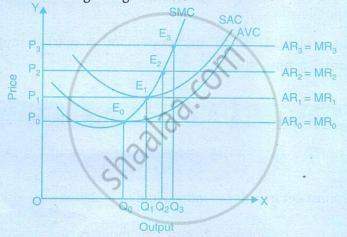
Mark the (i) Short-down point (ii) Break-even point
Very Short Answer Questions. (2 marks questions)
State the conditions of short-run equilibrium of the firm under perfect competition.
What are the conditions of long-run equilibrium of a firm under perfect competition?
What is the condition of short-run equilibrium of the industry under perfect competition?
State the conditions of long-run equilibrium of the industry under perfect competition.
Long-run equilibrium of the firm under perfect competition is only at the optimum output level.
What is the supply curve of a firm in the short run?
Why does a firm under perfect competition earn only normal profits in the long run?
What is the relationship between price and marginal cost of a firm under perfect competition?
Why is price per unit equal to the average revenue and marginal revenue of a firm under perfect competition?
Short Answer Questions. (3 marks questions)
Show with the help of a diagram, how a perfectly competitive firm earns a normal profit in short-run equilibrium.
Distinguish between break-even point and shut-down point with the help of a diagram.
Explain price determination under Perfect Competition.
Explain the short-run equilibrium of a firm facing losses under Perfect Competition.
Long-run equilibrium of a firm under perfect competition occurs at a point where price equals the minimum long-run average cost. Explain it with the help of a diagram.
Explain the significance of free entry and free exit under perfect competition. How does it ensure normal profit in the long-run?
Long Answer Questions. (6 marks questions)
Explain how short-run equilibrium is attained by a perfectly competitive firm earning super-normal profits.
Illustrate the short-run equilibrium of a perfectly competitive firm incurring losses. Show the same with the help of a diagram.
Why does a firm under perfect competition earn only normal profits in the long run?
Explain how a segment of the SMC curve of a firm is its supply curve in the short-run.
Describe the process by which the short-run super-normal profits of firms in a perfectly competitive industry are wiped out in the long-run.
Explain the equilibrium of firm under perfect competition.
Explain the equilibrium of industry under perfect competition.
Show how under perfect competition the price of a commodity is equal to its average and marginal costs of production in the long-run. Does the perfectly competitive firm always operate at the minimum point of the average cost curve?
Thinking Beyond...
Bring out the essential difference between the nature of equilibrium of a firm under perfect competition in the short-run and the long-run.
If average variable cost exceeds the market price and there are no fixed costs what level of output should the firm produce?
Solutions for 11: Determination of Equilibrium Price and Output Under Perfect Competition
Frank solutions for Economics [English] Class 12 ISC chapter 11 - Determination of Equilibrium Price and Output Under Perfect Competition
Shaalaa.com has the CISCE Mathematics Economics [English] Class 12 ISC CISCE solutions in a manner that help students grasp basic concepts better and faster. The detailed, step-by-step solutions will help you understand the concepts better and clarify any confusion. Frank solutions for Mathematics Economics [English] Class 12 ISC CISCE 11 (Determination of Equilibrium Price and Output Under Perfect Competition) include all questions with answers and detailed explanations. This will clear students' doubts about questions and improve their application skills while preparing for board exams.
Further, we at Shaalaa.com provide such solutions so students can prepare for written exams. Frank textbook solutions can be a core help for self-study and provide excellent self-help guidance for students.
Concepts covered in Economics [English] Class 12 ISC chapter 11 Determination of Equilibrium Price and Output Under Perfect Competition are Concept of Market, Market Structure, Perfect Competition, Monopoly, Monopolistic Competition, Oligopoly, Monopsony, Demand Curves of Firms under Different Market Forms, Comparison between different forms of market, Factors Determining Market Forms, Duopoly, Bilateral Monopoly, Other Forms of Market, Factors Determining Market / Extent of Market, Features of Perfect Competition, Pure and Perfect Competition, Features of Monopoly, Features of Monopolistic Competition, Features of Oligopoly, Features of Monopsony, Characteristics of Duopoly, Firm : An Economic Entity, Profit Maximisation Objective, The Definition of Profits, Rules for Profit-Maximisation, Producer's (Firm's) Equilibrium: Total Revenue and Total Cost Approach, Producer's (Firm's) Equilibrium: Marginal Revenue and Marginal Cost Approach, Short-run Equilibrium, Long-run Equilibrium, Firm is a Price Taker, Not a Price Maker, Equilibrium of Industry, Difference Between Firm and Industry's Equilibrium, Meaning of a Producer, Producer's Equilibrium under Perfect Competition, Determination of Price and Equilibrium Under Monopoly, Monopoly Equilibrium and Laws of Costs, Price Discrimination or Discriminating Monopoly, Price and Output Discrimination Under Discriminating Monopoly, Measures of Monopoly Power, Nature of Demand and Cost Curves, Difference Between Imperfect Competition and Monopolistic Competition, Equilibrium Price and Output under Monopolistic Competition, Group Equilibrium in Monopolistic Competition, Product Differentiation, Selling Costs, Equilibrium with Selling Costs, Price and Output Under Oligopoly Indeterminate, Price and Output Determination under Oligopoly, Price Rigidity-Sweezy's Kinky Demand Curve Model or Equilibrium under Independent Action, Reasons for Price Stability, Cournot's Model, Collusive Oligopoly, Mergers.
Using Frank Economics [English] Class 12 ISC solutions Determination of Equilibrium Price and Output Under Perfect Competition exercise by students is an easy way to prepare for the exams, as they involve solutions arranged chapter-wise and also page-wise. The questions involved in Frank Solutions are essential questions that can be asked in the final exam. Maximum CISCE Economics [English] Class 12 ISC students prefer Frank Textbook Solutions to score more in exams.
Get the free view of Chapter 11, Determination of Equilibrium Price and Output Under Perfect Competition Economics [English] Class 12 ISC additional questions for Mathematics Economics [English] Class 12 ISC CISCE, and you can use Shaalaa.com to keep it handy for your exam preparation.
