Please select a subject first
Advertisements
Advertisements
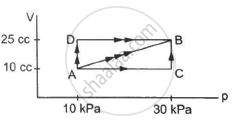
Figure shows three paths through which a gas can be taken from the state A to the state B. Calculate the work done by the gas in each of the three paths.
Concept: undefined >> undefined
Let Ta and Tb be the final temperatures of the samples A and B, respectively, in the previous question.
Concept: undefined >> undefined
Advertisements
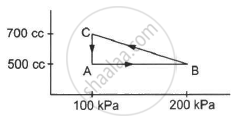
A gas is taken through a cyclic process ABCA as shown in figure. If 2.4 cal of heat is given in the process, what is the value of J ?
Concept: undefined >> undefined
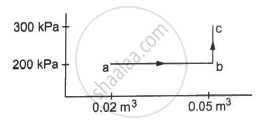
A substance is taken through the process abc as shown in figure. If the internal energy of the substance increases by 5000 J and a heat of 2625 cal is given to the system, calculate the value of J.
Concept: undefined >> undefined
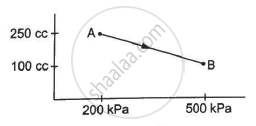
A gas is taken along the path AB as shown in figure. If 70 cal of heat is extracted from the gas in the process, calculate the change in the internal energy of the system.
Concept: undefined >> undefined
A gas is initially at a pressure of 100 kPa and its volume is 2.0 m3. Its pressure is kept constant and the volume is changed from 2.0 m3 to 2.5 m3. Its Volume is now kept constant and the pressure is increased from 100 kPa to 200 kPa. The gas is brought back to its initial state, the pressure varying linearly with its volume. (a) Whether the heat is supplied to or extracted from the gas in the complete cycle? (b) How much heat was supplied or extracted?
Concept: undefined >> undefined
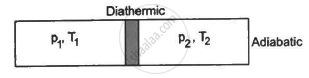
Figure shows a cylindrical tube of volume V with adiabatic walls containing an ideal gas. The internal energy of this ideal gas is given by 1.5 nRT. The tube is divided into two equal parts by a fixed diathermic wall. Initially, the pressure and the temperature are p1, T1 on the left and p2, T2 on the right. The system is left for sufficient time so that the temperature becomes equal on the two sides. (a) How much work has been done by the gas on the left part? (b) Find the final pressures on the two sides. (c) Find the final equilibrium temperature. (d) How much heat has flown from the gas on the right to the gas on the left?
Concept: undefined >> undefined
A body of mass m is placed on a table. The earth is pulling the body with a force mg. Taking this force to be the action what is the reaction?
Concept: undefined >> undefined
A boy is sitting on a chair placed on the floor of a room. Write as many action-reaction pairs of forces as you can.
Concept: undefined >> undefined
A lawyer alleges in court that the police had forced his client to issue a statement of confession. What kind of force is this ?
Concept: undefined >> undefined
When you hold a pen and write on your notebook, what kind of force is exerted by you on the pen? By the pen on the notebook? By you on the notebook?
Concept: undefined >> undefined
Is it true that the reaction of a gravitational force is always gravitational, of an electromagnetic force is always electromagnetic and so on?
Concept: undefined >> undefined
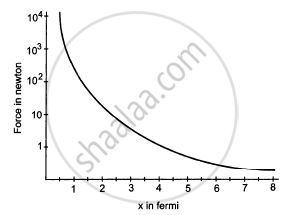
Suppose the magnitude of Nuclear force between two protons varies with the distance between them as shown in figure. Estimate the ratio "Nuclear force/Coulomb force" for
(a) x = 8 fm
(b) x = 4 fm
(c) x = 2 fm
(d) x = 1 fm (1 fm = 10 −15m).
Concept: undefined >> undefined
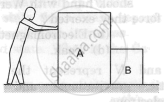
List all the forces acting on the block B in figure.
Concept: undefined >> undefined
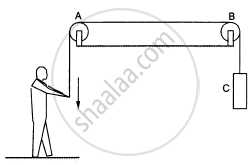
List all the forces acting on (a) the pulley A, (b) the boy and (c) the block C in figure.
Concept: undefined >> undefined
Figure shows a boy pulling a wagon on a road. List as many forces as you can which are relevant with this figure. Find the pairs of forces connected by Newton's third law of motion.
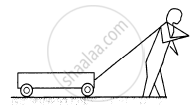
Concept: undefined >> undefined
Figure shows a cart. Complete the table shown below.
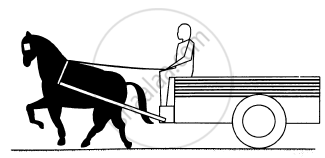
| Force on | Force by | Nature of the Force | Direction |
| Cart |
1 |
||
| Horse |
1 |
||
| Driver |
1 |
Concept: undefined >> undefined
When Neils Bohr shook hand with Werner Heisenberg, what kind of force they exerted ?
Concept: undefined >> undefined
Let E, G and N represent the magnitudes of electromagnetic gravitational and nuclear forces between two electrons at a given separation. Then
Concept: undefined >> undefined
The sum of all electromagnetic forces between different particles of a system of charged particles is zero
Concept: undefined >> undefined
