Advertisements
Advertisements
Question
A platinum resistance thermometer reads 0° when its resistance is 80 Ω and 100° when its resistance is 90 Ω.
Find the temperature at the platinum scale at which the resistance is 86 Ω.
Advertisements
Solution
Given:
Resistance at 0oC, R0 = 80
\[\Omega\]
Resistance at 100oC, R100 = 90
\[\Omega\]
Let t be the temperature at which the resistance (Rt) is 86
\[\Omega\]
\[t = \frac{R_t - R_0}{R_{100} - R_0} \times 100\]
\[ \Rightarrow t = \frac{86 - 80}{90 - 80} \times 100\]
\[ \Rightarrow t = \frac{6}{10} \times 100\]
\[ \Rightarrow t = 60°\]
Therefore, the resistance is 86
\[\Omega\] at 60°C
APPEARS IN
RELATED QUESTIONS
Two absolute scales A and B have triple points of water defined to be 200 A and 350 B. What is the relation between TA and TB?
Answer the following:
The triple-point of water is a standard fixed point in modern thermometry. Why? What is wrong in taking the melting point of ice and the boiling point of water as standard fixed points (as was originally done in the Celsius scale)?
Two ideal gas thermometers Aand Buse oxygen and hydrogen respectively. The following observations are made:
| Temperature | Pressure thermometer A | Pressure thermometer B |
| Triple-point of water | 1.250 × 10⁵ Pa | 0.200 × 10⁵ Pa |
| Normal melting point of sulphur | 1.797 × 10⁵ Pa | 0.287 × 10⁵ Pa |
(a) What is the absolute temperature of the normal melting point of sulphur as read by thermometers Aand B?
(b) What do you think is the reason behind the slight difference in answers of thermometers Aand B? (The thermometers are not faulty). What further procedure is needed in the experiment to reduce the discrepancy between the two readings?
A brass wire 1.8 m long at 27 °C is held taut with little tension between two rigid supports. If the wire is cooled to a temperature of –39 °C, what is the tension developed in the wire, if its diameter is 2.0 mm? Co-efficient of linear expansion of brass = 2.0 × 10⁻⁵ K–1; Young’s modulus of brass = 0.91 × 10¹¹ Pa.
If the temperature of a uniform rod is slightly increased by ∆t, its moment of inertia I about a perpendicular bisector increases by
In which of the following pairs of temperature scales, the size of a degree is identical?
(a) Mercury scale and ideal gas scale
(b) Celsius scale and mercury scale
(c) Celsius scale and ideal gas scale
(d) Ideal gas scale and absolute scale
Which of the following pairs represent units of the same physical quantity?
A constant-volume thermometer registers a pressure of 1.500 × 10⁴ Pa at the triple point of water and a pressure of 2.050 × 10⁴ Pa at the normal boiling point. What is the temperature at the normal boiling point?
The pressure measured by a constant volume gas thermometer is 40 kPa at the triple point of water. What will be the pressure measured at the boiling point of water (100°C)?
An aluminium vessel of mass 0.5 kg contains 0.2 kg of water at 20°C. A block of iron of mass 0.2 kg at 100°C is gently put into the water. Find the equilibrium temperature of the mixture. Specific heat capacities of aluminium, iron and water are 910 J kg−1 K−1, 470 J kg−1 K−1 and 4200 J kg−1 K−1 respectively.
In a Callender's compensated constant pressure air thermometer, the volume of the bulb is 1800 cc. When the bulb is kept immersed in a vessel, 200 cc of mercury has to be poured out. Calculate the temperature of the vessel.
A piece of iron of mass 100 g is kept inside a furnace for a long time and then put in a calorimeter of water equivalent 10 g containing 240 g of water at 20°C. The mixture attains and equilibrium temperature of 60°C. Find the temperature of the furnace. Specific heat capacity of iron = 470 J kg−1 °C−1.
Four 2 cm × 2 cm × 2 cm cubes of ice are taken out from a refrigerator and are put in 200 ml of a drink at 10°C. (a) Find the temperature of the drink when thermal equilibrium is attained in it. (b) If the ice cubes do not melt completely, find the amount melted. Assume that no heat is lost to the outside of the drink and that the container has negligible heat capacity. Density of ice = 900 kg m−3, density of the drink = 1000 kg m−3, specific heat capacity of the drink = 4200 J kg−1 K−1, latent heat of fusion of ice = 3.4 × 10⁵ J kg−1.
A metre scale is made up of steel and measures correct length at 16°C. What will be the percentage error if this scale is used (a) on a summer day when the temperature is 46°C and (b) on a winter day when the temperature is 6°C? Coefficient of linear expansion of steel = 11 × 10–6 °C–1.
An aluminium can of cylindrical shape contains 500 cm3 of water. The area of the inner cross section of the can is 125 cm2. All measurements refer to 10°C.
Find the rise in the water level if the temperature increases to 80°C. The coefficient of linear expansion of aluminium is 23 × 10–6 °C–1 and the average coefficient of the volume expansion of water is 3.2 × 10⁻⁴ °C–1.
A glass vessel measures exactly 10 cm × 10 cm × 10 cm at 0°C. It is filled completely with mercury at this temperature. When the temperature is raised to 10°C, 1.6 cm3 of mercury overflows. Calculate the coefficient of volume expansion of mercury. Coefficient of linear expansion of glass = 6.5 × 10⁻¹ °C–1.
A cube of iron (density = 8000 kg m−3, specific heat capacity = 470 J kg−1 K−1) is heated to a high temperature and is placed on a large block of ice at 0°C. The cube melts the ice below it, displaces the water and sinks. In the final equilibrium position, its upper surface just goes inside the ice. Calculate the initial temperature of the cube. Neglect any loss of heat outside the ice and the cube. The density of ice = 900 kg m−3 and the latent heat of fusion of ice = 3.36 × 10⁵ J kg−1.
Two steel rods and an aluminium rod of equal length l0 and equal cross-section are joined rigidly at their ends, as shown in the figure below. All the rods are in a state of zero tension at 0°C. Find the length of the system when the temperature is raised to θ. Coefficient of linear expansion of aluminium and steel are αa and αs, respectively. Young's modulus of aluminium is Ya and of steel is Ys.
| Steel |
| Aluminium |
| Steel |
A metal block of density 600 kg m−3 and mass 1.2 kg is suspended through a spring of spring constant 200 N m−1. The spring-block system is dipped in water kept in a vessel. The water has a mass of 260 g and the bloc is at a height 40 cm above the bottom of the vessel. If the support of the spring is broken, what will be the rise in the temperature of the water. Specific heat capacity of the block is 250 J kg−3 K−1 and that of water is 4200 J kg−1 K−1. Heat capacities of the vessel and the spring are negligible.
Answer the following question.
How a thermometer is calibrated?
Solve the following problem.
In a random temperature scale X, water boils at 200 °X and freezes at 20 °X. Find the boiling point of a liquid in this scale if it boils at 62 °C.
At what temperature, the reading of a fahrenheit thermometer will be three times that of celsius thermometer?
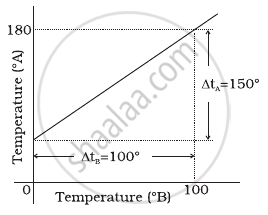
The graph between two temperature scales A and B is shown in figure. Between upper fixed point and lower fixed point there are 150 equal division on scale A and 100 on scale B. The relationship for conversion between the two scales is given by ______.
The Zeroth Law of Thermodynamics is the basis for which of the following?
Which thermometer is considered the most accurate?
Convert 37 °C (normal body temperature) to Kelvin.
A mercury thermometer is placed under a patient's tongue. Which sequence correctly describes what happens before a reading is taken?
A mercury thermometer has a column length of 20 mm at the ice point and 170 mm at the steam point. If the column length is 65 mm, what is the temperature?
Which of the following is NOT a characteristic of a good thermometer?
