Advertisements
Advertisements
Let An be the area enclosed by the nth orbit in a hydrogen atom. The graph of ln (An/A1) against ln(n)
(a) will pass through the origin
(b) will be a straight line with slope 4
(c) will be a monotonically increasing nonlinear curve
(d) will be a circle
Concept: undefined >> undefined
Ionization energy of a hydrogen-like ion A is greater than that of another hydrogen-like ion B. Let r, u, E and L represent the radius of the orbit, speed of the electron, energy of the atom and orbital angular momentum of the electron respectively. In ground state
Concept: undefined >> undefined
Advertisements
Calculate the smallest wavelength of radiation that may be emitted by (a) hydrogen, (b) He+ and (c) Li++.
Concept: undefined >> undefined
Find the binding energy of a hydrogen atom in the state n = 2.
Concept: undefined >> undefined
Find the radius and energy of a He+ ion in the states (a) n = 1, (b) n = 4 and (c) n = 10.
Concept: undefined >> undefined
A hydrogen atom emits ultraviolet radiation of wavelength 102.5 nm. What are the quantum numbers of the states involved in the transition?
Concept: undefined >> undefined
(a) Find the first excitation potential of He+ ion. (b) Find the ionization potential of Li++ion.
Concept: undefined >> undefined
A group of hydrogen atoms are prepared in n = 4 states. List the wavelength that are emitted as the atoms make transitions and return to n = 2 states.
Concept: undefined >> undefined
Find the maximum Coulomb force that can act on the electron due to the nucleus in a hydrogen atom.
Concept: undefined >> undefined
A hydrogen atom in a state having a binding energy of 0.85 eV makes transition to a state with excitation energy 10.2 e.V (a) Identify the quantum numbers n of the upper and the lower energy states involved in the transition. (b) Find the wavelength of the emitted radiation.
Concept: undefined >> undefined
Whenever a photon is emitted by hydrogen in Balmer series, it is followed by another photon in Lyman series. What wavelength does this latter photon correspond to?
Concept: undefined >> undefined
A hydrogen atom in state n = 6 makes two successive transitions and reaches the ground state. In the first transition a photon of 1.13 eV is emitted. (a) Find the energy of the photon emitted in the second transition (b) What is the value of n in the intermediate state?
Concept: undefined >> undefined
What is the energy of a hydrogen atom in the first excited state if the potential energy is taken to be zero in the ground state?
Concept: undefined >> undefined
In a photo diode, the conductive increases when the material is exposed to light. It is found that the conductivity changes only if the wavelength is less than 620 nm. What is the band gap?
(Use Planck constant h = 4.14 × 10⁻¹⁵ eV-s, Boltzmann constant k = 8·62 × 10-5 eV/K.)
Concept: undefined >> undefined
A gas of hydrogen-like ions is prepared in a particular excited state A. It emits photons having wavelength equal to the wavelength of the first line of the Lyman series together with photons of five other wavelengths. Identify the gas and find the principal quantum number of the state A.
Concept: undefined >> undefined
Find the maximum angular speed of the electron of a hydrogen atom in a stationary orbit.
Concept: undefined >> undefined
Suppose, in certain conditions only those transitions are allowed to hydrogen atoms in which the principal quantum number n changes by 2. (a) Find the smallest wavelength emitted by hydrogen. (b) List the wavelength emitted by hydrogen in the visible range (380 nm to 780 nm).
Concept: undefined >> undefined
Find the mutual inductance between the straight wire and the square loop of figure.
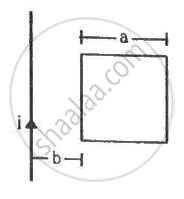
Concept: undefined >> undefined
Find the mutual inductance between the circular coil and the loop shown in figure.
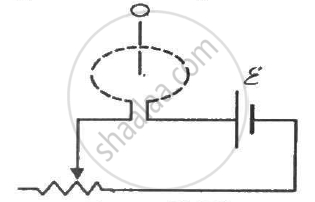
Concept: undefined >> undefined
The current in a long solenoid of radius R and having n turns per unit length is given by i= i0 sin ωt. A coil having N turns is wound around it near the centre. Find (a) the induced emf in the coil and (b) the mutual inductance between the solenoid ant the coil.
Concept: undefined >> undefined
