Please select a subject first
Advertisements
Advertisements
Select the correct option.
Thrust acting perpendicularly on the unit surface area is called
Concept: undefined >> undefined
What do you understand by the Light?
Concept: undefined >> undefined
Advertisements
What do you understand by the Diffused Light?
Concept: undefined >> undefined
Why are infinite images not seen when two plane mirrors are facing each other?
Concept: undefined >> undefined
State three ways in which the image formed in a plane mirror differs from the image formed in a pin hole camera.
Concept: undefined >> undefined
Draw a neat diagram of reflecting periscope.
Concept: undefined >> undefined
State two advantages and two disadvantages of the reflecting periscope.
Concept: undefined >> undefined
Write down four characteristics of image formed in a plane mirror.
Concept: undefined >> undefined
How many images will be formed when an object is placed between two parallel plane mirrors with their reflecting surfaces facing each other? Why do more distant images appear fainter?
Concept: undefined >> undefined
Describe the principle of simple periscope through an outline ray diagram. Give one of its uses.
Concept: undefined >> undefined
Draw diagrams to show the difference between regular and irregular reflection.
Concept: undefined >> undefined
An object is placed 2 cm from a plane mirror. If the object is moved by 1 cm towards the mirror, what will be the distance between the object and its new image?
Concept: undefined >> undefined
An object 3 cm high produces a real image 4.5 cm high when placed at a distance of 20 cm from a concave mirror. Calculate:
- the position of image
- focal length of the concave mirror.
Concept: undefined >> undefined
An object 1.5 cm high when placed in front of a concave. the mirror produces a virtual image 3 cm high. If the object is placed at a distance of 6 cm from the pole of the mirror, calculate:
- the position of the image
- the focal length of the mirror.
Concept: undefined >> undefined
A converging mirror, forms three times magnified virtual image when an object is placed at a distance of 8 cm from it. Calculate:
- the position of the image
- the focal length of the mirror.
Concept: undefined >> undefined
The base of the cylindrical vessel measures 300 cm2. Water is poured into it up to a depth of 6 cm. Calculate the pressure of water on the base in the vessel.
Concept: undefined >> undefined
Pressure in a water pipe on the ground floor of a building is 100,000 Pa. Calculate the pressure in the water pipe on the first floor at a height of 3 m. [Density of water = 1000 kgm−3 ; g = 10 ms−2]
Concept: undefined >> undefined
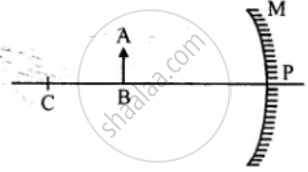
Copy the figure. By taking two rays from point A, show the formation of image. State four characteristics of the image.
Concept: undefined >> undefined
