Advertisements
Advertisements
Mr. Sharma lends ₹24,000 at 13% p.a. simple interest and an equal sum at 12% p.a. compound interest. Find the total interest earned by Mr. Sharma in 2 years.
Concept: undefined >> undefined
Peter borrows ₹ 12,000 for 2 years at 10% p.a. compound interest. He repays ₹ 8,000 at the end of the first year. Find:
- the amount at the end of the first year, before making the repayment.
- the amount at the end of the first year, after making the repayment.
- the principal for the second year.
- the amount to be paid at the end of the second year, to clear the account.
Concept: undefined >> undefined
Advertisements
Solve the following equation:
20 = 6 + 2x
Concept: undefined >> undefined
Solve the following equation:
15 + x = 5x + 3
Concept: undefined >> undefined
Solve the following equation:
`(3"x" + 2)/("x" - 6) = -7`
Concept: undefined >> undefined
The length of a rectangle is 16 cm and its perimeter is equal to the perimeter of a square with side 12.5 cm. Find the area of the rectangle.
Concept: undefined >> undefined
A certain sum of money invested for 5 years at 8% p.a. simple interest earns an interest of ₹ 12,000. Find:
(i) the sum of money.
(ii) the compound interest earned by this money in two years and at 10% p.a. compound interest.
Concept: undefined >> undefined
Each side of a rectangle is doubled. Find the ratio between :
(i) perimeters of the original rectangle and the resulting rectangle.
(ii) areas of the original rectangle and the resulting rectangle.
Concept: undefined >> undefined
In each of the following cases, ABCD is a square and PQRS is a rectangle. Find, in each case, the area of the shaded portion.
(All measurements are in metre).
(i)
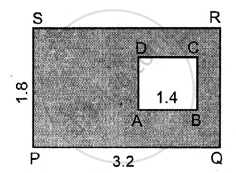
(ii)
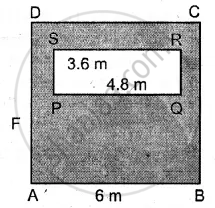
Concept: undefined >> undefined
The length and the breadth of a rectangular field are in the ratio 5: 4 and its area is 3380 m2. Find the cost of fencing it at the rate of ₹75 per m.
Concept: undefined >> undefined
A path of uniform width, 2.5 m, runs around the inside of a rectangular field 30 m by 27 m. Find the area of the path.
Concept: undefined >> undefined
A rectangular field is 30 m in length and 22m in width. Two mutually perpendicular roads, each 2.5 m wide, are drawn inside the field so that one road is parallel to the length of the field and the other road is parallel to its width. Calculate the area of the crossroads.
Concept: undefined >> undefined
The length and the breadth of a conference hall are in the ratio 7: 4 and its perimeter is 110 m. Find:
(i) area of the floor of the hall.
(ii) a number of tiles, each a rectangle of size 25 cm x 20 cm, required for the flooring of the hall.
(iii) the cost of the tiles at the rate of ₹ 1,400 per hundred tiles.
Concept: undefined >> undefined
In which of the following table, x and y vary directly:
| x | 3 | 5 | 8 | 11 |
| y | 4.5 | 7.5 | 12 | 16.5 |
Concept: undefined >> undefined
In which of the following table, x and y vary directly:
| x | 16 | 30 | 40 | 56 |
| y | 32 | 60 | 80 | 84 |
Concept: undefined >> undefined
Solve the following equation:
`(3"x")/("x" + 6) - "x"/("x" + 5) = 2`
Concept: undefined >> undefined
In which of the following table, x and y vary directly:
| x | 27 | 45 | 54 | 75 |
| y | 81 | 180 | 216 | 225 |
Concept: undefined >> undefined
Solve the following equation:
`1/("x - 1") + 2/("x" - 2) = 3/("x" - 3)`
Concept: undefined >> undefined
Solve the following equation:
`("x" - 1)/("7x" - 14) = ("x" - 3)/("7x" - 26)`
Concept: undefined >> undefined
Solve the following equation:
`1/("x" - 1) - 1/"x" = 1/("x" + 3) - 1/("x" + 4)`
Concept: undefined >> undefined
