Please select a subject first
Advertisements
Advertisements
Photosynthesis in green plants is directly and indirectly dependent on so many plant structures.
Explain briefly the role of the following structures in this process is Phloem tissue in the leaf veins.
Concept: undefined >> undefined
Photosynthesis in green plants is directly and indirectly dependent on so many plant structures.
Explain briefly the role of the following structures in this process is Stomata.
Concept: undefined >> undefined
Advertisements
A plant hormone related with inhibition of senescence is
Concept: undefined >> undefined
Apical dominance phenomenon is caused by
Concept: undefined >> undefined
Which of the following hormones regulate stomatal colour?
Concept: undefined >> undefined
Auxins are abundantly produced in
Concept: undefined >> undefined
Common gibberellin is
Concept: undefined >> undefined
Match the items in column A with those of column B.
| Column A | Column B | ||
| (a) | Auxin | (i) | apical dominance |
| (b) | Gibberellin | (ii) | cell-division |
| (c) | Cytokinin | (iii) | fruit ripening |
| (d) | Ethylene | (iv) | internodal elongation |
Concept: undefined >> undefined
Name the following:
Hormone that stimulates growth by cell division.
Concept: undefined >> undefined
Name the following:
Growth-retarding hormone in plants.
Concept: undefined >> undefined
List five plant growth hormones and briefly describe their roles.
Concept: undefined >> undefined
The tea plants are never allowed to grow lengthwise. This is done by cutting their apical buds, a process known as pruning. In this way, tea plants get a dense growth and easy yield. Answer the following questions:
- Name the scientific phenomenon that is being overcome by pruning.
- What plant hormone is responsible for the scientific phenomenon mentioned in (a)?
- Name one plant hormone which inhibits the said phenomenon.
Concept: undefined >> undefined
The tea plants are never allowed to grow lengthwise. This is done by cutting their apical buds, a process known as pruning. In this way, tea plants get a dense growth and easy yield. Answer the following question :
What plant hormone is responsible for the scientific phenomenon mentioned in 1.1.
Concept: undefined >> undefined
The tea plants are never allowed to grow lengthwise. This is done by cutting their apical buds, a process known as pruning. In this way, tea plants get a dense growth and easy yield. Answer the following question :
Name one plant hormone which inhibits the said phenomenon.
Concept: undefined >> undefined
The figure given below shows the stages of ripening in a banana. Answer the question that follow:
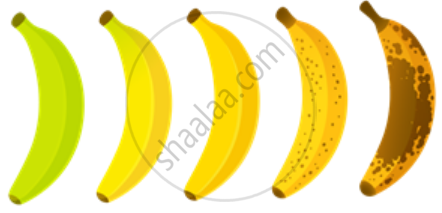
Mention two characteristic features of this hormone.
Concept: undefined >> undefined
Explain the following term :
Gray matter
Concept: undefined >> undefined
State any four major activities of the Red Cross Society.
Concept: undefined >> undefined
Explain the Term: Disinfectants
Concept: undefined >> undefined
Explain the Term: Antiseptics
Concept: undefined >> undefined
