Advertisements
Advertisements
A cell is used to send current to an external circuit.
- How does the voltage across its terminals compare with its e.m.f.?
- Under what condition is the e.m.f. of a cell equal to its terminal voltage?
Concept: undefined >> undefined
How is the working of an electric bell affected, if alternating current be used instead of direct current?
Concept: undefined >> undefined
Advertisements
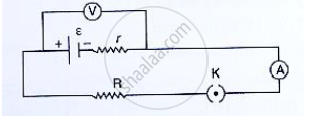
The diagram below in Fig. 8.40 shows a cell of e.m.f. ε = 2 volt and internal resistance r = 1 ohm to an external resistance R = 4 ohm. The ammeter A measures the current in the circuit and the
voltmeter V measures the terminal voltage across the cell. What will be the readings of the ammeter and voltmeter when (i) the key K is open, (ii) the key K is closed.
Concept: undefined >> undefined
A battery of e.m.f 3.0 V supplies current through a circuit in which the resistance can be changed.
A high resistance voltmeter is connected across the battery. When the current is 1.5 A, the voltmeter reads 2.7 V. Find the internal resistance of the battery.
Concept: undefined >> undefined
A cell of e.m.f. 1.8V and internal resistance 2Ω is connected in series with an ammeter of resistance 0.7Ω and a resistor of 4.5Ω as shown in Fig.
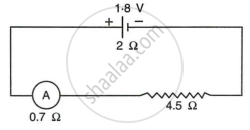
- What would be the reading of the ammeter?
- What is the potential difference across the terminals of the cell?
Concept: undefined >> undefined
A battery of e.m.f. 15 V and internal resistance 3 ohm is connected to two resistors of resistances 3 ohm and 6 ohm is series Find:
(a) the current through the battery
(b) the p.d. between the terminals of the battery.
Concept: undefined >> undefined
A cell of e.m.f. ε and internal resistance 𝔯 sends current 1.0 A when it is connected to an external resistance 1.9 Ω. But it sends current 0.5 A when it is connected to an external resistance 3.9 Ω. Calculate the values of ε and 𝔯.
Concept: undefined >> undefined
Describe one experiment to demonstrate the phenomenon of electromagnetic induction.
Concept: undefined >> undefined
Name the type of energy (kinetic energy K or potential energy U) possessed in the following case:
A piece of stone placed on the roof.
Concept: undefined >> undefined
- What kind of energy change takes place when a magnet is moved towards a coil having a galvanometer at its ends?
- Name the phenomenon.
Concept: undefined >> undefined
State different forms of potential energy and give one example of each.
Concept: undefined >> undefined
Write an expression for the potential energy of a body of mass m placed at a height h above the earth's surface. State the assumptions made, if any.
Concept: undefined >> undefined
Name the form of energy which a body may possess even when it is not in motion. Give an example to support your answer.
Concept: undefined >> undefined
What do you understand by the kinetic energy of a body?
Concept: undefined >> undefined
In which of the following case does the electromagnetic induction occur?
The current is stopped in a wire held near a loop of wire .
Concept: undefined >> undefined
In which of the following case does the electromagnetic induction occur?
A magnet is moved through a loop of wire .
Concept: undefined >> undefined
In which of the following case does the electromagnetic induction occur?
A loop of wire is held near a magnet.
Concept: undefined >> undefined
A body of mass m is moving with a velocity v. Write the expression for its kinetic energy.
Concept: undefined >> undefined
State the work energy theorem.
Concept: undefined >> undefined
A light mass and a heavy mass have equal momentum. Which will have more kinetic energy?
(Hint : Kinetic energy K = P2/2m where P is the momentum.)
Concept: undefined >> undefined
