Advertisements
Advertisements
Explain the following phenomena with the help of Henry’s law.
Feeling of weakness and discomfort in breathing at high altitude.
Concept: undefined >> undefined
Account for the following:
There are 5 OH groups in glucose
Concept: undefined >> undefined
Advertisements
Account for the following:
What happens when D – glucose is treated with the following reagents
Bromine water
Concept: undefined >> undefined
Account for the following:
What happens when D – glucose is treated with the following reagents
HNO3
Concept: undefined >> undefined
State Henry’s law and explain why are the tanks used by scuba divers filled with air diluted with helium (11.7% helium, 56.2% nitrogen and 32.1% oxygen)?
Concept: undefined >> undefined
Assume that argon exerts a partial pressure of 6 bar. Calculate the solubility of argon gas in water. (Given Henry’s law constant for argon dissolved in water, KH = 40 k bar)
Concept: undefined >> undefined
Arrange the following in the increasing order of their property indicated:
Ethanal, Propanone, Propanal, Butanone (reactivity towards nucleophilic addition)
Concept: undefined >> undefined
Observe the graph shown in figure and answer the following questions:
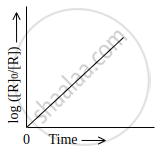
- What is the order of the reaction?
- What is the slope of the curve?
- Write the relationship between k and t1/2 (half life period).
Concept: undefined >> undefined
What happens when propanone is treated with CH3MgBr and then hydrolysed?
Concept: undefined >> undefined
What happens when ethanal is treated with excess ethanol and acid?
Concept: undefined >> undefined
Which will undergo faster nucleophilic addition reaction?
Acetaldehyde or Propanone
Concept: undefined >> undefined
The slope in the plot of ln[R] vs. time for a first order reaction is ______.
Concept: undefined >> undefined
Which of the following is most reactive in nucleophilic addition reactions?
Concept: undefined >> undefined
Draw the geometrical isomers of [Co(en)2Cl2]2+. Which geometrical isomer of [Co(en)2Cl2]2+ is not optically active and why?
Concept: undefined >> undefined
The following questions are case-based questions. Read the passage carefully and answer the questions that follow:
| The carbon-oxygen double bond is polarised in aldehydes and ketones due to higher electronegativity of oxygen relative to carbon. Therefore, they undergo nucleophilic addition reactions with a number of nucleophiles such as HCN, NaHSO3, alcohols, ammonia derivatives and Grignard reagents. Aldehydes are easily oxidised by mild oxidising agents as compared to ketones. The carbonyl group of carboxylic acid does not give reactions of aldehydes and ketones. Carboxylic acids are considerably more acidic than alcohols and most of simple phenols. |
Answer the following:
(a) Write the name of the product when an aldehyde reacts with excess alcohol in the presence of dry HCl. (1)
(b) Why carboxylic acid is a stronger acid than phenol? (1)
(c) (i) Arrange the following compounds in increasing order of their reactivity towards CH3MgBr: (1)
CH3CHO, \[\begin{array}{cc}
\ce{(CH3)3C-C-CH3}\\
\phantom{....}||\\
\phantom{....}\ce{O}
\end{array}\], \[\begin{array}{cc}
\ce{CH3-C-CH3}\\
||\\
\ce{O}
\end{array}\]
(ii) Write a chemical test to distinguish between propanal and propanone. (1)
OR
(c) Write the main product in the following: (2)
| (i) | 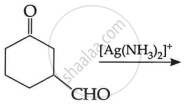 |
| (ii) |  |
Concept: undefined >> undefined
Arrange the following in increasing order of their boiling point:
C2H5OH, C2H5NH2, (C2H5)3N
Concept: undefined >> undefined
Aldehydes and ketones react with hydroxylamine to form ______.
Concept: undefined >> undefined
The slope in the plot of `log ["R"]_0/(["R"])` Vs. time for a first-order reaction is ______.
Concept: undefined >> undefined
When D-glucose reacts with HI, it forms ______.
Concept: undefined >> undefined
Solubility of gas in liquid decreases with increase in ______.
Concept: undefined >> undefined
