English

Science (English Medium) Class 12 - CBSE Question Bank Solutions for Physics

Advertisements
[object Object]
[object Object]
Subjects
Popular subjects
Topics
Advertisements
Advertisements
Physics
< prev  1661 to 1680 of 4193  next > 

The emf induced across the ends of a conductor due to its motion in a magnetic field is called motional emf. It is produced due to magnetic Lorentz force acting on the free electrons of the conductor. For a circuit shown in the figure, if a conductor of length l moves with velocity v in a magnetic field B perpendicular to both its length and the direction of the magnetic field, then all the induced parameters are possible in the circuit.

Direction of current induced in a wire moving in a magnetic field is found using ______.

[6] Electromagnetic Induction
Chapter: [6] Electromagnetic Induction
Concept: undefined >> undefined

The emf induced across the ends of a conductor due to its motion in a magnetic field is called motional emf. It is produced due to magnetic Lorentz force acting on the free electrons of the conductor. For a circuit shown in the figure, if a conductor of length l moves with velocity v in a magnetic field B perpendicular to both its length and the direction of the magnetic field, then all the induced parameters are possible in the circuit.

A conducting rod of length l is moving in a transverse magnetic field of strength B with velocity v. The resistance of the rod is R. The current in the rod is ______.

[6] Electromagnetic Induction
Chapter: [6] Electromagnetic Induction
Concept: undefined >> undefined

Advertisements

The emf induced across the ends of a conductor due to its motion in a magnetic field is called motional emf. It is produced due to magnetic Lorentz force acting on the free electrons of the conductor. For a circuit shown in the figure, if a conductor of length l moves with velocity v in a magnetic field B perpendicular to both its length and the direction of the magnetic field, then all the induced parameters are possible in the circuit.

A 0.1 m long conductor carrying a current of 50 A is held perpendicular to a magnetic field of 1.25 mT. The mechanical power required to move the conductor with a speed of 1 ms-1 is ______.

[6] Electromagnetic Induction
Chapter: [6] Electromagnetic Induction
Concept: undefined >> undefined

The emf induced across the ends of a conductor due to its motion in a magnetic field is called motional emf. It is produced due to magnetic Lorentz force acting on the free electrons of the conductor. For a circuit shown in the figure, if a conductor of length l moves with velocity v in a magnetic field B perpendicular to both its length and the direction of the magnetic field, then all the induced parameters are possible in the circuit.

A bicycle generator creates 1.5 V at 15 km/hr. The EMF generated at 10 km/hr is ______.

[6] Electromagnetic Induction
Chapter: [6] Electromagnetic Induction
Concept: undefined >> undefined

An e.m.f is produced in a coil, which is not connected to an external voltage source. This can be due to ______.

  1. the coil being in a time varying magnetic field.
  2. the coil moving in a time varying magnetic field.
  3. the coil moving in a constant magnetic field.
  4. the coil is stationary in external spatially varying magnetic field, which does not change with time.
[6] Electromagnetic Induction
Chapter: [6] Electromagnetic Induction
Concept: undefined >> undefined

A circular coil expands radially in a region of magnetic field and no electromotive force is produced in the coil. This can be because ______.

  1. the magnetic field is constant.
  2. the magnetic field is in the same plane as the circular coil and it may or may not vary.
  3. the magnetic field has a perpendicular (to the plane of the coil) component whose magnitude is decreasing suitably.
  4. there is a constant magnetic field in the perpendicular (to the plane of the coil) direction.
[6] Electromagnetic Induction
Chapter: [6] Electromagnetic Induction
Concept: undefined >> undefined

Find the current in the wire for the configuration shown in figure. Wire PQ has negligible resistance. B, the magnetic field is coming out of the paper. θ is a fixed angle made by PQ travelling smoothly over two conducting parallel wires separated by a distance d.

[6] Electromagnetic Induction
Chapter: [6] Electromagnetic Induction
Concept: undefined >> undefined

A magnetic field B = Bo sin ( ωt )`hatk` wire AB slides smoothly over two parallel conductors separated by a distance d (Figure). The wires are in the x-y plane. The wire AB (of length d) has resistance R and the parallel wires have negligible resistance. If AB is moving with velocity v, what is the current in the circuit. What is the force needed to keep the wire moving at constant velocity?

[6] Electromagnetic Induction
Chapter: [6] Electromagnetic Induction
Concept: undefined >> undefined

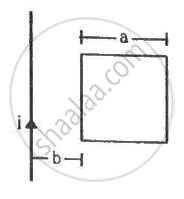
A rectangular loop of wire ABCD is kept close to an infinitely long wire carrying a current I(t) = Io (1 – t/T) for 0 ≤ t ≤ T and I(0) = 0 for t > T (Figure). Find the total charge passing through a given point in the loop, in time T. The resistance of the loop is R.

[6] Electromagnetic Induction
Chapter: [6] Electromagnetic Induction
Concept: undefined >> undefined

A rod of mass m and resistance R slides smoothly over two parallel perfectly conducting wires kept sloping at an angle θ with respect to the horizontal (Figure). The circuit is closed through a perfect conductor at the top. There is a constant magnetic field B along the vertical direction. If the rod is initially at rest, find the velocity of the rod as a function of time.

[6] Electromagnetic Induction
Chapter: [6] Electromagnetic Induction
Concept: undefined >> undefined

Find the current in the sliding rod AB (resistance = R) for the arrangement shown in figure. B is constant and is out of the paper. Parallel wires have no resistance. v is constant. Switch S is closed at time t = 0.

[6] Electromagnetic Induction
Chapter: [6] Electromagnetic Induction
Concept: undefined >> undefined

Find the current in the sliding rod AB (resistance = R) for the arrangement shown in figure. B is constant and is out of the paper. Parallel wires have no resistance. v is constant. Switch S is closed at time t = 0.

[6] Electromagnetic Induction
Chapter: [6] Electromagnetic Induction
Concept: undefined >> undefined

If the rms current in a 50 Hz ac circuit is 5 A, the value of the current 1/300 seconds after its value becomes zero is ______.

[7] Alternating Current
Chapter: [7] Alternating Current
Concept: undefined >> undefined

To reduce the resonant frequency in an LCR series circuit with a generator ______.

[7] Alternating Current
Chapter: [7] Alternating Current
Concept: undefined >> undefined

Which of the following combinations should be selected for better tuning of an LCR circuit used for communication?

[7] Alternating Current
Chapter: [7] Alternating Current
Concept: undefined >> undefined

As the frequency of an ac circuit increases, the current first increases and then decreases. What combination of circuit elements is most likely to comprise the circuit?

  1. Inductor and capacitor.
  2. Resistor and inductor.
  3. Resistor and capacitor.
  4. Resistor, inductor and capacitor.
[7] Alternating Current
Chapter: [7] Alternating Current
Concept: undefined >> undefined

In series LCR circuit, the plot of Imax vs ω is shown in figure. Find the bandwidth and mark in the figure.

[7] Alternating Current
Chapter: [7] Alternating Current
Concept: undefined >> undefined

A coil of 0.01 henry inductance and 1 ohm resistance is connected to 200 volt, 50 Hz ac supply. Find the impedance of the circuit and time lag between max. alternating voltage and current.

[7] Alternating Current
Chapter: [7] Alternating Current
Concept: undefined >> undefined

Consider the LCR circuit shown in figure. Find the net current i and the phase of i. Show that i = v/Z`. Find the impedance Z for this circuit.

[7] Alternating Current
Chapter: [7] Alternating Current
Concept: undefined >> undefined

For an LCR circuit driven at frequency ω, the equation reads

`L (di)/(dt) + Ri + q/C = v_i = v_m` sin ωt

  1. Multiply the equation by i and simplify where possible.
  2. Interpret each term physically.
  3. Cast the equation in the form of a conservation of energy statement.
  4. Integrate the equation over one cycle to find that the phase difference between v and i must be acute.
[7] Alternating Current
Chapter: [7] Alternating Current
Concept: undefined >> undefined
< prev  1661 to 1680 of 4193  next > 
Advertisements
Advertisements
CBSE Science (English Medium) Class 12 Question Bank Solutions
Question Bank Solutions for CBSE Science (English Medium) Class 12 Biology
Question Bank Solutions for CBSE Science (English Medium) Class 12 Chemistry
Question Bank Solutions for CBSE Science (English Medium) Class 12 Computer Science (C++)
Question Bank Solutions for CBSE Science (English Medium) Class 12 Computer Science (Python)
Question Bank Solutions for CBSE Science (English Medium) Class 12 English Core
Question Bank Solutions for CBSE Science (English Medium) Class 12 English Elective - NCERT
Question Bank Solutions for CBSE Science (English Medium) Class 12 Entrepreneurship
Question Bank Solutions for CBSE Science (English Medium) Class 12 Geography
Question Bank Solutions for CBSE Science (English Medium) Class 12 Hindi (Core)
Question Bank Solutions for CBSE Science (English Medium) Class 12 Hindi (Elective)
Question Bank Solutions for CBSE Science (English Medium) Class 12 History
Question Bank Solutions for CBSE Science (English Medium) Class 12 Informatics Practices
Question Bank Solutions for CBSE Science (English Medium) Class 12 Mathematics
Question Bank Solutions for CBSE Science (English Medium) Class 12 Physical Education
Question Bank Solutions for CBSE Science (English Medium) Class 12 Physics
Question Bank Solutions for CBSE Science (English Medium) Class 12 Political Science
Question Bank Solutions for CBSE Science (English Medium) Class 12 Psychology
Question Bank Solutions for CBSE Science (English Medium) Class 12 Sanskrit (Core)
Question Bank Solutions for CBSE Science (English Medium) Class 12 Sanskrit (Elective)
Question Bank Solutions for CBSE Science (English Medium) Class 12 Sociology
Share
Notifications

Englishहिंदीमराठी


      Forgot password?
Use app×