Please select a subject first
Advertisements
Advertisements
An electron makes 3 × 10⁵ revolutions per second in a circle of radius 0.5 angstrom. Find the magnetic field B at the centre of the circle.
Concept: undefined >> undefined
Calculate the amplification factor of a triode valve that has plate resistance of 2 kΩ and transconductance of 2 millimho.
Concept: undefined >> undefined
Advertisements
The plate resistance and amplification factor of a triode are 10kΩ and 20. The tube is operated at plate voltage 250 V and grid voltage −7.5 V. The plate current is 10 mA. (a) To what value should the grid voltage be changed so as to increase the plate current to 15 mA? (b) To what value should the plate voltage be changed to take the plate current back to 10 mA?
Concept: undefined >> undefined
The plate current, plate voltage and grid voltage of a 6F6 triode tube are related as ip = 41 (Vp + 7 Vg)1.41
Here, Vp and Vg are in volts and ip in microamperes.
The tube is operated at Vp = 250 V, Vg = −20 V. Calculate (a) the tube current, (b) the plate resistance, (c) the mutual conductance and (d) the amplification factor.
Concept: undefined >> undefined
A triode has mutual conductance of 2.0 millimho and plate resistance of 20 kΩ. It is desired to amplify a signal by a factor of 30. What load resistance should be added in the circuit?
Concept: undefined >> undefined
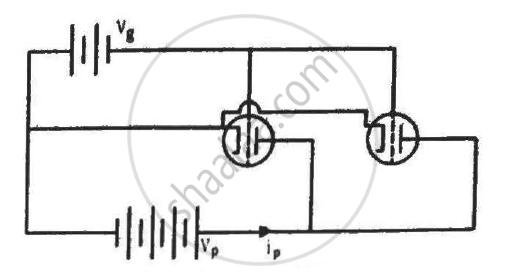
The figure shows two identical triode tubes connected in parallel. The anodes are connected together and the cathodes are connected together. Show that the equivalent plate resistance is half the individual plate resistance, the equivalent mutual conductance is double the individual mutual conductance and the equivalent amplification factor is the same as the individual amplification factor.
Concept: undefined >> undefined
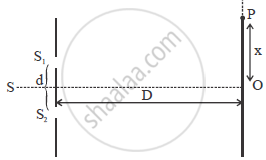
The intensity at the central maximum (O) in a Young’s double slit experimental set-up shown in the figure is IO. If the distance OP equals one-third of the fringe width of the pattern, show that the intensity at point P, would equal `(I_0)/4`.
Concept: undefined >> undefined
In Young’s double slit experiment, the slits are separated by 0.5 mm and screen is placed 1.0 m away from the slit. It is found that the 5th bright fringe is at a distance of 4.13 mm from the 2nd dark fringe. Find the wavelength of light used.
Concept: undefined >> undefined
An equilateral glass prism has a refractive index 1.6 in the air. Calculate the angle of minimum deviation of the prism, when kept in a medium of refractive index `4sqrt(2)"/"5.`
Concept: undefined >> undefined
Answer the following question.
Describe any two characteristic features which distinguish between interference and diffraction phenomena. Derive the expression for the intensity at a point of the interference pattern in Young's double-slit experiment.
Concept: undefined >> undefined
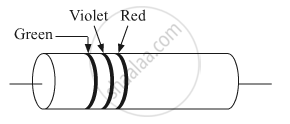
A carbon resistor is shown in the figure. Using color code, write the value of the resistance.
Concept: undefined >> undefined
How does the angle of minimum deviation of a glass prism vary if the incident violet light is replaced by red light?
Concept: undefined >> undefined
The ______, a property of materials C, Si, and Ge depends upon the energy gap between their conduction and valence bands.
Concept: undefined >> undefined
Two cells of 1.25 V and 0.75 V are connected in series with anode of one connected to cathode of the other. The effective voltage will be ______.
Concept: undefined >> undefined
The magnetic field lines ______.
Concept: undefined >> undefined
If we have two coherent sources S1 and S2 vibrating in phase, then for an arbitrary point P constructive interference is observed whenever the path difference is ______.
Concept: undefined >> undefined
A long, hollow conducting cylinder is kept coaxially inside another long, hollow conducting cylinder of larger radius. Both the cylinders are initially electrically neutral ______.
Concept: undefined >> undefined
Consider a current carrying wire (current I) in the shape of a circle.
Concept: undefined >> undefined
Assertion: Bending a wire does not effect electrical resistance.
Reason: Resistance of wire is proportional to resistivity of material.
Concept: undefined >> undefined
Concept: undefined >> undefined
