Please select a subject first
Advertisements
Advertisements
A small compass needle of magnetic moment ‘m’ is free to turn about an axis perpendicular to the direction of uniform magnetic field ‘B’. The moment of inertia of the needle about the axis is ‘I’. The needle is slightly disturbed from its stable position and then released. Prove that it executes simple harmonic motion. Hence deduce the expression for its time period.
Concept: undefined >> undefined
Name the device which is used as a voltage regulator. Draw the necessary circuit diagram and explain its working?
Concept: undefined >> undefined
Advertisements
A short bar magnet of magnetic moment 0.9 J/T is placed with its axis at 30° to a uniform magnetic field. It experiences a torque of 0.063 J.
(i) Calculate the magnitude of the magnetic field.
(ii) In which orientation will the bar magnet be in stable equilibrium in the magnetic field?
Concept: undefined >> undefined
Draw the I − V characteristics of zener diode and explain briefly how reverse current suddenly increase at the breakdown voltage.
Concept: undefined >> undefined
Describe briefly with the help of a circuit diagram how a zener diode works to obtain a constant dc voltage from the unregulated dc output of a rectifier ?
Concept: undefined >> undefined
Trace the rays of light showing the formation of an image due to a point object placed on the axis of a spherical surface separating the two media of refractive indices n1 and n2. Establish the relation between the distances of the object, the image and the radius of curvature from the central point of the spherical surface.
Hence derive the expression of the lens maker’s formula.
Concept: undefined >> undefined
Can a virtual image be photographed by a camera?
Concept: undefined >> undefined
If a spherical mirror is dipped in water, does its focal length change?
Concept: undefined >> undefined
If a thin lens is dipped in water, does its focal length change?
Concept: undefined >> undefined
Four modifications are suggested in the lens formula to include the effect of the thickness t of the lens. Which one is likely to be correct?
Concept: undefined >> undefined
Can a charged particle be accelerated by a magnetic field? Can its speed be increased?
Concept: undefined >> undefined
Which of the following particles will have minimum frequency of revolution when projected with the same velocity perpendicular to a magnetic field?
Concept: undefined >> undefined
A particle moves in a region with a uniform magnetic field and a parallel, uniform electric field. At some instant, the velocity of the particle is perpendicular to the field direction. The path of the particle will be
Concept: undefined >> undefined
You are facing a circular wire carrying an electric current. The current is clockwise as seen by you. Is the field at the centre coming towards you or going away from you?
Concept: undefined >> undefined
A vertical wire carries a current in upward direction. An electron beam sent horizontally towards the wire will be deflected
Concept: undefined >> undefined
Two parallel wires carry currents of 20 A and 40 A in opposite directions. Another wire carying a current anti parallel to 20 A is placed midway between the two wires. T he magnetic force on it will be
Concept: undefined >> undefined
A wire of length l carries a current i long the x-axis. A magnetic field exists, which is given as `vecB = B_0 (veci + vecj + veck)` T. Find the magnitude of the magnetic force acting on the wire.
Concept: undefined >> undefined
A current of 5.0 A exists in the circuit shown in the figure. The wire PQ has a length of 50 cm and the magnetic field in which it is immersed has a magnitude of 0.20 T. Find the magnetic force acting on the wire PQ.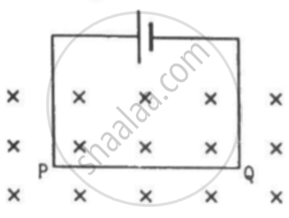
Concept: undefined >> undefined
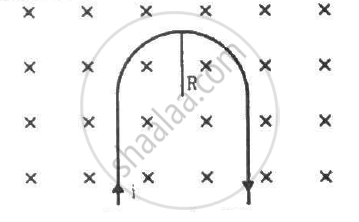
A rigid wire consists of a semi-circular portion of radius R and two straight sections (figure). The wire is partially immersed in a perpendicular magnetic field B, as shown in the figure. Find the magnetic force on the wire if it carries a current i.
Concept: undefined >> undefined
Consider a non-conducting plate of radius r and mass m that has a charge q distributed uniformly over it. The plate is rotated about its axis with an angular speed ω. Show that the magnetic moment µ and the angular momentum l of the plate are related as `mu = q/(2 m)l`
Concept: undefined >> undefined
