Please select a subject first
Advertisements
Advertisements
Three infinitely long parallel straight current-carrying wires A, B and C are kept at equal distance from each other as shown in the figure. The wire C experiences net force F. The net force on wire C, when the current in wire A is reversed will be ______.

Concept: undefined >> undefined
Draw a ray diagram of compound microscope for the final image formed at least distance of distinct vision?
Concept: undefined >> undefined
Advertisements
An angular magnification of 30X is desired using an objective of focal length 1.25 cm and an eye piece of focal length 5 cm. How will you set up the compound microscope for the final image formed at least distance of distinct vision?
Concept: undefined >> undefined
Figure shows some equipotential lines distributed in space. A charged object is moved from point A to point B.
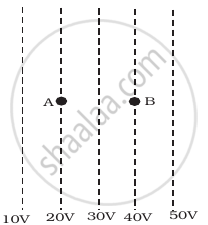 |
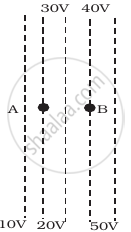 |
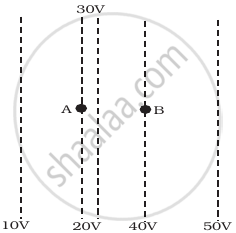 |
| (i) | (ii) | (iii) |
Concept: undefined >> undefined
Two batteries of emf ε1 and ε2 (ε2 > ε1) and internal resistances r1 and r2 respectively are connected in parallel as shown in figure.

Concept: undefined >> undefined
A cell of emf E and internal resistance r is connected across an external resistance R. Plot a graph showing the variation of P.D. across R, versus R.
Concept: undefined >> undefined
Do magnetic forces obey Newton’s third law. Verify for two current elements dl1 = dlî located at the origin and dl2 = dlĵ located at (0, R, 0). Both carry current I.
Concept: undefined >> undefined
Five long wires A, B, C, D and E, each carrying current I are arranged to form edges of a pentagonal prism as shown in figure. Each carries current out of the plane of paper.

- What will be magnetic induction at a point on the axis O? AxisE is at a distance R from each wire.
- What will be the field if current in one of the wires (say A) is switched off?
- What if current in one of the wire (say) A is reversed?
Concept: undefined >> undefined
The near vision of an average person is 25 cm. To view an object with an angular magnification of 10, what should be the power of the microscope?
Concept: undefined >> undefined
Consider a beam of electrons (each electron with energy E0) incident on a metal surface kept in an evacuated chamber. Then ______.
Concept: undefined >> undefined
Consider figure in the NCERT textbook of physics for Class XII. Suppose the voltage applied to A is increased. The diffracted beam will have the maximum at a value of θ that ______.
Concept: undefined >> undefined
In a nuclear reactor, moderators slow down the neutrons which come out in a fission process. The moderator used have light nuclei. Heavy nuclei will not serve the purpose because ______.
Concept: undefined >> undefined
Why do stable nuclei never have more protons than neutrons?
Concept: undefined >> undefined
Two long straight parallel conductors carrying currents I1 and I2 are separated by a distance d. If the currents are flowing in the same direction, show how the magnetic field produced by one exerts an attractive force on the other. Obtain the expression for this force and hence define 1 ampere.
Concept: undefined >> undefined
With the help of a ray diagram, show how a compound microscope forms a magnified image of a tiny object, at least distance of distinct vision. Hence derive an expression for the magnification produced by it.
Concept: undefined >> undefined
| A compound microscope consists of two converging lenses. One of them, of smaller aperture and smaller focal length, is called objective and the other of slightly larger aperture and slightly larger focal length is called eye-piece. Both lenses are fitted in a tube with an arrangement to vary the distance between them. A tiny object is placed in front of the objective at a distance slightly greater than its focal length. The objective produces the image of the object which acts as an object for the eye-piece. The eye-piece, in turn, produces the final magnified image. |
In a compound microscope, the images formed by the objective and the eye-piece are respectively.
Concept: undefined >> undefined
| A compound microscope consists of two converging lenses. One of them, of smaller aperture and smaller focal length, is called objective and the other of slightly larger aperture and slightly larger focal length is called eye-piece. Both lenses are fitted in a tube with an arrangement to vary the distance between them. A tiny object is placed in front of the objective at a distance slightly greater than its focal length. The objective produces the image of the object which acts as an object for the eye-piece. The eye-piece, in turn, produces the final magnified image. |
The magnification due to a compound microscope does not depend upon ______.
Concept: undefined >> undefined
| A compound microscope consists of two converging lenses. One of them, of smaller aperture and smaller focal length, is called objective and the other of slightly larger aperture and slightly larger focal length is called eye-piece. Both lenses are fitted in a tube with an arrangement to vary the distance between them. A tiny object is placed in front of the objective at a distance slightly greater than its focal length. The objective produces the image of the object which acts as an object for the eye-piece. The eye-piece, in turn, produces the final magnified image. |
Which of the following is not correct in the context of a compound microscope?
Concept: undefined >> undefined
| A compound microscope consists of two converging lenses. One of them, of smaller aperture and smaller focal length, is called objective and the other of slightly larger aperture and slightly larger focal length is called eye-piece. Both lenses are fitted in a tube with an arrangement to vary the distance between them. A tiny object is placed in front of the objective at a distance slightly greater than its focal length. The objective produces the image of the object which acts as an object for the eye-piece. The eye-piece, in turn, produces the final magnified image. |
A compound microscope consists of an objective of 10X and an eye-piece of 20X. The magnification due to the microscope would be:
Concept: undefined >> undefined
| A compound microscope consists of two converging lenses. One of them, of smaller aperture and smaller focal length, is called objective and the other of slightly larger aperture and slightly larger focal length is called eye-piece. Both lenses are fitted in a tube with an arrangement to vary the distance between them. A tiny object is placed in front of the objective at a distance slightly greater than its focal length. The objective produces the image of the object which acts as an object for the eye-piece. The eye-piece, in turn, produces the final magnified image. |
The focal lengths of the objective and eye-piece of a compound microscope are 1.2 cm and 3.0 cm respectively. The object is placed at a distance of 1.25 cm from the objective. If the final image is formed at infinity, the magnifying power of the microscope would be:
Concept: undefined >> undefined
