Advertisements
Advertisements
Equation of a plane progressive wave is given by `y = 0.6 sin 2π (t - x/2)`. On reflection from a denser medium its amplitude becomes 2/3 of the amplitude of the incident wave. The equation of the reflected wave is ______.
Concept: undefined >> undefined
During propagation of a plane progressive mechanical wave ______.
- all the particles are vibrating in the same phase.
- amplitude of all the particles is equal.
- particles of the medium executes S.H.M.
- wave velocity depends upon the nature of the medium.
Concept: undefined >> undefined
Advertisements
The speed-time graph of a particle moving along a fixed direction is shown in Fig. 3.28. Obtain the distance traversed by the particle between (a) t = 0 s to 10 s, (b) t = 2 s to 6 s.
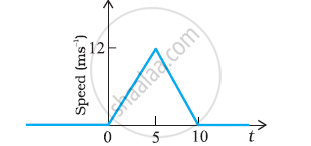
What is the average speed of the particle over the intervals in (a) and (b)
Concept: undefined >> undefined
The velocity-time graph of a particle in one-dimensional motion is shown in Figure
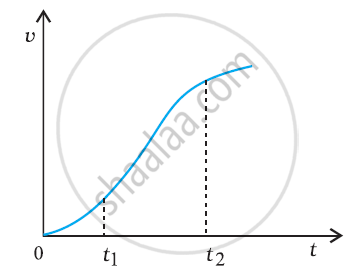
Which of the following formulae are correct for describing the motion of the particle over the time-interval t2 to t1?
(a) x(t2) = x(t1) + v(t1)(t2–t1) + (1/2)a(t2–t1)2
(b) v(t2)= v(t1) + a(t2–t1)
(c) vAverage = (x(t2) – x(t1)) / (t2 – t1)
(d) aAverage = (v(t2) – v(t1)) / (t2 – t1)
(e) x(t2) = x(t1) + vAverage(t2 – t1) + (1/2)aAverage(t2 – t1)2
(f) x(t2) – x(t1) = area under the v–t curve bounded by the t-axis and the dotted line shown.
Concept: undefined >> undefined
Choose the correct alternative:
If the zero of potential energy is at infinity, the total energy of an orbiting satellite is negative of its kinetic/potential energy.
Concept: undefined >> undefined
Choose the correct alternative:
The energy required to launch an orbiting satellite out of earth’s gravitational influence is more/less than the energy required to project a stationary object at the same height (as the satellite) out of earth’s influence.
Concept: undefined >> undefined
A satellite orbits the earth at a height of 400 km above the surface. How much energy must be expended to rocket the satellite out of the earth’s gravitational influence? Mass of the satellite = 200 kg; mass of the earth = 6.0 ×1024 kg; radius of the earth = 6.4 ×10⁶ m; G = 6.67 × 10⁻¹¹ N m2 kg–2
Concept: undefined >> undefined
A body is moving unidirectionally under the influence of a source of constant power. Its displacement in time t is proportional to ______.
Concept: undefined >> undefined
A pump on the ground floor of a building can pump up water to fill a tank of volume 30 m3 in 15 min. If the tank is 40 m above the ground, and the efficiency of the pump is 30%, how much electric power is consumed by the pump?
Concept: undefined >> undefined
The blades of a windmill sweep out a circle of area A.
- If the wind flows at a velocity v perpendicular to the circle, what is the mass of the air passing through it in time t?
- What is the kinetic energy of the air?
- Assume that the windmill converts 25% of the wind’s energy into electrical energy, and that A = 30 m2, v = 36 km/h and the density of air is 1.2 kg m–3. What is the electrical power produced?
Concept: undefined >> undefined
A family uses 8 kW of power.
- Direct solar energy is incident on the horizontal surface at an average rate of 200 W per square meter. If 20% of this energy can be converted to useful electrical energy, how large an area is needed to supply 8 kW?
- Compare this area to that of the roof of a typical house.
Concept: undefined >> undefined
Prove the theorem of perpendicular axes.
(Hint: Square of the distance of a point (x, y) in the x–y plane from an axis through the origin perpendicular to the plane is x2 + y2).
Concept: undefined >> undefined
Prove the theorem of parallel axes.
(Hint: If the centre of mass is chosen to be the origin `summ_ir_i = 0`
Concept: undefined >> undefined
Explain why The angle of contact of mercury with glass is obtuse, while that of water with glass is acute
Concept: undefined >> undefined
Explain why Water on a clean glass surface tends to spread out while mercury on the same surface tends to form drops. (Put differently, water wets glass while mercury does not.)
Concept: undefined >> undefined
Explain why Surface tension of a liquid is independent of the area of the surface
Concept: undefined >> undefined
Explain why Water with detergent dissolved in it should have small angles of contact.
Concept: undefined >> undefined
Explain why A drop of liquid under no external forces is always spherical in shape
Concept: undefined >> undefined
Fill in the blanks using the word(s) from the list appended with each statement
Surface tension of liquids generally . . . with temperatures (increases / decreases)
Concept: undefined >> undefined
A U-shaped wire is dipped in a soap solution and removed. The thin soap film formed between the wire and the light slider supports a weight of 1.5 × 10⁻² N (which includes the small weight of the slider). The length of the slider is 30 cm. What is the surface tension of the film?
Concept: undefined >> undefined
