Advertisements
Advertisements
A child running a temperature of 101°F is given an antipyrin (i.e. a medicine that lowers fever) which causes an increase in the rate of evaporation of sweat from his body. If the fever is brought down to 98 °F in 20 min, what is the average rate of extra evaporation caused, by the drug? Assume the evaporation mechanism to be the only way by which heat is lost. The mass of the child is 30 kg. The specific heat of human body is approximately the same as that of water, and latent heat of evaporation of water at that temperature is about 580 cal g–1.
Concept: undefined >> undefined
A geyser heats water flowing at the rate of 3.0 litres per minute from 27 °C to 77 °C. If the geyser operates on a gas burner, what is the rate of consumption of the fuel if its heat of combustion is 4.0 × 10⁴ J/g?
Concept: undefined >> undefined
Advertisements
A geyser heats water flowing at the rate of 3.0 litres per minute from 27 °C to 77 °C. If the geyser operates on a gas burner, what is the rate of consumption of the fuel if its heat of combustion is 4.0 × 10⁴ J/g?
Concept: undefined >> undefined
What amount of heat must be supplied to 2.0 x 10⁻² kg of nitrogen (at room temperature) to raise its temperature by 45 °C at constant pressure? (Molecular mass of N2 = 28; R = 8.3 J mol-1 K-1.)
Concept: undefined >> undefined
What amount of heat must be supplied to 2.0 x 10⁻² kg of nitrogen (at room temperature) to raise its temperature by 45 °C at constant pressure? (Molecular mass of N2 = 28; R = 8.3 J mol-1 K-1.)
Concept: undefined >> undefined
The coolant in a chemical or a nuclear plant (i.e., the liquid used to prevent the different parts of a plant from getting too hot) should have high specific heat.
Concept: undefined >> undefined
The coolant in a chemical or a nuclear plant (i.e., the liquid used to prevent the different parts of a plant from getting too hot) should have high specific heat.
Concept: undefined >> undefined
One end of a U-tube containing mercury is connected to a suction pump and the other end to the atmosphere. A small pressure difference is maintained between the two columns. Show that, when the suction pump is removed, the column of mercury in the U-tube executes simple harmonic motion.
Concept: undefined >> undefined
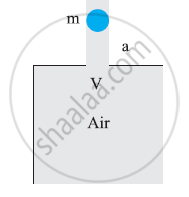
An air chamber of volume V has a neck area of cross section a into which a ball of mass m just fits and can move up and down without any friction (Fig.14.33). Show that when the ball is pressed down a little and released, it executes SHM. Obtain an expression for the time period of oscillations assuming pressure-volume variations of air to be isothermal
Concept: undefined >> undefined
Show that for a particle in linear SHM the average kinetic energy over a period of oscillation equals the average potential energy over the same period.
Concept: undefined >> undefined
A circular disc of mass 10 kg is suspended by a wire attached to its centre. The wire is twisted by rotating the disc and released. The period of torsional oscillations is found to be 1.5 s. The radius of the disc is 15 cm. Determine the torsional spring constant of the wire. (Torsional spring constant α is defined by the relation J = –α θ, where J is the restoring couple and θ the angle of twist).
Concept: undefined >> undefined
A body describes simple harmonic motion with an amplitude of 5 cm and a period of 0.2 s. Find the acceleration and velocity of the body when the displacement is 0 cm.
Concept: undefined >> undefined
The metre is defined as the distance travelled by light in `1/(299,792,458)` second. Why didn't people choose some easier number such as `1/(300,000,000)` second? Why not 1 second?
Concept: undefined >> undefined
Suppose you are told that the linear size of everything in the universe has been doubled overnight. Can you test this statement by measuring sizes with a metre stick? Can you test it by using the fact that the speed of light is a universal constant and has not changed? What will happen if all the clocks in the universe also start running at half the speed?
Concept: undefined >> undefined
Suggest a way to measure the distance between the sun and the moon.
Concept: undefined >> undefined
Find the dimensions of electric dipole moment p .
The defining equations are p = q.d and M = IA;
where d is distance, A is area, q is charge and I is current.
Concept: undefined >> undefined
Find the dimensions of magnetic dipole moment M.
The defining equations are p = q.d and M = IA;
where d is distance, A is area, q is charge and I is current.
Concept: undefined >> undefined
Express the power of a 100 watt bulb in CGS unit.
Concept: undefined >> undefined
The kinetic energy K of a rotating body depends on its moment of inertia I and its angular speedω. Assuming the relation to be \[k = KI^0w^B\] where k is a dimensionless constant, find a and b. Moment of inertia of a sphere about its diameter is \[\frac{2}{5}M r^2\]
Concept: undefined >> undefined
The velocity of a particle is towards west at an instant. Its acceleration is not towards west, not towards east, not towards north and towards south. Give an example of this type of motion .
Concept: undefined >> undefined
