Advertisements
Advertisements
Elements \[\ce{X, Y}\] and \[\ce{Z}\] have 4, 5 and 7 valence electrons respectively. Write the molecular formula of the compounds formed by these elements individually with hydrogen.
Concept: undefined >> undefined
Elements \[\ce{X, Y}\] and \[\ce{Z}\] have 4, 5 and 7 valence electrons respectively. Which of these compounds will have the highest dipole moment?
Concept: undefined >> undefined
Advertisements
Which of the following figures does not represent 1 mole of dioxygen gas at STP?
(i) 16 grams of gas
(ii) 22.7 litres of gas
(iii) 6.022 × 10²³ dioxygen molecules
(iv) 11.2 litres of gas
Concept: undefined >> undefined
What will be the molar volume of nitrogen and argon at 273.15 K and 1 atm?
Concept: undefined >> undefined
\[\ce{PCl5, PCl3 and Cl2}\] are at equilibrium at 500 K in a closed container and their concentrations are 0.8 × 10⁻³ mol L–1, 1.2 × 10⁻³ mol L–1 and 1.2 × 10⁻³ mol L–1 respectively. The value of Kc for the reaction \[\ce{PCl5 (g) ⇌ PCl3 (g) + Cl2 (g)}\] will be ______.
Concept: undefined >> undefined
\[\ce{pH}\] of a solution of a strong acid is 5.0. What will be the \[\ce{pH}\] of the solution obtained after diluting the given solution a 100 times?
Concept: undefined >> undefined
Calculate the \[\ce{pH}\] of a solution formed by mixing equal volumes of two solutions A and B of a strong acid having \[\ce{pH}\] = 6 and \[\ce{pH}\] = 4 respectively.
Concept: undefined >> undefined
Match the following graphical variation with their description
| A | B |
(i) 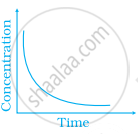 |
(a) Variation in product concentration with time |
(ii) 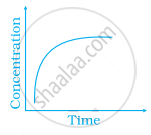 |
(b) Reaction at equilibrium |
(iii) 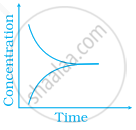 |
(c) Variation in reactant concentration with time |
Concept: undefined >> undefined
The oxide that gives \[\ce{H2O2}\] on treatment with dilute \[\ce{H2SO4}\] is ______.
Concept: undefined >> undefined
When sodium peroxide is treated with dilute sulphuric acid, we get ______.
Concept: undefined >> undefined
Which of the following ions will cause hardness in water sample?
Concept: undefined >> undefined
Which of the following compounds is used for water softening?
Concept: undefined >> undefined
Hardness of water may be temporary or permanent. Permanent hardness is due to the presence of:
(i) Chlorides of \[\ce{Ca}\] and \[\ce{Mg}\] in water.
(ii) Sulphates of \[\ce{Ca}\] and \[\ce{Mg}\] in water.
(iii) Hydrogen carbonates of \[\ce{Ca}\] and \[\ce{Mg}\] in water.
(iv) Carbonates of alkali metals in water.
Concept: undefined >> undefined
Complete the following equations:
\[\ce{PbS (s) + H2O2 (aq) ->}\]
Concept: undefined >> undefined
Complete the following equations:
\[\ce{CO (g) + 2H2 (g) ->[Cobalt][Catalyst]}\]
Concept: undefined >> undefined
Discuss briefly de-mineralisation of water by ion exchange resin.
Concept: undefined >> undefined
Why is the Ionisation enthalpy of hydrogen higher than that of sodium?
Concept: undefined >> undefined
Match the items in Column I with the relevant item in Column II.
| Column I | Column II |
| (i) Hydrogen peroxide is used as a | (a) zeolite |
| (ii) Used in Calgon method | (b) perhydrol |
| (iii) Permanent hardness of hard water is removed by | (c) sodium hexametaphosphate |
| (d) propellant |
Concept: undefined >> undefined
Assertion (A): Permanent hardness of water is removed by treatment with washing soda.
Reason (R): Washing soda reacts with soluble magnesium and calcium sulphate to form insoluble carbonates.
Concept: undefined >> undefined
If a trivalent atom replaces a few silicon atoms in three-dimensional network of silicon dioxide, what would be the type of charge on overall structure?
Concept: undefined >> undefined
