Please select a subject first
Advertisements
Advertisements
Photosynthetic organisms occur at different depths in the ocean. Do they receive qualitatively and quantitatively the same light? How do they adapt to carry out photosynthesis under these conditions?
Concept: undefined >> undefined
In tropical rain forests, the canopy is thick and plants growing below receive filtered light. How are they able to carry out photosynthesis?
Concept: undefined >> undefined
Advertisements
Why does the rate of photosynthesis decrease at higher temperatures?
Concept: undefined >> undefined
Dialysing unit (artificial kidney) contains a fluid which is almost same as plasma except that it has ______.
Concept: undefined >> undefined
There are many endocrine glands in human body. Name the glands which is absent in male and the one absent in female.
Concept: undefined >> undefined
State whether true or false:
Gastrointestinal tract, kidney and heart also produce hormones.
Concept: undefined >> undefined
The figure shows the effect of light on the rate of photosynthesis. Based on the graph, answer the following question:
- At which point/s (A, B or C) in the curve is light a limiting factor?
- What could be the limiting factor/s in Region A?
- What do C and D represent on the curve?
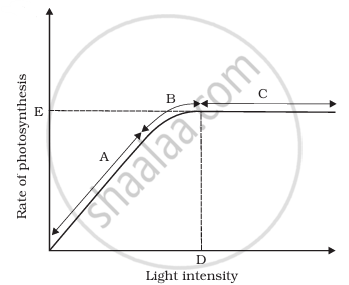
Graph of light intensity on the rate of photosynthesis
Concept: undefined >> undefined
List the hormones secreted by the following:
Atrium
Concept: undefined >> undefined
List the hormones secreted by the following:
Kidney
Concept: undefined >> undefined
Differentiate between Apoplast and Symplast pathways of movement of water in plants
Concept: undefined >> undefined
How is the mycorrhizal association helpful in absorption of water and minerals in plants?
Concept: undefined >> undefined
What are respiratory substrates?
Concept: undefined >> undefined
Name the most common respiratory substrate.
Concept: undefined >> undefined
Differentiate between Respiration and Combustion.
Concept: undefined >> undefined
Many pulses of daily use belong to one of the families below (tick the correct answer)
Concept: undefined >> undefined
Which of the following plants is used to extract the blue dye?
Concept: undefined >> undefined
Write floral formula for a flower which, is bisexual; actinomorphic; pentamerous sepal, petal, stamens free with ovary, syncarpous, superior, trilocular with axile placentation.
Concept: undefined >> undefined
Add the missing floral organs of the given floral formula of Fabaceae.
\[\ce{φ \overrightarrow{\text{♀}} K_{(5)} -> A_{(g + 1)} \underline{G}_{1}}\]
Concept: undefined >> undefined
Distinguish between families Fabaceae, Solanaceae, Liliaceae on the basis of gynoecium characteristics (with figures). Also write economic importance of any one of the above family.
Concept: undefined >> undefined
Epiblema of roots is equivalent to ______.
Concept: undefined >> undefined
