Advertisements
Advertisements
What do you understand by the term ’auto-protolysis’ of water? What is its significance?
Concept: undefined >> undefined
Consider the reaction of water with F2 and suggest, in terms of oxidation and reduction, which species are oxidized/reduced.
Concept: undefined >> undefined
Advertisements
Complete the following chemical reaction.
\[\ce{PbS_{(s)} + H_2O_{2(aq)} ->}\] ______
Classify the chemical reaction into (a) hydrolysis, (b) redox and (c) hydration reactions.
Concept: undefined >> undefined
Complete the following chemical reaction.
\[\ce{MnO^-_{4(aq)} + H_2O_{(g)} ->}\]
Classify the chemical reaction into (a) hydrolysis, (b) redox and (c) hydration reactions.
Concept: undefined >> undefined
Complete the following chemical reaction.
\[\ce{CaO_{(s)} + H_2O_{(g)} ->}\]?
Classify the chemical reaction into (a) hydrolysis, (b) redox and (c) hydration reactions.
Concept: undefined >> undefined
Complete the following chemical reaction.
\[\ce{AlCl_{3(g)} + H_2O_{(l)} ->}\] ?
Classify the chemical reaction into (a) hydrolysis, (b) redox and (c) hydration reactions.
Concept: undefined >> undefined
Complete the following chemical reaction.
\[\ce{Ca_3N_{2(s)} + H_2O_{(l)} ->}\] ?
Classify the chemical reaction into (a) hydrolysis, (b) redox and (c) hydration reactions.
Concept: undefined >> undefined
Write chemical reactions to show the amphoteric nature of water.
Concept: undefined >> undefined
What is the difference between the terms ‘hydrolysis’ and ‘hydration’?
Concept: undefined >> undefined
Do you expect different products in solution when aluminium (III) chloride and potassium chloride treated separately with (i) normal water (ii) acidified water, and (iii) alkaline water? Write equations wherever necessary.
Concept: undefined >> undefined
What is the relationship between the members of following pairs of structures? Are they structural or geometrical isomers or resonance contributors?
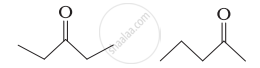
Concept: undefined >> undefined
What is the relationship between the members of following pairs of structures? Are they structural or geometrical isomers or resonance contributors?
\[\begin{array}{cc}\ce{^+OH}\\||\\
\ce{H - C - OH}\end{array}\]
\[\begin{array}{cc}\ce{OH}\phantom{.}\\|\phantom{...}\\
\ce{H - C^+ - OH}\end{array}\]
Concept: undefined >> undefined
What is meant by the term bond order?
Concept: undefined >> undefined
Identify the reagents shown in bold in the following equation as nucleophiles or electrophiles:
\[\ce{CH3COOH + \underline{\ce{H}\overset{-}{\ce{O}}} -> CH3COO^- + H2O }\]
Concept: undefined >> undefined
Identify the reagents shown in bold in the following equation as nucleophiles or electrophiles:
\[\ce{CH3COCH3 + \underline{\overset{-}{\ce{C}}\ce{N}} -> (CH3)2C(CN)(OH)}\]
Concept: undefined >> undefined
Which of the following statements indicates that law of multiple proportion is being followed?
Concept: undefined >> undefined
One of the statements of Dalton’s atomic theory is given below: “Compounds are formed when atoms of different elements combine in a fixed ratio”
Which of the following laws is not related to this statement?
(i) Law of conservation of mass
(ii) Law of definite proportions
(iii) Law of multiple proportions
(iv) Avogadro law
Concept: undefined >> undefined
If two elements can combine to form more than one compound, the masses of one element that combine with a fixed mass of the other element, are in whole number ratio.
Is this statement true?
Concept: undefined >> undefined
If two elements can combine to form more than one compound, the masses of one element that combine with a fixed mass of the other element, are in whole number ratio.
If yes, according to which law?
Concept: undefined >> undefined
If two elements can combine to form more than one compound, the masses of one element that combine with a fixed mass of the other element, are in whole number ratio.
Give one example related to this law.
Concept: undefined >> undefined
