Advertisements
Advertisements
If z and w are two complex numbers such that |zw| = 1 and arg(z) – arg(w) = `pi/2`, then show that `barz`w = –i.
Concept: undefined >> undefined
arg(z) + arg`barz (barz ≠ 0)` is ______.
Concept: undefined >> undefined
Advertisements
If |z| = 4 and arg(z) = `(5pi)/6`, then z = ______.
Concept: undefined >> undefined
State True or False for the following:
Let z1 and z2 be two complex numbers such that |z1 + z2| = |z1| + |z2|, then arg(z1 – z2) = 0.
Concept: undefined >> undefined
Find z if |z| = 4 and arg(z) = `(5pi)/6`.
Concept: undefined >> undefined
Find principal argument of `(1 + i sqrt(3))^2`.
Concept: undefined >> undefined
|z1 + z2| = |z1| + |z2| is possible if ______.
Concept: undefined >> undefined
The value of arg (x) when x < 0 is ______.
Concept: undefined >> undefined
Find the linear inequalities for which the shaded region in the given figure is the solution set.
Concept: undefined >> undefined
Solve the following system of inequalities `(2x + 1)/(7x - 1) > 5, (x + 7)/(x - 8) > 2`
Concept: undefined >> undefined
Find the linear inequalities for which the shaded region in the given figure is the solution set.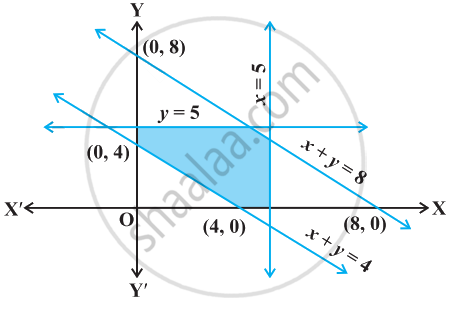
Concept: undefined >> undefined
Show that the following system of linear inequalities has no solution x + 2y ≤ 3, 3x + 4y ≥ 12, x ≥ 0, y ≥ 1
Concept: undefined >> undefined
Solve the following system of linear inequalities:
3x + 2y ≥ 24, 3x + y ≤ 15, x ≥ 4
Concept: undefined >> undefined
Show that the solution set of the following system of linear inequalities is an unbounded region 2x + y ≥ 8, x + 2y ≥ 10, x ≥ 0, y ≥ 0.
Concept: undefined >> undefined
Solution set of x ≥ 0 and y ≤ 0 is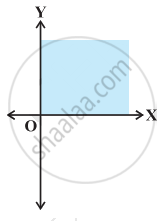
Concept: undefined >> undefined
Solution set of x ≥ 0 and y ≤ 1 is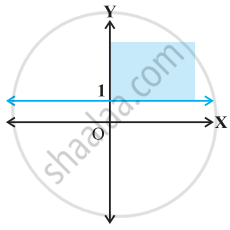
Concept: undefined >> undefined
At the end of each year the value of a certain machine has depreciated by 20% of its value at the beginning of that year. If its initial value was Rs 1250, find the value at the end of 5 years.
Concept: undefined >> undefined
If a, b, c, d are in G.P., prove that a2 – b2, b2 – c2, c2 – d2 are also in G.P.
Concept: undefined >> undefined
If a, b, c, d are four distinct positive quantities in G.P., then show that a + d > b + c
Concept: undefined >> undefined
In a G.P. of positive terms, if any term is equal to the sum of the next two terms. Then the common ratio of the G.P. is ______.
Concept: undefined >> undefined
