Advertisements
Advertisements
The deviation of light ray from its path when it travels from one transparent medium to another transparent medium is called ______.
Concept: undefined >> undefined
The angle of incidence for a ray of light having zero reflection angle is ______.
Concept: undefined >> undefined
Advertisements
If a beam of red light and a beam of violet light are incident at the same angle on the inclined surface of a prism from air medium and produce angles of refraction r and v respectively, which of the following is correct?
Concept: undefined >> undefined

The angle of incidence from air to glass at the point O on the hemispherical glass slab is.
Concept: undefined >> undefined
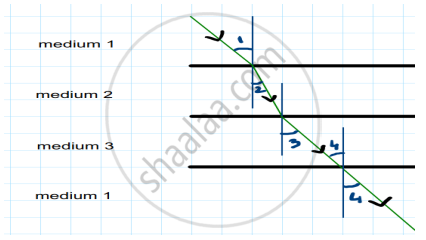
In the above diagram light is travelling through different media. It is noted by a scientist that ∠1= ∠3 = ∠4 but ∠2 < ∠1. Which of the following statement would be correct?
Concept: undefined >> undefined
Noor, a young student, was trying to demonstrate some properties of light in her Science project work. She kept ‘X’ inside the box (as shown in the figure) and with the help of a laser pointer made light rays pass through the holes on one side of the box. She had a small butter-paper screen to see the spots of light being cast as they emerged.

Her friend noted the following observations from this demonstration:
- Glass is optically rarer than air.
- Air and glass allow light to pass through them with the same velocity.
- Air is optically rarer than glass.
- Speed of light through a denser medium is faster than that of a rarer medium.
- The ratio: sin of angle of incidence in the first medium to the ratio of sin of angle of refraction in the second medium, gives the refractive index of the second material with respect to the first one.
Which one of the combinations of the above statements given below is correct.
Concept: undefined >> undefined
A pencil when dipped in water in a glass tumbler appears to be bent at the interface of air and water. Will the pencil appear to be bent to the same extent, if instead of water we use liquids like, kerosene or turpentine. Support your answer with reason.
Concept: undefined >> undefined
A ray of light starting from diamond is incident on the interface separating diamond and water. Draw a labelled ray diagram to show. the refraction of light in this case.
Concept: undefined >> undefined
A student was asked to observe and identify the various parts of an embryo of a red kidney bean seed. He identified the parts and listed them as under:
I. Tegmen
II. Testa
III. Cotyledon
IV. Radicle
V. Plumule
The correctly identified parts among these are
(A) I, II and III
(B) II, III and IV
(C) III, IV and V
(D) I, III, IV and V
Concept: undefined >> undefined
Name the parts A, B and C shown in the diagram and write their functions.

Concept: undefined >> undefined
Name the parts labelled as A, B, C and D in the diagram given below:-

Concept: undefined >> undefined
What is pollination?
Concept: undefined >> undefined
How does fertilisation occur in flowers? Name the parts of the flower that develop into (i) seed, and (ii) fruit after fertilisation.
Concept: undefined >> undefined
In the following diagram showing the structure of embryo of a dicot seed, what are the parts marked I, II and III sequentially?

Concept: undefined >> undefined

(i) Name the part marked 'A' in the diagram.
(ii) How dose 'A' reachese part 'B'?
(iii) State the importance of the part 'C'.
(iv) What happens to the part marked 'D' after fertilisation is over?
Concept: undefined >> undefined
A student while observing an embryo of a pea seed in the laboratory listed various parts of the embryo as given below:
Testa, Tegmen, Radicle, Plumule, Micropyle, Cotyledon.
On examining the list the teacher remarked that only three parts are correct. Select three correct parts from the above list:
(a) Testa, Radicle, Cotyleddon
(b) Tegmen, Radicle, Micropyle
(c) Cotyledon, Plumule, Testa
(d) Radicle, Cotyledon, Plumule
Concept: undefined >> undefined
Name the parts A, B and C shown in the following diagram and state one function of each.

Concept: undefined >> undefined
A student has to perform the experiment "To identify the different parts of an embryo of a dicot seed." Select from the following an appropriate group of seeds:
(a) Pea, gram, wheat
(b) Red kidney bean, maize, gram
(c) Maize, wheat, red kidney bean
(d) Red kidney bean, pea, gram
Concept: undefined >> undefined
State significance of pollination.
Concept: undefined >> undefined
Name and differentiate between the two modes of pollination in flowering plants.
Concept: undefined >> undefined
