Please select a subject first
Advertisements
Advertisements
State the cause of dispersion of white light
Concept: undefined >> undefined
What is observed when a solution of sodium sulphate is added to a solution of barium chloride taken in a test tube? Write equation for the chemical reaction involved and name the type of reaction in this case.
Concept: undefined >> undefined
Advertisements
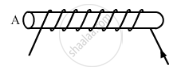
The figure shows a solenoid wound on a core of soft iron. Will the end A be a N pole or S pole when the current flows in the direction shown?
Concept: undefined >> undefined
Give two characteristics of the chemical reaction which occurs on adding potassium iodide solution to lead nitrate solution.
Concept: undefined >> undefined
What type of chemical reaction is represented by the following equation?
PQ + RS → PS + RQ
Concept: undefined >> undefined
What type of reaction is represented by the following equation?
CuSO4 + 2NaOH → Cu(OH)2 + Na2SO4
Concept: undefined >> undefined
What is meant by double displacement reaction? Explain with help of one example.
Concept: undefined >> undefined
What happens when silver nitrate solution is added to sodium chloride solution?
Name the type of reaction involved.
Concept: undefined >> undefined
Write a chemical equation to show the process of corrosion of iron.
Concept: undefined >> undefined
What special name is given to their corrosion of iron?
Concept: undefined >> undefined
What type of chemical reaction is involved in the corrosion of iron?
Concept: undefined >> undefined
Name any three objects (or structures) which are gradually damaged by the corrosion of iron and steel.
Concept: undefined >> undefined
(a) What happens when an aqueous solution of sodium sulphate reacts with an aqueous solution of barium chloride?
(b) Write the balanced chemical equation for the reaction which takes place.
(c) State the physical conditions of reactants in which the reaction will not take place.
(d) Name the type of chemical reaction which occurs.
(e) Give one example of another reaction which is of the same type as the above reaction.
Concept: undefined >> undefined
The chemical reaction involved in the corrosion of iron metal is that of:
(a) oxidation as well as displacement
(b) reduction as well as combination
(c) oxidation as well as combination
(d) reduction as well as displacement
Concept: undefined >> undefined
Consider the reaction:
KBr (aq) + AgNO3 (aq) → KNO3 (aq) + AgBr (s)
This is an example of:
(a) decomposition reaction
(b) combination reaction
(c) double displacement reaction
(d) displacement reaction
Concept: undefined >> undefined
A metal X forms a water soluble salt XNO3. When an aqueous solution of XNO3 is added to common salt solution, then a white precipitate of compound Y is formed alongwith sodium nitrate solution. Metal X is said to be the best conductor of electricity and it does not evolve hydrogen when put in dilute hydrohloric acid.
(a) What is metal X?
(b) What is salt XNO3?
(c) Name the compound Y.
(d) Write the chemical equation of the reaction which takes place on reacting XNO3 solution and common salt solution giving the physical states of all the reactants and products.
(e) What type of chemical reaction is illustrated by the above equation?
Concept: undefined >> undefined
A red-brown metal X forms a salt XSO4. When hydrogen sulphide gas is passed through an aqueous solution of XSO4, then a black precipitate of XS is formed alongwith sulphuric acid solution.
(a) What could the salt XSO4 be?
(b) What is the colour of salt XSO4?
(c) Name the black precipitate XS.
(d) By using the formula of the salt obtained in (a) above, write an equation of the reaction which takes place when hydrogen sulphide gas is passed through its aqueous solution.
(e) What type of chemical reaction takes place in this case?
Concept: undefined >> undefined
(i) A ray of white light breaks up into its components while passing through a glass prism. Draw a ray diagram to show the path of rays.
(ii) Mark the least deviated colour in your diagram

(iii) Why do different coloured rays deviate differently in a prism?
Concept: undefined >> undefined
As light rays pass from air into a glass prism, are they refracted towards or away from the normal?
Concept: undefined >> undefined
As light rays emerge from a glass prism into air, are they refracted towards or away from the normal?
Concept: undefined >> undefined
