Please select a subject first
Advertisements
Advertisements
Determine the position of the centroid of the plane lamina. Shaded portion is removed.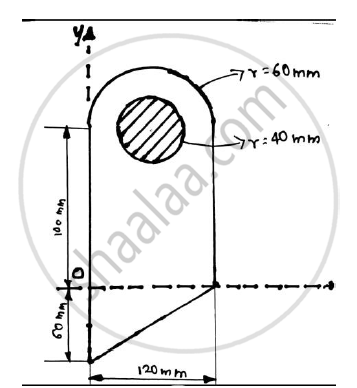
Concept: Centroid for Plane Laminas
Find the centroid of the shaded portion of the plate shown in the figure.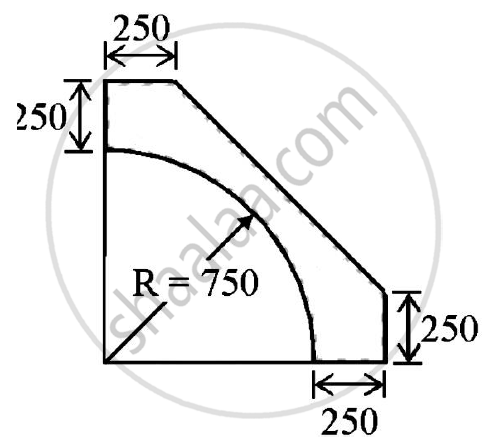
Concept: Centroid for Plane Laminas
For the composite lamina shown in the figure, determine the coordinates of its centroid.
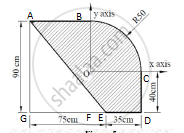
Concept: Centroid for Plane Laminas
Determine the reaction at points of constant 1,2 and 3. Assume smooth surfaces.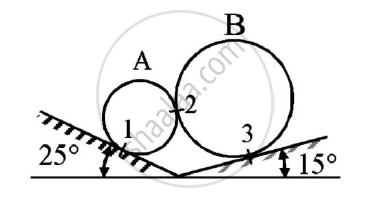
Given: The spheres are in equilibrium
To find: Reactions at points 1,2 and 3
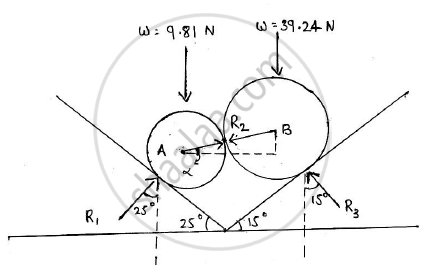
Concept: Condition of Equilibrium for non-concurrent nonparallel general forces
Explain the conditions for equilibrium of forces in space.
Concept: Condition of equilibrium for concurrent forces
Find the support reactions at A and B for the beam loaded as shown in the given figure.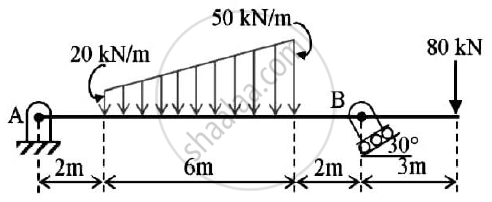
Concept: Condition of equilibrium for parallel forces
Determine the force P required to move the block A of 5000 N weight up the inclined plane, coefficient of friction between all contact surfaces is 0.25. Neglect the weight of the wedge and the wedge angle is 15 degrees.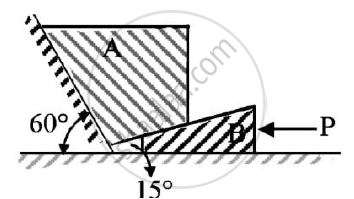
Given : Weight of block A = 5000 N
μs=0.25
Wedge angle = 15º
To find : Force P required to move block A up the inclined plane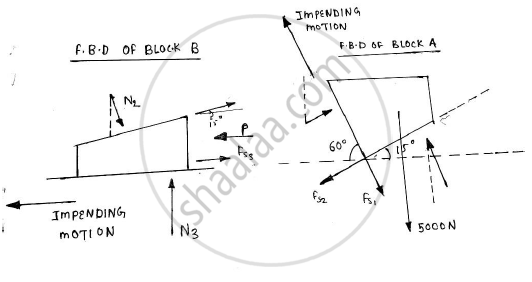
Concept: Condition of equilibrium for concurrent forces
State Lami’s theorem.
State the necessary condition for application of Lami’s theorem.
Concept: Condition of equilibrium for parallel forces
Two spheres A and B of weight 1000N and 750N respectively are kept as shown in the figure..Determine reaction at all contact points 1,2,3 and 4. Radius of A is 400 mm and radius of B is 300 mm
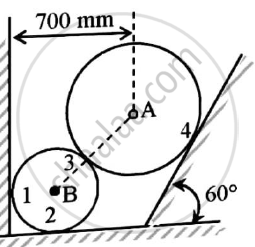
Given : Two spheres are in equilibrium
W1=1000 N
W2=750 N
rA=400 mm
rB=300 mm
To find : Reaction forces at contact points 1,2,3 and 4
Concept: Condition of Equilibrium for non-concurrent nonparallel general forces
Refer to figure.If the co-efficient of friction is 0.60 for all contact surfaces and θ = 30o,what force P applied to the block B acting down and parallel to the incline will start motion and what will be the tension in the cord parallel to inclined plane attached to A.
Take WA=120 N and WB=200 N.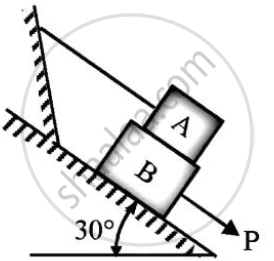
Concept: Condition of equilibrium for concurrent forces
Two blocks A and B are resting against the wall and floor as shown in the figure.Find the minimum value of P that will hold the system in equilibrium. Take μ=0.25 at the floor,μ=0.3 at the wall and μ=0.2 between the blocks.
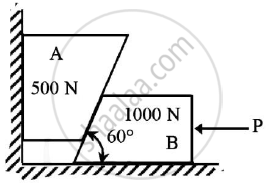
Given : μ=0.25 at floor
μ=0.2 between blocks
To find : Minimum value of force P
Concept: Condition of equilibrium for concurrent forces
Three blocks A,B and C of masses 3 kg,2 kg and 7 kg respectively are connected as shown.Determine the acceleration of A,B and C.Also find the tension in the string.
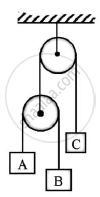
Given : mA=3kg
mB=2 kg
mC=7kg
To find: Acceleration of blocks A,B and C
Concept: Condition of equilibrium for parallel forces
Block A of weight 2000N is kept on the inclined plane at 35° .It is connected to weight B by an inextensible string passing over smooth pulley.
Determine the weight of pan B so that B just moves down.Assume μ=0.2.
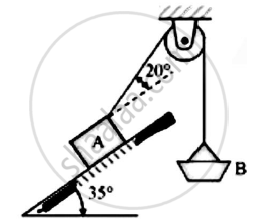
Given : Weight of block A=2000N
Angle of inclined plane = 35°
μ=0.2
To find : Weight of pan B
Concept: Condition of equilibrium for parallel forces
A rod AD of length 40 cm is suspended from point D as shown in figure. If it has a weight of 25 N and also supports a load of 40N,find the tension in the cable using the method of virtual work.Take AC=30 cm.
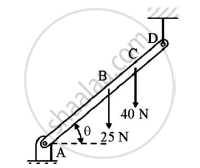
Given : Length of rod AD=40cm=0.4m
AC=0.3m
W=25N
Load on rod AD=40N
To find : Tension in the cable
Concept: Condition of equilibrium for parallel forces
The acceleration of the train starting from rest at any instant is given by the expression `a=8/(v^2+1)` where v is the velocity of train in m/s. Find the velocity of the train when its displacement is 20 m and its displacement when velocity is 64.8 kmph.
Concept: Beams Support
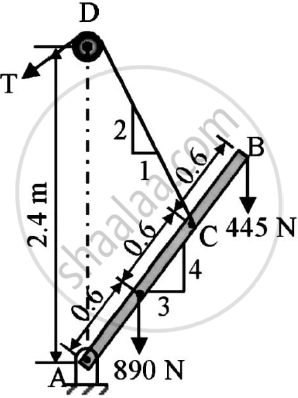
A boom AB is supported as shown in the figure by a cable runs from C over a small smooth pulley at D.
Compute the tension T in cable and reaction at A.Neglect the weight of the boom and size of the pulley.
Concept: Beams Support
The given figure shows a beam AB hinged at A and roller supported at B. The L shaped portion is welded at D to the beam AB. For the loading shown,find the support reactions.
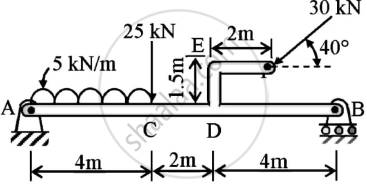
Given : Beam AB hinged at A and roller supported at B and different forces acting on it.
To find : Support reactions
Concept: Determination of reactions at supports for various types of loads on beams
If the support reaction at A, for the beam shown in Figure 3, is zero, then find force ‘P’ and the support reaction at B.
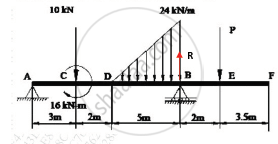
Concept: Determination of reactions at supports for various types of loads on beams
For the truss shown in figure 4, find: (i) zero force members, if any (Justify your answer with FBD), (ii) support reactions at C and D.
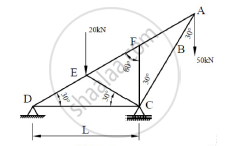
Concept: Load Support
The cylinder B, diameter 400mm and weight 5kN, is held in position as shown in Figure 12 with the help of cable AB. Find the tension in the cable and the reaction developed at contact C.
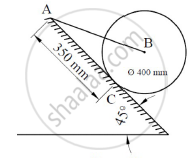
Concept: Determination of reactions at supports for various types of loads on beams
