Advertisements
Advertisements
How would you account for the following : Transition metals form coloured compounds
Concept: General Properties of the Transition Elements (d-block)
Complete the following equation :
`2MnO_4^(-)+6H^++5NO_2^(-)rarr`
Concept: Some Important Compounds of Transition Elements - Oxides and Oxoanions of Metals
Account for the following:
Cu+ ion is unstable in aqueous solution.
Concept: General Properties of the Transition Elements (d-block)
Complete the following equations:Cr2O72- + 2OH- →
Concept: Some Important Compounds of Transition Elements - Oxides and Oxoanions of Metals
Complete the following equations : MnO4- + 4H+ + 3e- →
Concept: Some Important Compounds of Transition Elements - Oxides and Oxoanions of Metals
With reference to structural variability and chemical reactivity, write the differences between lanthanoids and actinoids
Concept: F-block Elements >> The Actinoids
Name a member of the lanthanoid series which is well known to exhibit +4 oxidation state.
Concept: F-block Elements >> The Lanthanoids
Out of Mn3+ and Cr3+, which is more paramagnetic and why ?
(Atomic nos. : Mn = 25, Cr = 24)
Concept: General Properties of the Transition Elements (d-block)
Complete the following chemical equation
Cr2O72- + 3Sn2+ + 14H+ →
Concept: Some Important Compounds of Transition Elements - Oxides and Oxoanions of Metals
Explain why Cu+ ion is not stable in aqueous solutions?
Concept: General Properties of the Transition Elements (d-block)
How is the variability in oxidation states of transition metals different from that of the non-transition metals? Illustrate with examples.
Concept: General Properties of the Transition Elements (d-block)
Indicate the steps in the preparation of KMnO4 from pyrolusite ore.
Concept: Some Important Compounds of Transition Elements - Oxides and Oxoanions of Metals
How would you account for the following?
Transition metals and their compounds act as catalysts.
Concept: General Properties of the Transition Elements (d-block)
On adding NaOH to ammonium sulphate, a colourless gas with pungent odour is evolved, which forms a blue-coloured complex with Cu2+ ion. Identify the gas.
Concept: Bonding in Coordination Compounds >> Colour in Coordination Compounds
Write the IUPAC name of the given compound:
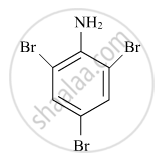
Concept: Nomenclature of Coordination Compounds - Naming of Mononuclear Coordination Compounds
When a co-ordination compound CrCl3.6H2O is mixed with AgNO3, 2 moles of AgCl are precipitated per mole of the compound. Write
(i) Structural formula of the complex.
(ii) IUPAC name of the complex.
Concept: Nomenclature of Coordination Compounds - Naming of Mononuclear Coordination Compounds
Differentiate between adsorbtion and absorption.
Concept: Types of Adsorption
Out of MgCl2 and AlCl3, which one is more effective in causing coagulation of negatively charged sol and why?
Concept: Properties of Colloidal Solutions
Out of sulphur sol and proteins, which one form multimolecular colloids?
Concept: Purification of Colloidal Solution
Out of sulphur sol and proteins, which one form multimolecular colloids?
Concept: Purification of Colloidal Solution
