Please select a subject first
Advertisements
Advertisements
fill in the blanks with suitable functions: Eustachian Tube and ______
Concept: Blood Circulatory System
The diagram given below represents the human heart in one phase of its functions. Study the diagram carefully and answer the questions that follow:
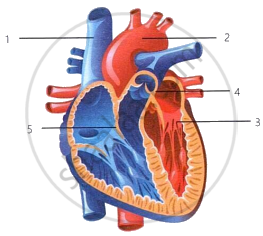
- Name the phase.
- Which part of the heart is contracting in this phase? Give a reason to support your answer.
- Name the parts labelled 1 to 4.
- What type of blood flows through 2?
- State the function of the part numbered ‘5’.
- Name the membrane that covers the heart.
Concept: Blood Circulatory System
The exact location of the tricuspid valve
Concept: Blood Circulatory System
The diagram below represents the simplified pathway of the circulation of blood. Study the same and answer the questions which follow:

(i) Name the blood vessels labelled 1 and 2.
(ii) State the function of blood vessels labelled 5 and 8.
(iii) What is the importance of the blood vessel labelled 6?
(iv) Which blood vessel will contain a high amount of glucose and amino acids after a meal?
(v) Draw a diagram of the different blood cells as seen in a smear of human blood.
Concept: Blood Circulatory System
Explain Diapedesis.
Concept: Blood Circulatory System
Give technical terms for The protective covering of the heart
Concept: Blood Circulatory System
Name the following:
The blood vessel which supplies blood to the liver.
Concept: Blood Circulatory System
Blood in the pulmonary artery or pulmonary vein (Which one contains less oxyhaemoglobin?)
Concept: Blood Circulatory System
Mention the exact location of the Pulmonary semilunar valve
Concept: Blood Circulatory System
Give appropriate biological or technical terms for the following :
The complex consisting of a DNA strand and a core of histones
Concept: Blood Circulatory System
Give appropriate biological or technical terms for the following
The relaxation phase of the heart.
Concept: Blood Circulatory System
Given below is a diagram of a human blood smear. Study the diagram and answer the questions that follow:

- Name the components numbered ‘1’ to ‘4’.
- Mention two structural differences between the parts ‘1’ and ‘2’.
- Name the soluble protein found in part ‘4’ which forms insoluble threads during clotting of blood.
- What is the average lifespan of the component numbered ‘1’ ?
- Component numbered ‘1’ do not have certain organelles but are very efficient in their function. Explain.
Concept: Blood Circulatory System
Match the items given in Column A with the most appropriate ones in Column B and REWRITE the correct matching pairs :
Column A Column B
(i) Cranial nerves Testosterone
(ii) Leydig cells Natural reflex
(iii) Acetylcholine 12 pairs
(iv) Spinal nerves Prolactin
(v) Sneezing Neurotransmitter
- 18 pairs
- 31 pairs
- Conditioned reflex
Concept: Blood Circulatory System
The heart sound 'Dub' is produced when ______.
Concept: Heart Beat
Name the Following
The organ which produces urea.
Concept: Excretion
Mention the exact location of the Prostate gland.
Concept: Excretion
Give biological reasons for the following statements: There is frequent urination in winter than in summer
Concept: Excretion
The nephrons discharge their urine at ______.
Concept: Excretion
