Please select a subject first
Advertisements
Advertisements
Give one reason for Ultrasonic waves use for echo depth sounding purpose.
Concept: Natural Vibrations
Why are the Ultrasonic waves are not audible to us?
Concept: Natural Vibrations
State two conditions for an echo to take place
Concept: Characteristics of Sound
Name the phenomenon involved in tunning a radio set to a particular station
Concept: Forced Vibrations
What do you understand by the loudness of sound?
Concept: Characteristics of Sound
In which units is the loudness of sound measured?
Concept: Characteristics of Sound
Draw a graph between displacement and the time for a body executing free/natural vibrations.
Concept: Natural Vibrations
State the safe limit of sound level in terms of decibel for human hearing.
Concept: Characteristics of Sound
Name the characteristic of sound in relation to its waveform
Concept: Reflection of Sound Waves
A person standing between two vertical cliffs and 480 m from the nearest cliff shouts. He hears the first echo after 3s and the second echo 2s later. Calculate:
1)The speed of sound.
2) The distance of the other cliff from the person
Concept: Characteristics of Sound
In the diagram below, A, B, C, D are four pendulums suspended from the same elastic string PQ. The length of A and C are equal to each other while the length of pendulum B is smaller than that of D. Pendulum A is set into a mode of vibrations
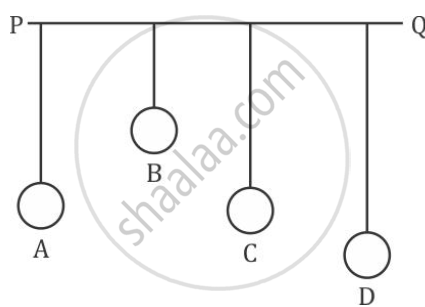
1) Name the type of vibrations taking place in pendulums B and D?
2) What is the state of pendulum C?
3) State the reason for the type of vibrations in pendulum B and C.
Concept: Forced Vibrations
Name one property of waves that do not change when the wave passes from one medium to another.
Concept: Characteristics of Sound
The adjacent diagram shows three different modes of vibrations P, Q and R of the same string.
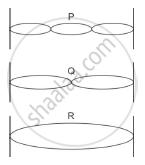
(i) Which vibration will produce a louder sound and why?
(ii) The sound of which string will have maximum shrillness?
(iii) State the ratio of wavelengths of P and R.
Concept: Forced Vibrations
State one important property of waves used for echo depth sounding.
Concept: Characteristics of Sound
Displacement distance graph of two sound waves A and B, travelling in a medium, are as shown in the diagram below.
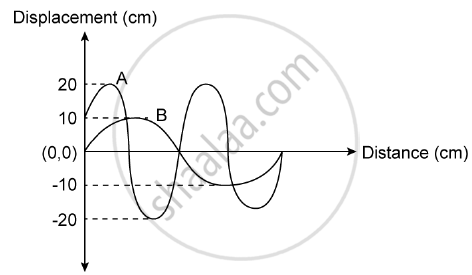
Study the two sound waves and compare their:
1) Amplitudes
2) Wavelengths
Concept: Reflection of Sound Waves
What do you understand by free vibrations of a body?
Concept: Natural Vibrations
Why does the amplitude of a vibrating body continuously decrease during damped vibrations?
Concept: Damped Vibrations
