Advertisements
Advertisements
Gautam went for a vacation to the village where his grandmother lived. His grandmother took him to watch 'nautanki' one evening. They noticed a blackbox connected to the mike lying nearby. Gautam's grandmother did not know what that box was. When she asked this question to Gautam, he explained to her that it was an amplifier.
(i) Which values were displayed by the grandmother? How can inculcation of these values in students be promoted?
(ii) What is the function of an amplifier?
(iii) Which basic electronic device is used in the amplifier?
Concept: Junction Transistor >> Transistor as an Amplifier (Ce-configuration)
The V − I characteristic of a silicon diode is as shown in the figure. Calculate the resistance of the diode at (i) I = 15 mA and (ii) V= −10 V.

Concept: Diode as a Rectifier
Write briefly the important processes that occur during the formation of p−n junction. With the help of necessary diagrams, explain the term 'barrier potential'.
Concept: Special Purpose P-n Junction Diodes
What is an 'integrated circuit (I.C.) ?
Concept: Integrated Circuits
Distinguish between (i) linear I.C. and (ii) digital I.C.
Concept: Integrated Circuits
Identify the equivalent gate for the following circuit and write its truth table.

Concept: Integrated Circuits
Answer the following question :
Distinguish between digital and analogue signals.
Concept: Digital Electronics and Logic Gates
Plot a graph showing variation of current versus voltage for the material GaAs ?
Concept: Semiconductor Diode
Identify the gate equivalent to the circuit shown in the figure. Write its truth table.
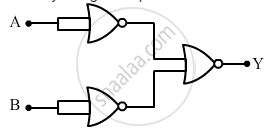
Concept: Integrated Circuits
Identify the equivalent gate represented by the circuit shown in the figure. Draw its logic symbol and write the truth table.
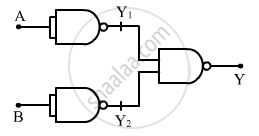
Concept: Integrated Circuits
In the circuit shown in the figure, identify the equivalent gate of the circuit and make its truth table.
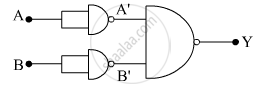
Concept: Integrated Circuits
Figure shows a block diagram of a transmitter identify the boxes ‘X’ and ‘Y’ and write their functions.
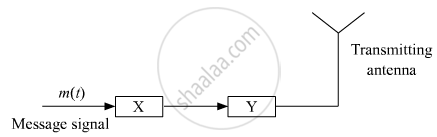
Concept: Junction Transistor >> Transistor as an Amplifier (Ce-configuration)
Figure shows a block diagram of a detector for amplitude modulated signal. Identify the boxes ‘X’ and ‘Y’ and write their functions.

Concept: Junction Transistor >> Transistor as an Amplifier (Ce-configuration)
What happens to the width of depletion player of a p-n junction when it is (i) forward biased, (ii) reverse biased?
Concept: Special Purpose P-n Junction Diodes
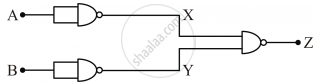
You are given a circuit below. Write its truth table. Hence, identify the logic operation carried out by this circuit. Draw the logic symbol of the gate it corresponds to.
Concept: Digital Electronics and Logic Gates
Draw the circuit diagram of an illuminated photodiode in reverse bias. How is photodiode used to measure light intensity?
Concept: Special Purpose P-n Junction Diodes
Explain the formation of depletion layer and potential barrier in a p−n junction.
Concept: Special Purpose P-n Junction Diodes
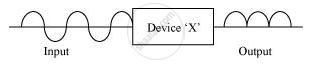
In the figure given below the input waveform is converted into the output waveform by a device ‘X’. Name the device and draw its circuit diagram.
Concept: Integrated Circuits
Identify the logic gate represented by the circuit as shown and write its truth table.

Concept: Digital Electronics and Logic Gates
With the help of circuit diagram explain the working principle of a transistor amplifier as an oscillator.
Concept: Junction Transistor >> Feedback Amplifier and Transistor Oscillator
