Advertisements
Advertisements
Write the structure of the major organic product in the following reaction:
\[\ce{CH3CH2CH2Cl + NaI ->[acetone][heat]}\]
Concept: Methods of Preparation of Haloalkanes
Write the structure of the major organic product in the following reaction:
\[\ce{C6H5ONa + C2H5Cl ->}\]
Concept: Reactions of Haloalkanes - Reaction with Metals
What happens when ethyl chloride is treated with aqueous KOH?
Concept: Reactions of Haloalkanes - Nucleophilic Substitution Reactions
How the following conversion can be carried out?
Ethyl chloride to propanoic acid.
Concept: Reactions of Haloalkanes - Nucleophilic Substitution Reactions
C–Cl bond length in chlorobenzene is shorter than C–Cl bond length in CH3–Cl.
Concept: Reactions of Haloalkanes - Nucleophilic Substitution Reactions
SN1 reactions are accompanied by racemization in optically active alkyl halides.
Concept: Reactions of Haloalkanes - Nucleophilic Substitution Reactions
Complete the given chemical equations
`F_2 + 2Cl^(-)`
Concept: Oxidation Reduction
What happens when HCl is added to MnO2? Write the equations involved
Concept: Oxidation Reduction
Write the structure of 1-Bromo-4-chlorobut-2-ene
Concept: Nomenclature of Haloalkanes and Haloarenes
Out of 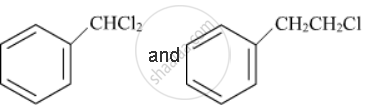 which is an example of a benzylic halide?
Concept: Nomenclature of Haloalkanes and Haloarenes
Write the mechanism (using curved arrow notation) of the following reaction:

Concept: Nomenclature of Haloalkanes and Haloarenes
Why does copper obtained in the extraction from copper pyrites have a blistered appearance?
Concept: Occurrence of Metals
What is the role of depressants in the froth floatation process?
Concept: Types of Separation or Concentration of an Ore >> Froth Floatation Method
Write the product(s) in the following reactions:
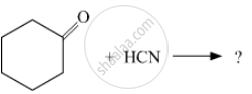
Concept: Nomenclature of Haloalkanes and Haloarenes
Write the product(s) in the following reaction:
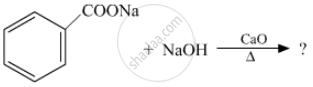
Concept: Nomenclature of Haloalkanes and Haloarenes
Write the product(s) in the following reactions:

Concept: Nomenclature of Haloalkanes and Haloarenes
Which would undergo SN2 reaction faster in the following pair and why ?
CH3 – CH2 – Br and CH3 – CH2 – I
Concept: Reactions of Haloalkanes - Nucleophilic Substitution Reactions
Indicate the principle behind the method used for the refining of Nickel.
Concept: Refining of Crude Metals
What is the role of dilute NaCN in the extraction of gold ?
Concept: Types of Separation or Concentration of an Ore >> Leaching
What is 'copper matte' ?
Concept: Occurrence of Metals
