Advertisements
Advertisements
A student while observing an embryo of a pea seed in the laboratory listed various parts of the embryo as given below:
Testa, Tegmen, Radicle, Plumule, Micropyle, Cotyledon.
On examining the list the teacher remarked that only three parts are correct. Select three correct parts from the above list:
(a) Testa, Radicle, Cotyleddon
(b) Tegmen, Radicle, Micropyle
(c) Cotyledon, Plumule, Testa
(d) Radicle, Cotyledon, Plumule
Concept: Sexual Reproduction in Plants
"The chromosomal number of the sexually producing parents and their offspring is the same." Justify this statement.
Concept: Sexual Reproduction in Plants
Write the names of those parts of a flower which serve the same function as the following do in the animals :
(i) testis,
(ii) sperm,
(iii) ovary,
(iv) egg
Concept: Sexual Reproduction in Plants
State the function of flowers in the flowering plants.
Concept: Sexual Reproduction in Plants
How is the process of pollination different from fertilization?
Concept: Sexual Reproduction in Plants
Name the male part of the flower.
Concept: Sexual Reproduction in Plants
Give one example each of unisexual and bisexual flowers. Differentiate between the two types of pollination that occur in flowers. What happens when a pollen lands on a suitable stigma? Write about the events that occur till the seed formation in the ovary.
Concept: Sexual Reproduction in Plants
You have to perform the experiment, "To identify the different parts of an embryo of a gram seed." Describe the procedure that you would follow.
Concept: Sexual Reproduction in Plants
The students of a class were asked by the teacher to study the different parts of an embryo of an angiosperm. Given below are the essential steps for the experiment :
A. Soak the seeds in plain water and keep them overnight.
B. Cut open the soaked seed and observe its different parts.
C. Take some healthy seeds in a petri-dish.
D. Drain the excess water, cover the seeds with a wet cotton cloth and leave them as it is for a day.
The correct sequence of these steps is
(a) C, A, D, B
(b) C, D, A, B
(c) A, C, D, B
(d) A, C, B, D
Concept: Sexual Reproduction in Plants
Draw a diagram of the longitudinal section of a flower exhibiting germination of pollen on stigma and label (i) ovary, (ii) male germ-cell, (iii) female germ-cell and (iv) ovule on it.
Concept: Sexual Reproduction in Plants
Identify A, B, C and D in the given diagram and write their names.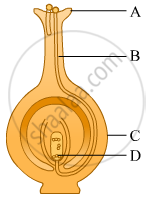
Concept: Sexual Reproduction in Plants
A student is asked to study the different parts of an embryo of pea seeds. Given below are the essential steps for the experiment :
(I) Soak the pea seeds in plain water and keep them overnight.
(II) Cut open the soaked seed and observe its different parts.
(III) Take some pea seeds in a petri dish.
(IV) Drain the excess water. Cover the seeds with a wet cotton cloth and leave them as it is for a day.
The correct sequence of these steps is
(A) III, I, IV, II
(B) III, IV, I, II
(C) III, I, II, IV
(D) III, II, I, IV
Concept: Sexual Reproduction in Plants
“Cell division is a type of reproduction in unicellular organism.” Justify.
Concept: Sexual Reproduction in Plants
Distinguish between unisexual and bisexual flowers giving one example of each. Draw a diagram showing process of germination of pollen grains on stigma and label the following parts:
(a) Female germ cell
(b) Male germ cell
(c) Ovary
Concept: Sexual Reproduction in Plants
Draw a diagram of the longitudinal section of a flower and label on it sepal, petal, ovary and stigma.
Concept: Sexual Reproduction in Plants
Write the names of male and female reproductive parts of a flower.
Concept: Sexual Reproduction in Plants
Answer the following question.
List two agents of pollination?
Concept: Sexual Reproduction in Plants
Trace the path a male gamete takes to fertilise a female gamete after being released from the penis.
Concept: Sexual Reproduction in Plants
State the number of sets of chromosomes present in a zygote.
Concept: Sexual Reproduction in Plants
Sexual maturation of reproductive tissues and organs are necessary link for reproduction. Elucidate.
Concept: Sexual Reproduction in Plants
