Please select a subject first
Advertisements
Advertisements
Answer the following question.
Compare 'intensive subsistence farming' with that of 'commercial farming' practiced in India.
Concept: Types of Farming
Identify the Crop with the help of the following information and choose the correct option.
|
Concept: Cropping Pattern
Explain any two features of Rabi cropping season.
Concept: Cropping Pattern
Explain any three institutional reforms taken for the development of Indian agriculture.
Concept: Technological and Institutional Reforms for Agriculture
On the given Map of India, locate and label the following with appropriate symbol.
Tarapur - Nuclear Power Plant
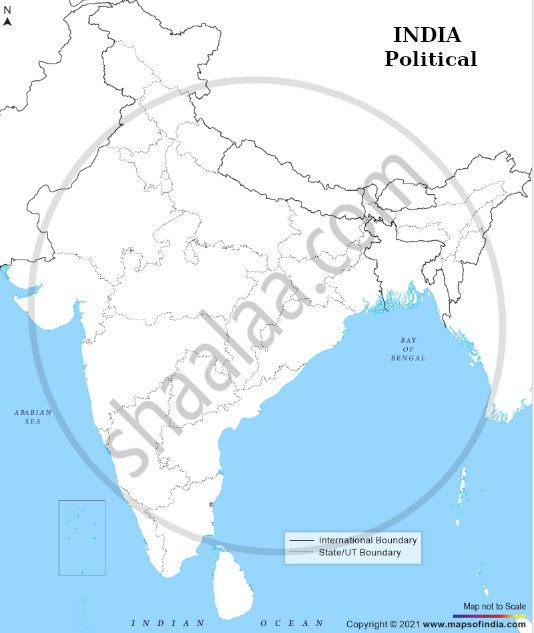
Concept: Energy Resources
On the given Map of India, locate and label the following with appropriate symbol.
Kalpakkam - Nuclear Power Plant
Concept: Energy Resources
Which one of the following is an example of the Ferrous Metal?
Concept: Mode of Occurrence of Minerals
Suggest three steps to minimize the environmental degradation caused by the industrial development in India.
Concept: Industrial Pollution and Environmental Degradation
"The credit activities of the informal sector should be discouraged." Support the statement with arguments.
Concept: Formal Institution - Nationalized Commercial Bank
Describe the vital and positive role of credit with examples.
Concept: Role of Money in an Economy
Which one of the following is an example of outcomes of a democracy that produces an accountable government?
(A) Open to public debates on major policies and legislation
(B) Open in promoting economic development
(C) Open in reducing economic inequalities
(D) Open to rulers elected by the people
Concept: Communal Divisions Affect Democracy
Which one of the following is a formal source of credit?
Concept: Formal and Informal Financial Institutions for Savings and Credit
Which one of the following is the appropriate meaning of collateral?
Concept: Role of Money in an Economy
Why is it necessary for the banks and cooperative societies to increase their lending facilities in rural areas? Explain.
Concept: Formal and Informal Financial Institutions for Savings and Credit
Answer the following question.
"Social divisions affect politics." Examine the statement.
Concept: Divisions Inherent to the Working of Democracy
Answer the following question.
Give any two examples of the informal sector of credit.
Concept: Formal and Informal Financial Institutions for Savings and Credit
Answer the following question.
How has the ever-increasing number of industries in India made a worse position by exerting pressure on existing fresh water resources? Explain.
Concept: Scarcity of Water
Answer the following question.
Why is cheap and affordable credit important for the country's development? Explain any three reasons.
Concept: Formal and Informal Financial Institutions for Savings and Credit
Consider the following statements on Power sharing and choose the correct option.
- Imposing the will of majority community over others.
- It helps in reducing the possibility of conflict between the social groups.
- Power sharing is a good way to ensure the stability of political order.
- It brings socio-political opposition among parties.
Concept: Accommodation in Belgium
Consider the following statements on Power Sharing and choose the correct option.
- Majoritarianism is the real spirit of democracy.
- It creates balance and harmony in different groups.
- It reduces the possibility of conflict among social groups.
- Power sharing is the essence of democracy.
Concept: Accommodation in Belgium
