Please select a subject first
Advertisements
Advertisements
In a tabular form, differentiate between ethanol and ethanoic acid under the following heads:
(i) Physical state
(ii) Taste
(iii) NaHCO3 test
(iv) Ester test
Concept: Ethanol
Write a chemical reaction to show the dehydration of ethanol.
Concept: Ethanol
Acetic acid smells like:
(1) a banana
(2) vinegar
(3) an orange
(4) a lemon
Concept: Ethanoic Acid
Acetic acid solution turns:
(1) blue litmus red
(2) red litmus blue
(3) blue litmus colourless
(4) red litmus colourless
Concept: Ethanoic Acid
On adding NaHCO3 to acetic acid, a gas is evolved which turns lime water milky due to the formation of:
(1) Calcium bicarbonate
(2) Calcium hydroxide
(3) Calcium carbonate
(4) Calcium acetate
Concept: Ethanoic Acid
State two characteristic features of carbon which when put together give rise to a large number of carbon compounds.
Concept: Carbon: A Versatile Element
With a labelled diagram describe an activity to show the formation of an ester.
Concept: Ethanol
Distinguish between ionic and covalent compounds under the following properties:
(i) Strength of forces between constituent elements
(ii) Solubility of compounds in water
(iii) Electrical conduction in substances
Concept: The Covalent Bond
Explain the ways in which glucose is broken down in absence or shortage of oxygen.
Concept: Carbon: A Versatile Element
What is hydrocarbon? Give its one example.
Concept: Carbon: A Versatile Element
Give the structural difference between saturated and unsaturated hydrocarbons with two examples each.
Concept: Carbon: A Versatile Element
Name of the following compounds :

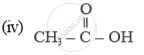
Concept: Carbon: A Versatile Element
List the conclusions you will draw while studying the following properties of ethanoic acid :
(a) Odour
(b) Solubility in water
(c) Effect on litmus paper
(d) Reaction with sodium hydrogen carbonate
Concept: Carbon: A Versatile Element
Answer the following question.
What is methane? Draw its electron dot structure. Name the type of bonds formed in this compound. Why are such compounds:
(i) poor conductors of electricity? and
(ii) have low melting and boiling points? What happens when this compound burns in oxygen?
Concept: The Covalent Bond
When sodium hydrogen carbonate is added to ethanoic acid, a gas evolves. Consider the following statements about the gas evolved.
- It turns lime water milky.
- It is evolved with brisk effervescence.
- It has a smell of burning sulfur.
- It is also a by-product of respiration.
Concept: Ethanoic Acid
Why is the conversion of ethanol to ethanoic acid considered an oxidation reaction? Write the oxidising agent used in the reaction involved.
Concept: Ethanol
Draw the structures for ethanol.
Concept: Ethanol
Assertion (A): In a homologous series of alcohols, the formula for the second member is C2H5OH and the third member is C3H7OH.
Reason (R): The difference between the molecular masses of the two consecutive members of a homologous series is 144.
Concept: Homologous Series
Distinguish between esterification and saponification reactions with the help of chemical equations for each.
Concept: Ethanoic Acid
With a labelled diagram describe in brief an activity to show the formation of ester.
Concept: Ethanoic Acid
