Definitions [6]
Define a triangle.
A plane figure bounded by three lines in a plane is called a triangle. The figure below represents a ΔABC, with AB, AC andBC as the three line segments.

A triangle (denoted by the symbol △) is the simplest closed shape in geometry. It is a two-dimensional figure made by connecting three points that do not lie on the same straight line (non-collinear).
The line segment joining a vertex of a triangle to the midpoint of its opposite side is called a median of the triangle.
- The point where all three medians meet is called the centroid.
An altitude of a triangle is a straight line from one vertex, drawn perpendicular (at 90°) to the opposite side (or to its extension)
- Orthocentre: The altitudes of a triangle pass through exactly one point; that means they are concurrent. The point of concurrence is called the orthocentre.
An exterior angle is formed when a side of a triangle is extended beyond its vertex. The angle created between the extended side and the adjacent side of the triangle is the exterior angle.
Equilateral Triangle: A triangle in which all three sides are of equal lengths is called an equilateral triangle.
Isosceles Triangle: A triangle in which two sides are of equal lengths is called an isosceles triangle.
Theorems and Laws [5]
Angle Sum Property of a Triangle:
Theorem: The sum of the angles of a triangle is 180°.
Construction: Draw a line XPY parallel to QR through the opposite vertex P.
Proof:
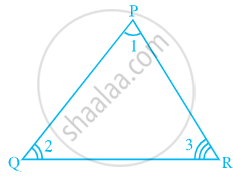
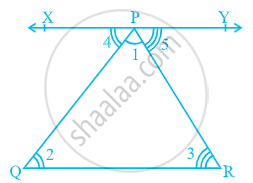
In △ PQR,
Sum of all angles of a triangle is 180°.
∠PQR + ∠PRQ + ∠QPR = 180°......(1)
Since XY is a straight line, it can be concluded that:
Therefore, ∠XPY + ∠QRP + ∠RPY = 180°.
But XPY || QR and PQ, PR are transversals.
So,
∠XPY = ∠PQR.....(Pairs of alternate angles)
∠RPY = ∠PRQ.....(Pairs of alternate angles)
Substituting ∠XPY and ∠RPY in (1), we get
∠PQR + ∠PRQ + ∠QPR = 180°
Thus, The sum of the angles of a triangle is 180°.
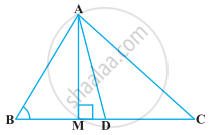
In the given figure, AD is a median of a triangle ABC and AM ⊥ BC. Prove that:
(i) `"AC"^2 = "AD"^2 + "BC"."DM" + (("BC")/2)^2`
(ii) `"AB"^2 = "AD"^2 - "BC"."DM" + (("BC")/2)^2`
(iii) `"AC"^2 + "AB"^2 = 2"AD"^2 + 1/2"BC"^2`
(i) Applying Pythagoras theorem in ΔAMD, we obtain
AM2 + MD2 = AD2 … (1)
Applying Pythagoras theorem in ΔAMC, we obtain
AM2 + MC2 = AC2
AM2 + (MD + DC)2 = AC2
(AM2 + MD2) + DC2 + 2MD.DC = AC2
AD2 + DC2 + 2MD.DC = AC2 [Using equation (1)]
Using the result, DC = `"BC"/2`, we obtain
`"AD"^2+(("BC")/2)^2 + 2"MD".(("BC")/2) = "AC"^2`
`"AD"^2+(("BC")/2)^2 + "MC" xx "BC" = "AC"^2`
(ii) Applying Pythagoras theorem in ΔABM, we obtain
AB2 = AM2 + MB2
= (AD2 − DM2) + MB2
= (AD2 − DM2) + (BD − MD)2
= AD2 − DM2 + BD2 + MD2 − 2BD × MD
= AD2 + BD2 − 2BD × MD
= `"AD"^2+(("BC")/2)^2 - 2(("BC")/2) xx "MD"`
= `"AD"^2 + ("BC"/2)^2 - "BC" xx "MD"`
(ii) Applying Pythagoras theorem in ΔABM, we obtain
AM2 + MB2 = AB2 … (1)
Applying Pythagoras theorem in ΔAMC, we obtain
AM2 + MC2 = AC2 … (2)
Adding equations (1) and (2), we obtain
2AM2 + MB2 + MC2 = AB2 + AC2
2AM2 + (BD − DM)2 + (MD + DC)2 = AB2 + AC2
2AM2+BD2 + DM2 − 2BD.DM + MD2 + DC2 + 2MD.DC = AB2 + AC2
2AM2 + 2MD2 + BD2 + DC2 + 2MD (− BD + DC)
= AB2 + AC2
= `2("AM"^2 + "MD"^2) + (("BC")/2)^2 + (("BC")/2)^2 + 2"MD" ((-"BC")/2 + ("BC")/2) = "AB"^2 + "AC"^2`
`"2AD"^2 + ("BC"^2)/2 = "AB"^2 + "AC"^2`
In the given figure, AD is a median of a triangle ABC and AM ⊥ BC. Prove that:
`"AC"^2 = "AD"^2 + "BC"."DM" + (("BC")/2)^2`
Applying Pythagoras theorem in ΔAMD, we obtain
AM2 + MD2 = AD2 … (1)
Applying Pythagoras theorem in ΔAMC, we obtain
AM2 + MC2 = AC2
AM2 + (MD + DC)2 = AC2
(AM2 + MD2) + DC2 + 2MD.DC = AC2
AD2 + DC2 + 2MD.DC = AC2 [Using equation (1)]
Using the result, DC = `"BC"/2`, we obtain
`"AD"^2+(("BC")/2)^2 + 2"MD".(("BC")/2) = "AC"^2`
`"AD"^2+(("BC")/2)^2 + "MC" xx "BC" = "AC"^2`
Prove that, in a right-angled triangle, the square of the hypotenuse is equal to the sum of the square of remaining two sides.
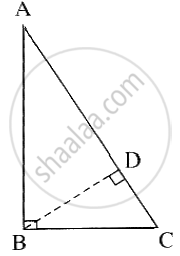
Draw perpendicular BD from the vertex B to the side AC. A – D
In right-angled ΔABC
seg BD ⊥ hypotenuse AC.
∴ By the similarity in right-angled triangles
ΔABC ~ ΔADB ~ ΔBDC
Now, ΔABC ~ ΔADB
∴ `"AB"/"AD" = "AC"/"AB"` ...(c.s.s.t)
∴ AB2 = AC × AD ...(1)
Also, ΔABC ~ ΔBDC
∴ `"BC"/"DC" = "AC"/"BC"` ...(c.s.s.t)
∴ BC2 = AC × DC ...(2)
From (1) and (2),
AB2 + BC2 = AC × AD + AC × DC
= AC × (AD + DC)
= AC × AC ...(A – D – C)
∴ AB2 + BC2 = AC2
i.e., AC2 = AB2 + BC2
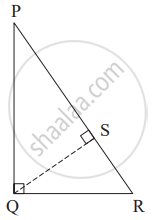
Given: In ΔPQR, ∠PQR = 90°.
To prove: PR2 = PQ2 + QR2.
Construction:
Draw seg QS ⊥ side PR such that P–S–R.
Proof: In ΔPQR,
∠PQR = 90° ...(Given)
Seg QS ⊥ hypotenuse PR ...(Construction)
∴ ΔPSQ ∼ ΔQSR ∼ ΔPQR ...(Similarity of right-angled triangles) ...(1)
ΔPSQ ∼ ΔPQR ...[From (1)]
∴ `"PS"/"PQ" = "PQ"/"PR"` ...(Corresponding sides of similar triangles are in proportion)
∴ PQ2 = PS × PR ...(2)
ΔQSR ∼ ΔPQR ...[From (1)]
∴ `"SR"/"QR" = "QR"/"PR"` ...(Corresponding sides of similar triangles are in proportion)
∴ QR2 = SR × PR ...(3)
Adding (2) and (3), we get
PQ2 + QR2 = PS × PR + SR × PR
∴ PQ2 + QR2 = PR(PS + SR)
∴ PQ2 + QR2 = PR × PR ...(P–S–R)
∴ PQ2 + QR2 = PR2 OR PR2 = PQ2 + QR2.
In the given figure, ∆ABC is an obtuse triangle, obtuse-angled at B. If AD ⊥ CB (produced) prove that AC2 = AB2 + BC2 + 2BC · BD.
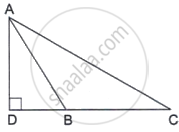
Given: An obtuse triangle ABC, obtuse-angled at B and AD is perpendicular to CB produced.
To Prove: AC2 = AB2 + BC2 + 2BC × BD
Proof: Since ∆ADB is a right triangle right angled at D. Therefore, by
Pythagoras theorem, we have AB2 = AD2 + DB2 ….(i)
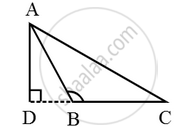
Again ∆ADC is a right triangle right angled at D.
Therefore, by Phythagoras theorem, we have
AC2 = AD2 + DC2
⇒ AC2 = AD2 + (DB + BC)2
⇒ AC2 = AD2 + DB2 + BC2 + 2BC • BD
⇒ AC2 = AB2 + BC2 + 2BC • BD [Using (i)]
Hence, AC2 = AB2 + BC2 + 2BC • BD
Concepts [9]
- Basic Concepts of Triangles
- Classification of Triangles based on Sides
- Classification of Triangles based on Angles
- Median of a Triangle
- Altitudes of a Triangle
- Exterior Angle of a Triangle and Its Property
- Some Special Types of Triangles - Equilateral and Isosceles Triangles
- Basic Properties of a Triangle
- Right-angled Triangles and Pythagoras Property
